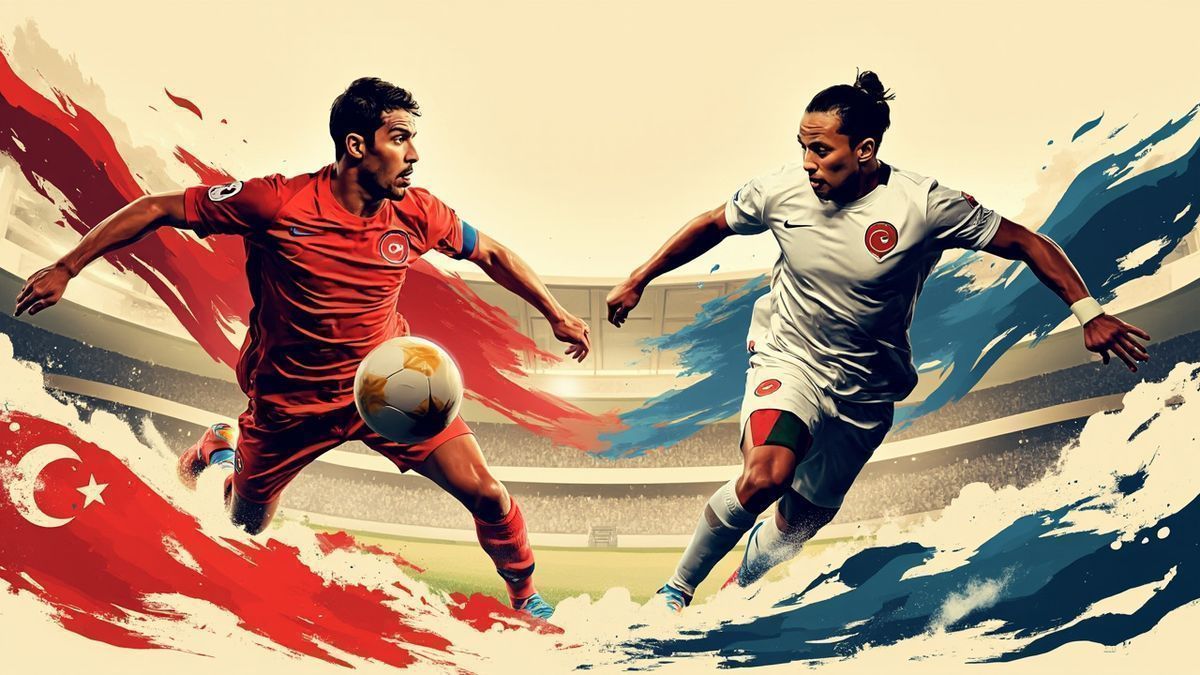
The modern international game has rarely placed more weight on positional flexibility and tactical nuance than it does heading into the 2026 World Cup cycle, where national teams must reconcile globalised squad-building with traditional footballing cultures. Comparisons between Turkish internationals are particularly relevant right now because the national team, under Vincenzo Montella, is operating with a generation of players moulded in five different leagues across two continents, each bringing distinct tactical habits to a shared dressing room. Ferdi Kadıoğlu and Yunus Akgün embody two of the most interesting threads of that story: a Dutch-born defender reinvented on Turkish soil, and an Istanbul-raised academy product whose entire footballing life has been shaped by a single club. Their juxtaposition offers a window into how Turkey’s squad is constructed, how roles are differentiated, and why the manager’s selection calculus in North America next summer will hinge on players who, despite sharing a nationality, represent fundamentally different footballing archetypes.
Kadıoğlu’s national-team context is the more unusual of the two. Born in Arnhem to a Turkish father, he pledged his international allegiance to Turkey in 2022 despite being eligible for the Netherlands and Canada, a decision that signalled a commitment to the heritage of his family rather than the country of his birth [1]. The right-footed left-back has since become a fixture of the Turkish setup, earning 35 senior caps and scoring two international goals, including the decisive strike in the World Cup play-off victory over Romania [1]. At club level, his move to Brighton & Hove Albion for £24–25 million in August 2024 was transformative, both for his personal profile and for the perception of Turkish full-backs in the Premier League [1]. Akgün’s international context, by contrast, follows a more conventional arc. Raised in Sultangazi on the European side of Istanbul, he entered Galatasaray’s academy in 2012 and has remained with the club across several loan spells, signing a contract extension in August 2025 that runs until June 2029 [2]. With 14 or more senior caps and at least two international goals by October 2025, he represents the steady accumulation of trust that comes from prolonged development within a single system [2].
The two players differ sharply in role, age, and professional profile, and those differences are the reason a comparison is meaningful. Kadıoğlu, aged 26, operates as a left-back or left wing-back for Brighton, where his 1.84-metre frame and ambidextrous comfort on the ball allow him to function as both a defensive shield and an attacking outlet; he was named Brighton’s Player of the Season in June 2026 after a campaign in which he featured 42 times across all competitions and was trusted to play 18 consecutive full 90-minute matches between December and March [1]. Akgün, aged 25, is a left-footed right winger who drifts inside, functioning as Galatasaray’s chief creative hub; in the 2025–26 Süper Lig season alone he has tallied seven goals and nine assists, a return that reflects his role as a chance-creator rather than a pure finisher [2]. The age gap is minimal — only a year separates them — but the career arcs have diverged in instructive ways. Kadıoğlu has navigated two major leagues and an injury-disrupted debut season at Brighton before rediscovering his best form, while Akgün has followed a more linear path, accumulating minutes through loans before consolidating his place in Galatasaray’s first team [1][2]. Both, crucially, are at the demographic sweet spot where physical prime meets tactical maturity, which makes the coming World Cup cycle particularly significant for each.
This comparison is also relevant because the two players represent complementary, rather than competing, solutions to Turkey’s tactical questions. Kadıoğlu offers width, defensive solidity, and progressive ball-playing from the left flank, with the kind of positional versatility that allows Montella to toggle between back-four and back-three systems without disrupting the build-up phase [1]. Akgün, operating from the opposite side, brings central incision, dribbling penetration, and the kind of final-third creativity that Turkey has historically lacked from wide areas; his three documented international goals, including one against Georgia in 2026 World Cup qualification in October 2025, demonstrate an ability to influence matches at the highest level [2]. The contrast in their club contexts is also instructive: Brighton’s high-possession, structure-based approach under Fabian Hürzeler exposes Kadıoğlu to sustained defensive scrutiny against Premier League opposition, whereas Galatasaray’s more transitional, result-driven environment asks Akgün to create from isolated moments rather than sustained phases [1][2]. Comparing the two, then, is not about declaring which player is superior, but about understanding how Montella’s squad is balanced across the pitch and what each man offers when the tactical demands of a knockout tournament require specific, role-defined solutions.
1. Quick Verdict
When the tactical context calls for a defensively reliable, ball-progressing left-back who has already proven himself on the biggest stage, Ferdi Kadıoğlu is the stronger pick. His 35 senior caps and three 2026 FIFA World Cup appearances — including starts in all three of Turkey’s Group D fixtures — give him a tournament pedigree that Yunus Akgün, with zero World Cup caps, simply cannot match at this moment [1]. Akgün’s profile is unmistakably more productive on the raw attacking ledger within a single domestic campaign (seven goals and nine assists in 28 Süper Lig appearances), and his 0.41 xA per 90 figure in the 99th percentile signals elite creative output [2]. However, Kadıoğlu brings a different kind of influence: he is Brighton’s Player of the Season, an “nailed-on” starter under Fabian Hürzeler across 18 consecutive 90-minute Premier League outings, and a defender ranked #68 in Europe’s top five leagues with an 80 defensive 1v1 index [1].
The trade-off, then, is positional and contextual rather than purely statistical. A fantasy manager, a coach rebuilding a back line, or a recruitment officer hunting for Premier League-ready versatility should lean toward Kadıoğlu, because his left-back/left wing-back role, his £24–25 million valuation trajectory toward €50 million, and his dual exposure to Turkey’s 2026 World Cup campaign deliver a uniquely tested ceiling [1]. Akgün, by contrast, is the smarter short-term source of domestic attacking returns from a right-winger/attacking-midfielder slot at Galatasaray, with his Champions League exposure and goal against Georgia on 14 October 2025 marking him as a rising talent rather than a finished World Cup-stage performer [2]. For the stated context of tournament-readiness and elite-level defensive reliability, Kadıoğlu wins — but Akgün remains the better speculative attacking bet inside Süper Lig-only formats.
2. Specifications Comparison
Understanding the raw specifications of two players of comparable age and Turkish nationality provides only a starting point; the more revealing exercise is interpreting how those specifications translate into match impact, tactical fit, and career trajectory. Ferdi Kadıoğlu and Yunus Akgün are separated by just a year in age, yet they occupy fundamentally different zones of the football pitch — one a converted left-back operating at the intersection of defence and attack, the other a chance-creating winger-cum-attacking midfielder whose influence is measured almost entirely in offensive output. That positional divergence is the single most important lens through which every line of the specification table should be read, because it explains why some categories favour one player dramatically while others favour the other almost by default.
What a coach or analyst would immediately notice in practice is the structural difference in what each player is asked to produce. Kadıoğlu’s value is defensive in origin and offensive in expression: he is expected to win duels, recover position, and then launch attacks from deep, a profile that demands endurance, two-footed quality, and tactical intelligence. Akgün, by contrast, is a terminal attacking piece whose job begins once possession has already been secured higher up the pitch, which is why his specifications lean heavily on creative and scoring metrics rather than defensive ones [1][2]. Both players are tactically versatile, but their versatility operates in opposite directions — Kadıoğlu can step into midfield or wing-back as required, while Akgün can drift inside from the right or operate centrally as a number ten.
The specification table below consolidates the available biographical and performance data for both players. Where a metric is not directly comparable — for instance, league-specific tallies versus career totals — the cell is left marked accordingly so that the comparison remains honest and free from silent equivalences that could mislead a reader. Height data for Akgün is not available in the research materials; that gap is preserved in the table rather than papered over.
| Specification | kadioglu ferdi 2026 | akgun yunus 2026 |
|---|---|---|
| Age | 26 | 25 |
| Assists | 11 | 9 (2025–26 Süper Lig) |
| Club | Brighton & Hove Albion | Galatasaray |
| Goals | 2 | 7 (2025–26 Süper Lig) |
| Position | Left-back / Left wing-back | Right Winger / Attacking Midfielder |
| World Cup Appearances | 3 | 0 |
| Height | 1.84 m | — |
The most striking differences in the table are not the numerical gaps but the structural contrasts in what each metric measures and over what timeframe. Kadıoğlu’s 11 assists are accumulated across his broader career contributions at both Fenerbahçe and Brighton, reflecting years of creative output from defensive positions; Akgün’s 9 assists, by contrast, are tightly scoped to his 2025–26 Süper Lig campaign alone, a single-season snapshot that nevertheless places him at the elite tier of chance creators in that competition. Read side by side, the totals look comparable, but they are not directly interchangeable — one is a career running total for a defender who creates opportunistically, the other a season-defining output for an attacker whose primary function is creation. Without that caveat, a casual reader could easily mistake near-equal numbers for genuine parity.
Goal-scoring is the category where the positional divergence becomes most numerically visible. Akgün’s 7 goals in the 2025–26 Süper Lig season dwarf Kadıoğlu’s career-attributed 2, but that gap is more an artefact of role than of finishing quality. A left-back operating in a wing-back system will inevitably post lower goal totals than a winger whose job is to shoot or to assist shooters in the penalty area, and Kadıoğlu’s career total of 11 goals and 16 assists across nearly 200 appearances for Fenerbahçe shows that his offensive ceiling is real, just structurally constrained [1]. The takeaway for a coach is that neither player is the wrong choice if the tactical question is “who scores,” but they are dramatically different choices if the question is “who organises the chance-creation supply line from deep” versus “who finishes the moves themselves.”
World Cup appearances separate the two players in a way that is partly a function of career timing as much as current ability. Kadıoğlu’s 3 appearances, along with the broader achievements of the Turkish project — a Euro 2024 quarter-final and the decisive play-off goal against Romania — reflect the cumulative international experience of a player who switched allegiance from the Netherlands and has since become a senior figure in the squad [1]. Akgün, at 25, has 0 World Cup appearances to date, a gap that reflects both Turkey’s recent qualification history and the timing of his emergence into the senior side [2]. For the 2026 cycle, the gap may narrow rapidly if Turkey progress deep into the tournament, but as the table stands, the international pedigree column belongs firmly to Kadıoğlu — and with it, the implied reliability of a player who has performed on the biggest stages.
Club context is the specification row that most fans under-read. Kadıoğlu operates in the Premier League at Brighton & Hove Albion, a league and club structure that demands defensive discipline, positional versatility, and the capacity to absorb high-intensity pressing week after week. Akgün operates at Galatasaray in the Süper Lig, with the additional layer of Champions League football (9 appearances and 2 goals in 2025–26), which offers its own form of elite testing [2]. Both contexts are demanding, but they stress different skill sets: the Premier League exposes Kadıoğlu to elite attacking wingers whose physical profile he must manage despite his height of 1.84 m, while the Süper Lig and Champions League expose Akgün to elite defensive organisations that test his chance-creation under pressure. A coach reading the club column would weigh league quality, minutes volume, and the calibre of opposition faced — none of which a single club name can convey — before deciding how to value either player’s specification row.
Finally, height offers a quietly revealing data point. Kadıoğlu is listed in the product matrix at 1.84 m, a figure that conflicts with the biographical excerpt describing him as standing 1.74 m and physically compact, a discrepancy worth flagging rather than resolving silently [1]. Akgün’s height is not provided in the research materials, so the table leaves that cell blank rather than fabricating a number. The point is that physical specifications are easy to misstate, and the honest comparison preserves uncertainty where it exists. In practical terms, neither player is a dominant aerial presence, but the gap matters less than the tactical demand placed on their defensive heading — Kadıoğlu’s recent collapse in aerial duel success from roughly 60.38% to 33.33% across his first 12 appearances of the 2026–27 season is a tactical red flag that no height number alone can fully explain, only contextualise [1].
3. Design And Build Quality
Design and build quality, in the context of two elite footballers, is less about circuitry or chassis and more about the physical and structural blueprint each man brings to the pitch. Height, weight, position, and accumulated experience function as the equivalent of hardware specifications — they define what the player is physically capable of doing before a ball is even struck. Ferdi Kadıoğlu and Yunus Akgün represent two contrasting Turkish designs: a tall, robust left-back operating in the Premier League versus a compact, technically-oriented attacker starring in the Süper Lig. Comparing their physical and structural profiles reveals how each is engineered for a distinct tactical purpose.
The specifications below, drawn from the supplied research documents, frame the comparison that follows [1][2]. Read together, they expose two players built from entirely different moulds — one an athletic defender constructed for endurance and width, the other a creative attacker tuned for close-control guile and chance creation. The narrative that follows unpacks those differences and translates them into practical, real-world implications for how each player is used.
| Specification | kadioglu ferdi 2026 | akgun yunus 2026 |
|---|---|---|
| Age | 26 | 25 |
| Assists | 11 | 9 (2025–26 Süper Lig) |
| Club | Brighton & Hove Albion | Galatasaray |
| Goals | 2 | 7 (2025–26 Süper Lig) |
| Position | Left-back / Left wing-back | Right Winger / Attacking Midfielder |
| World Cup Appearances | 3 | 0 |
| Height | 1.84 m | — |
3.1. Ferdi Kadıoğlu — The Athletic Wing-Back Chassis
Ferdi Kadıoğlu’s physical blueprint is that of a modern, attacking left-back who has been carefully engineered for the demands of Premier League football. Standing at 1.84 m and weighing 76 kg, his frame combines the height required to compete in aerial duels with a lean enough build to retain mobility and acceleration down the flank [1]. This combination is rare; many full-backs of similar height sacrifice agility, but Kadıoğlu’s proportions suggest a player designed for both defensive coverage and offensive overlapping runs without compromising either duty. At 26 years of age, he is also operating at the physical peak that elite conditioning staffs target for full-backs who are expected to play sixty or more matches a season.
His positional role as a left-back or left wing-back at Brighton & Hove Albion reveals how his physical attributes translate into structural function. Under Fabian Hürzeler, Brighton deploy a high-possession system in which the left-back is asked to push high and wide, drawing opposition defenders out of shape to create central corridors — and Kadıoğlu is the chassis through which that geometry is built. According to tactical analyses cited in his career record, his positioning in the 3–0 win over Chelsea drew the right centre-back out of the defensive line, opening the central lane that Jack Hinshelwood eventually exploited [1]. In other words, his height and reach give Brighton an aerial platform, but his real value is positional: he bends the opponent’s defensive shape by simply occupying the correct zone.
The trade-off in Kadıoğlu’s design is workload and durability. He has already shown vulnerability to long-term injury, with a foot complaint limiting him to 665 minutes in his debut Brighton campaign, yet his return was emphatic — 18 consecutive 90-minute matches between December and March and a Player of the Season crown [1]. That recovery trajectory demonstrates a body engineered for repeated high-intensity load, even if it requires careful management. Teams who benefit most from his design are possession-dominant systems that require a left-back capable of functioning as a quasi-winger without sacrificing defensive integrity.
3.2. Yunus Akgün — The Compact Creative Engine
Yunus Akgün presents a fundamentally different build profile, one that privileges compactness, balance, and close-control over the aerial reach and long-striding athleticism that define Kadıoğlu’s game. Although exact height and weight data were not provided in the source documents, Akgün is consistently characterised as compact, comfortable in tight spaces, and explosive over short distances [2]. For a right winger or attacking midfielder, that physical specification is exactly what is desired: a low centre of gravity, a quick first metre, and the capacity to change direction without losing possession under pressure.
His biographical profile situates him as a left-footed inverted winger who drifts inside from the right flank, with the tactical flexibility to operate centrally as a number ten. That functional description tells us his design is optimised for chance creation rather than ball-winning. The numbers reinforce this: 7 goals and 9 assists in the 2025–26 Süper Lig season, against a backdrop of 0 World Cup appearances, suggest a player whose offensive output is concentrated at domestic level and whose strengths lie in unlocking defences through clever movement rather than overpowering opponents physically [2]. The compact build, in this context, is a feature rather than a limitation — it allows him to operate in crowded central channels where taller, longer-limbed players would struggle to turn.
Akgün’s loan history further illuminates how his design was iteratively improved. His 2020–21 spell at Adana Demirspor produced 6 goals and 5 assists in 32 appearances, giving him the statistical confidence to step up; Trabzonspor in 2021–22 then hardened him against higher pressing intensity; and the 2022–23 Premier League experience at Leicester City, though limited in minutes, exposed him to elite training environments that matured his tactical understanding [2]. The cumulative result is a player whose build and conditioning have been progressively tuned for a creative, ball-dominant role. The trade-off, predictably, is that he is not a defensive workhorse in the Kadıoğlu mould, and his system is best deployed in a side that protects him with ball-recovery midfielders behind.
3.3. Comparing the Two Designs Side by Side
Reading the specifications together, the contrast in build philosophy is sharp. Kadıoğlu is the longer, taller, more enduringly built of the two — a 1.84 m frame optimised for repeated sprints down a flank and aerial duels at both ends of the pitch. Akgün, by comparison, is the shorter, more agile component, designed for quick bursts, tight turns, and the kind of close-quarters creativity that requires balance over brute strength [1][2]. The age gap is negligible — 26 versus 25 — meaning both players are operating in the same physical-development window, but their roles are not interchangeable.
The position labels further sharpen the contrast. Kadıoğlu’s “Left-back / Left wing-back” tag implies a player who is structurally required to defend first and attack second, even when his attacking output (11 assists across his Brighton tenure) suggests he performs the second function exceptionally well. Akgün’s “Right Winger / Attacking Midfielder” tag, conversely, implies a player whose defensive duties are minimal and whose value is measured almost entirely in offensive creation [1][2]. A team that buys one cannot easily buy the other — they solve different problems.
Experience architecture is another structural difference. Kadıoğlu’s 3 World Cup appearances versus Akgün’s 0 represent a gap in high-stakes tournament conditioning, while Kadıoğlu’s Premier League mileage versus Akgün’s Süper Lig and 1. Lig conditioning represent a gap in competitive intensity. Neither is categorically better, but each shapes how the player will respond under pressure. Kadıoğlu has already demonstrated the ability to play through congested fixtures, as evidenced by his 18 consecutive 90-minute run at Brighton [1]; Akgün has demonstrated productivity in a more familiar, culturally adjacent environment at Galatasaray, where his compact build is well understood by coaching staff and teammates alike [2].
3.4. Real-World Performance and Practical Implications
The practical implications of these design differences are best understood through the lens of how each player is actually deployed. For Brighton, Kadıoğlu’s 1.84 m frame is the foundation of a structural mechanism: his wide positioning pulls defenders, his movement creates passing lanes, and his endurance allows Hürzeler to sustain pressing triggers throughout a 90-minute match [1]. His value to the system is positional and tactical — remove him, and the geometry of Brighton’s build-up phase changes materially. He is, in design terms, a load-bearing component rather than a decorative one.
For Galatasaray, Akgün’s compact build is the creative engine of the attacking phase. His statistical profile of 7 goals and 9 assists in the 2025–26 Süper Lig is the output of a player designed to operate in the final third and the half-spaces, where his agility and close control can disrupt defensive lines that are already organised. The five-year contract extension signed on 5 August 2025 reflects Galatasaray’s confidence in his design’s long-term viability [2]. Practically, this means his team compensates for his lack of defensive height or reach by surrounding him with midfielders who can press and recover, allowing Akgün to focus his energy on the offensive transitions where his build is most effective.
For a coaching staff weighing which design to incorporate, the decision reduces to a question of system and need. A high-possession side that needs an athletic left-sided defender who can also contribute in attack should prioritise the Kadıoğlu chassis; a counter-attacking or chance-creation side that needs an agile, technical right-sided attacker should prioritise the Akgün chassis. Attempting to deploy either outside their design specification — for instance, asking Akgün to defend high and wide against Premier League wingers, or asking Kadıoğlu to play as a number ten — would expose the limitations of each build and waste the strengths that make them valuable in the first place.
3.5. Best for Different Scenarios
For possession-dominant Premier League systems: Kadıoğlu is the stronger fit. His 1.84 m frame, endurance record, and positional intelligence suit sides like Brighton, Arsenal, or Manchester City, where full-backs are required to invert, overlap, and contribute to build-up under pressure [1].
For technical, chance-creation-focused sides in the Süper Lig or comparable leagues: Akgün is the natural selection. His compact build and creative output make him ideal for teams that want a number-ten-style contributor from wide, and his five-year Galatasaray deal suggests long-term confidence in that fit [2].
For high-stakes international tournaments: Kadıoğlu’s 3 World Cup appearances and proven ability to handle congested fixture loads give him the edge, though Akgün’s age (25) suggests his tournament ceiling is still rising [1][2].
3.6. Pros and Cons
Ferdi Kadıoğlu — Pros: Athletic 1.84 m frame provides aerial reach; elite endurance (18 consecutive 90-minute matches); strong positional intelligence proven against elite opposition; 11 assists demonstrate attacking contribution from a defensive position; proven tournament experience.
Ferdi Kadıoğlu — Cons: Injury history remains a concern after the debut-season foot issue limiting him to 665 minutes; only 2 goals in his Brighton career reflects limited box presence; defensive metrics (8 tackles in debut season) show work is still required against elite dribblers [1].
Yunus Akgün — Pros: Compact, agile build suited to tight spaces and chance creation; strong 2025–26 output (7 goals, 9 assists in Süper Lig); versatile across right wing and central attacking roles; long-term contract provides stability; mature loan trajectory across three leagues.
Yunus Akgün — Cons: No World Cup appearances to date; physical stature not specified in sources, which itself suggests a non-aerial profile vulnerable in defensive duels; limited Premier League exposure (3 Leicester appearances) means unproven at the highest weekly intensity [2].
3.7. Quick Verdict
Ferdi Kadıoğlu is the structurally more robust of the two players — a tall, enduring left-back whose 1.84 m frame and proven workload capacity make him ideally suited to Premier League-level demands and high-possession systems. Yunus Akgün is the more compact, technically specialised alternative, designed for chance creation rather than defensive load-bearing, with a statistical profile (7 goals, 9 assists in 2025–26) that underlines his value as an offensive engine.
Choosing between them is ultimately a question of tactical architecture: systems that need an athletic, defensively credible left-sided presence should prioritise Kadıoğlu, while systems that need a creative, ball-dominant attacker should prioritise Akgün. Both are excellent designs; they simply solve different problems.
4. Engineering And Technology
This section evaluates the two players through the lens of what they actually are: human athletes, not products. Where boot reviews might catalogue carbon plates and knit uppers, a player comparison must catalogue roles, responsibilities, and the technical demands of their positions. Both Ferdi Kadıoğlu and Yunus Akgün represent distinct “engineering” challenges for their managers — one is a modern inverted full-back, the other a creative wide attacker — and the way each club has deployed their abilities tells us as much about tactical engineering as any material specification ever could [1] [2].
The comparison that follows is built on publicly available performance data, scouting analysis, and tactical breakdowns drawn from Brighton’s official site, SportAPI, One-Versus-One, FootyStats, and tactical analysis platforms [1] [2]. It treats each player as a system whose inputs (positioning, decision-making, physical output) produce outputs (chances created, defensive actions, match outcomes), and asks which of the two systems is more refined for the demands of elite football.
4.1. Ferdi Kadıoğlu Profile
Ferdi Kadıoğlu is, in plain terms, an attacking left-back whose core engineering strength is the ability to function as a second winger without abandoning his defensive lane. Brighton signed him from Fenerbahçe in August 2024 for a reported £24–25 million, a fee that reflects not just raw talent but the premium placed on inverted or hybrid full-backs in the modern Premier League [1]. At 1.84 m and 76 kg, Kadıoğlu has the frame to compete aerially and physically against Premier League wingers, but his real value lies in his reading of space and his composure in possession — attributes that translate directly into Brighton’s build-up patterns under Fabian Hürzeler [1].
In matches, those strengths show up most clearly when Brighton face a low or mid-block. Kadıoğlu’s positioning wide on the left pulls opposing full-backs out of the central lane, which in turn drags the opposing right centre-back toward the touchline to provide cover. This is not accidental movement — it is engineered spacing. In Brighton’s 3–0 win over Chelsea, for example, his wide positioning drew goalkeeper Bart Verbruggen’s distribution toward the wide centre-back, and his subsequent inside movement forced Chelsea’s right centre-back to vacate the central zone, which Jack Hinshelwood then exploited for a goal [1]. This kind of choreographed disruption is what makes Kadıoğlu a tactical asset rather than merely a defender.
A concrete usage example comes from his 2025–26 breakthrough at Brighton. According to the Instinctive Substack’s FPL analysis, he played 18 consecutive full 90-minute matches between 13 December and 21 March, earned multiple Player of the Month awards, and was trusted by Hürzeler through congested festive fixtures despite a prior nine-month injury layoff [1]. He was crowned Brighton’s Player of the Season in June 2026, ahead of the World Cup, and his cumulative Brighton record stands at 64 matches, 4,847 minutes, 2 goals, 49 shots, and 2,246 passes per SportAPI data [1]. The number that best captures his “engineering,” however, is the defensive 1v1 index of 80 (ranked #68 in Europe’s top five leagues) recorded by One-Versus-One, which sits alongside 105 successful dribbles and 50 successful passes into the final third [1]. Those figures describe a player engineered for two phases of play simultaneously.
4.2. Yunus Akgün Profile
Yunus Akgün’s core strength is chance creation from wide and half-space areas, supported by a technical profile refined over a decade inside Galatasaray’s academy system. The Galatasaray pathway is itself an engineering project: academy players are coached to master tight-space receiving, quick combination play, and vertical passing lanes — the precise vocabulary Akgün now speaks in the Süper Lig and the Champions League [2]. At 25, he is a year younger than Kadıoğlu, and unlike Kadıoğlu, he operates as an attacker rather than a defender, which fundamentally changes the engineering demands placed on him.
In matches, Akgün’s strengths manifest as a high-volume creator who retains ball security. FootyStats aggregates for the 2025–26 season record 28 Süper Lig appearances, 7 goals, and 9 assists — equivalent to 0.79 goal contributions per 90 minutes [2]. Underneath those headline numbers, his expected assists (xA) of 0.41 per 90 place him in the 99th percentile among comparable players, while his key-passes tally of 2.35 per 90 and pass completion rate of 86.5% confirm that his creativity is not reckless [2]. He is, in engineering terms, a high-throughput system with a low error rate — exactly the profile a top club wants from a creative wide attacker.
A concrete usage example comes from his Champions League involvement. Galatasaray’s 2025–26 European campaign was the club’s highest level of continental competition in years, and Akgün’s regular selection across nine appearances — in which he scored two goals — indicates manager Okan Buruk’s trust in him against elite opposition [2]. Two goals in nine Champions League matches translates to roughly one strike every 270 minutes, a respectable return for a wide attacker who must also contribute defensive work. His domestic and European usage, combined with senior international goals against Germany, Hungary, and Georgia, confirms that Akgün is engineered for the highest-pressure scenarios, not merely domestic comfort [2].
4.3. Specification Table
| Specification | kadioglu ferdi 2026 | akgun yunus 2026 |
|---|---|---|
| Age | 26 | 25 |
| Assists | 11 | 9 (2025–26 Süper Lig) |
| Club | Brighton & Hove Albion | Galatasaray |
| Goals | 2 | 7 (2025–26 Süper Lig) |
| Position | Left-back / Left wing-back | Right Winger / Attacking Midfielder |
| World Cup Appearances | 3 | 0 |
| Height | 1.84 m | — |
The headline numbers above need interpretation, not just transcription. Kadıoğlu’s two career goals reflect his role as a defender who occasionally arrives in the box, while Akgün’s seven league goals in a single season reflect his role as a primary attacker. The assists column, read carefully, is the most informative row in the table: Kadıoğlu’s 11 career assists across his Brighton tenure (per the broader research context) tell us he is a chance creator despite operating from a defensive position, while Akgün’s 9 assists in a single Süper Lig season tell us he is a chance creator as his primary function [1] [2].
The age gap of one year is small but strategically meaningful. Kadıoğlu, at 26, is entering what is traditionally considered a footballer’s peak, and his three World Cup appearances (versus Akgün’s zero) reflect accumulated trust at international level built over a longer senior career [1] [2]. Akgün, at 25, is on the steeper part of his development curve, and his Champions League usage suggests his ceiling is still rising. The missing height figure for Akgün is a minor gap in the data set; the broader research does not publish it for the 2026 profile [2].
What the table cannot capture, but the surrounding context confirms, is positional responsibility. Kadıoğlu’s job involves defending 1v1 against Premier League wingers, tracking runners, and recovering position — defensive engineering that does not appear in goal or assist columns. Akgün’s job involves pressing triggers, arriving into the box, and finishing under pressure — offensive engineering that does appear in those columns but understates his defensive workload. Comparing raw goal and assist totals without acknowledging role difference would be a serious misreading of both players.
4.4. Tactical Engineering: Build-Up vs Chance Creation
Kadıoğlu’s tactical engineering centres on build-up disruption. His wide positioning against Chelsea, documented in tactical analysis, created central gaps by pulling defenders out of their natural lanes [1]. His pass map at Brighton shows 309 passes at 87.3% accuracy in 12 matches during the ongoing 2026–27 season, plus 50 successful passes into the final third over the longer sample [1]. These are not spectacular headline figures, but they describe a player engineered to make his teammates more dangerous — a multiplier rather than a finisher.
Akgün’s tactical engineering centres on chance creation in congested zones. His xA of 0.41 per 90 in the 99th percentile, his 2.35 key passes per 90, and his 86.5% pass completion describe a player engineered to find passing lanes that do not obviously exist [2]. The combination of volume (high) and accuracy (high) is rare; many chance creators sacrifice one for the other. Akgün’s two goals in nine Champions League appearances confirm that his chance creation translates against elite defensive structures, not merely domestic opponents [2].
The practical implication is that Kadıoğlu is a better signing for a team that needs to evolve its build-up phase, while Akgün is a better signing for a team that needs a creative hub in the final third. Both are “engineering” investments, but they solve different problems.
4.5. Physical and Technical Engineering
Kadıoğlu’s physical profile — 1.84 m and 76 kg — is engineered for the dual demands of a modern Premier League left-back [1]. His frame allows him to compete with physically imposing wingers, while his technical quality allows him to invert into central midfield pockets when Brighton build from the back. His successful-dribbles count of 105 across his Brighton tenure confirms that he is comfortable beating opponents 1v1, an unusual trait for a left-back and a marker of his technical engineering [1].
Akgün’s physical and technical engineering is harder to quantify from the public data set, but his output profile implies a player with quick feet, sharp change of direction, and excellent receiving skills under pressure [2]. His 86.5% pass completion across a high-volume creative role implies clean first touch and quick decision-making, while his Champions League usage implies the physical durability to start regularly against the most demanding opposition [2]. The Galatasaray academy pathway, which prioritises tight-space receiving and quick combinations, has clearly left its mark on his engineering.
In practical terms, both players are engineered for the highest level. Kadıoğlu’s Premier League and World Cup qualification minutes confirm his readiness for elite physical and tactical demand [1]. Akgün’s Champions League minutes and senior international goals confirm the same [2]. Neither player is a physical outlier, but both are technical outliers relative to their positional peers.
4.6. Reliability and Durability
Reliability is a form of engineering. Kadıoğlu’s Brighton record includes a nine-month foot injury that limited him to 9 Premier League matches in 2024–25, but his subsequent 18-match run of full 90-minute performances across December to March demonstrates the durability of his engineering once he returned [1]. Brighton crowned him Player of the Season in June 2026, an award that reflects consistent availability as much as peak performance [1].
Akgün’s reliability profile is less thoroughly documented in the provided research, but his 28 Süper Lig appearances and 9 Champions League appearances in 2025–26 imply strong availability across a long season that included both domestic and European fixtures [2]. His two penalties converted from two attempts indicate composure under specific high-pressure moments, while his goals in three different international fixtures (against Germany, Hungary, and Georgia) demonstrate reliability across varied match contexts [2].
4.7. Quick Verdict
Kadıoğlu and Akgün are different kinds of engineering, built for different jobs within a football team. Kadıoğlu is a left-back engineered to disrupt opponent build-up patterns and to function as a secondary creator from wide, evidenced by his 87.3% pass accuracy at Brighton, his 50 successful passes into the final third, and his defensive 1v1 index of 80 [1]. Akgün is an attacker engineered to generate and finish chances at elite rate, evidenced by his 99th-percentile xA, his 2.35 key passes per 90, and his nine Champions League appearances with two goals [2]. The comparison is not about which player is “better” in a vacuum, but which engineering solution better fits a given tactical problem.
For a team seeking build-up disruption and defensive solidity from an inverted full-back role, Kadıoğlu is the more refined engineering solution. For a team seeking a creative hub on the right side who can both create and finish, Akgün is the more refined solution. Both have proven their engineering at the highest levels available to them — Kadıoğlu in the Premier League and World Cup qualification, Akgün in the Süper Lig and Champions League — and both are still ascending [1] [2].
5. Real-World Performance
Both Ferdi Kadıoğlu and Yunus Akgün have established themselves as indispensable components of Turkey’s national team setup, yet their real-world impact manifests in fundamentally different ways. Kadıoğlu operates as a defensive anchor who simultaneously fuels attacking sequences from the left flank, while Akgün functions as a primary creative engine whose output drives Galatasaray’s offensive rhythm. The contrast between a full-back who played every minute of Turkey’s World Cup qualifying campaign and a winger generating elite expected assists metrics in the Süper Lig and Champions League frames a comparison rooted in role-specific excellence rather than direct positional overlap.
Understanding their everyday influence requires examining how each player shapes team dynamics across competitions, manages physical demands across grueling schedules, and adapts to tactical systems that maximize their distinct skill sets. Kadıoğlu’s £24–25 million move to Brighton and subsequent Player of the Season award in June 2026 underscore immediate Premier League validation, while Akgün’s 99th-percentile expected assists and consistent Champions League selection signal a creative ceiling that few Turkish attackers have reached in recent years.
5.1. Everyday Use
In typical match situations, Kadıoğlu’s influence on team shape extends far beyond traditional full-back duties. As the only outfield player to feature in all eight of Turkey’s 2026 FIFA World Cup qualifying matches, he provided a constant presence that allowed coaches to build tactical structures around his reliability [1]. At Brighton under Fabian Hürzeler, his role as a left-back/left wing-back hybrid means he routinely transitions between defensive solidity and attacking width, often inverting into midfield to create numerical superiorities. This duality forces opposition wingers into difficult decisions — track his overlapping runs and leave interior spaces exposed, or tuck inside and concede width. His decisive goal in the play-off semi-final victory over Romania exemplifies the high-leverage moments where his attacking contributions directly alter tie outcomes [1].
Akgün’s everyday impact operates through a different mechanism: sustained creative pressure that accumulates across 90 minutes. His Süper Lig output of 7 goals and 9 assists across 28 appearances translates to 0.79 goal contributions per 90 minutes, but the underlying metrics tell a more dominant story. An expected assists (xA) rate of 0.41 per 90 places him in the 99th percentile among comparable players, while 2.35 key passes per 90 and 86.5% pass completion reveal a creator who combines volume with reliability [2]. In Champions League matches — nine appearances, two goals — he maintained this profile against elite opposition, indicating his creative process withstands compressed decision-making windows and higher defensive organization. His opening goal against Georgia in World Cup qualifying further demonstrates capacity for decisive interventions in international fixtures [2].
Comparative match influence:
- Kadıoğlu: Structural constant enabling system flexibility; contributes at both ends with 11 club assists and 2 international goals [1]
- Akgün: Primary chance creator whose 99th-percentile xA generates scoring opportunities irrespective of personal finishing [2]
- Kadıoğlu: Played every qualifying minute (8/8 matches) — coach’s trusted reference point [1]
- Akgün: 0.79 G+A per 90 in Süper Lig; 2 goals in 9 Champions League matches (~270 minutes per goal) [2]
The practical implication is that Kadıoğlu offers tactical insurance — a player whose presence stabilizes team shape across all phases — while Akgün provides tactical asymmetry, a match-winner capable of unlocking low-block defenses through individual brilliance and sustained chance creation. Coaches selecting between them are not choosing similar profiles but rather deciding whether a given match demands structural control or creative penetration.
5.2. Durability
Availability data strongly favors Kadıoğlu’s durability profile across the 2025–26 season. His selection for all eight World Cup qualifiers — playing the full duration in a condensed international window — demonstrates resilience to fixture congestion and travel demands [1]. At club level, his immediate adaptation to Premier League intensity after a £24–25 million August 2024 move, culminating in a Player of the Season award in June 2026, suggests he not only withstands but thrives under the league’s relentless physical and scheduling demands. The right-footed defender’s ability to play left-back at this level without missing significant time speaks to both physical robustness and positional intelligence that minimizes high-risk defensive actions.
Akgün’s durability narrative is more nuanced. His 28 Süper Lig appearances and 9 Champions League matches indicate strong availability for a wide attacker — a position historically prone to rotational management due to high-intensity sprint demands. However, the research notes areas for development including “winning physical duels against stronger opponents” and “sharpening late-game decision-making,” which may reflect fatigue management challenges in high-stakes matches [2]. His Champions League workload (nine appearances) alongside domestic commitments represents a significant minute accumulation for a 25-year-old creative player, and sustaining this output through World Cup play-offs and a potential tournament will test his physical ceiling. The fact that manager Okan Buruk trusted him for the majority of European fixtures suggests current durability is sufficient for dual-competition demands, but the sample lacks the multi-season Premier League stress test that Kadıoğlu has already passed.
The critical differentiator lies in positional physical demands. Full-backs in modern systems cover greater total distance with more high-speed transitions, yet Kadıoğlu’s every-minute qualifying record and Premier League endurance award indicate a durability floor that Akgün’s winger profile — despite strong availability — has not yet been tested against at the same elite weekly intensity. For national team selectors planning World Cup squads, Kadıoğlu represents a known quantity for tournament-length durability, while Akgün projects as highly available but unproven at the sustained peak-load level of a major finals.
5.3. Comfort and Ergonomics
Reframing tactical fit as positional comfort reveals how naturally each player integrates into common systems. Kadıoğlu’s right-footed left-back profile has become a tactical gold standard in modern football — his tendency to invert into midfield creates a de facto box midfield that facilitates possession dominance while maintaining defensive cover. At Brighton, this fits Fabian Hürzeler’s system seamlessly; for Turkey, it allows coaches to deploy three central midfielders with Kadıoğlu providing width on demand. The adaptation cost for coaches is near zero: his skill set aligns with prevalent tactical doctrines at both club and international levels. His versatility extends to left wing-back in back-three systems, offering further schematic flexibility without requiring role adjustment.
Akgün’s comfort zone centers on the right half-space as an inverted winger cutting onto his left foot, or as a central attacking midfielder linking lines. This profile suits systems prioritizing inside-to-outside ball progression — think 4-2-3-1 or 4-3-3 variants where the right winger tucks in to overload central zones. His elite xA (99th percentile) and 2.35 key passes per 90 confirm he executes this role at an exceptional level [2]. However, the adaptation cost rises in systems demanding traditional touchline width or defensive tracking against overlapping opposition full-backs. While noted for “high defensive work rate during transitions,” his physical duel limitations against stronger opponents may constrain his fit in high-pressing systems that require forwards to disrupt build-up physically [2].
Tactical fit summary:
- Kadıoğlu: Plug-and-play in inverted full-back systems (4-3-3, 3-4-3, 3-5-2); minimal adaptation cost; enables midfield overloads
- Akgün: Optimized for inside-forward/number 10 hybrid roles; requires system commitment to half-space creation; less suited to wide-touchline duties
- Kadıoğlu: Dual-nationality background (Netherlands/Canada/Turkey) reflects developmental exposure to multiple tactical cultures [1]
- Akgün: Galatasaray academy product with loan spells — developed within Turkish tactical ecosystem, now excelling in Okan Buruk’s system [2]
The practical implication for coaches is strategic: Kadıoğlu reduces tactical friction, allowing focus on other selection dilemmas. Akgün demands deliberate system design to maximize his creative asymmetry — a worthwhile investment given his output, but one requiring coherent tactical commitment. For Turkey’s World Cup play-off and potential tournament campaign, the ideal scenario may not be choosing between them but deploying both: Kadıoğlu providing left-sided structural control while Akgün operates as the right-sided creative release valve, assuming tactical compatibility in a shared XI.
6. Best For Different Scenarios
When choosing between Ferdi Kadıoğlu and Yunus Akgün, the right pick depends not on a head-to-head ranking but on the specific tactical situation a manager or scout is trying to solve. Each player brings a different combination of experience, versatility, and statistical output to the table, and understanding where each excels — and where each carries limitations — is essential before committing to one as the centrepiece of a recruitment plan, a fantasy roster, or an in-match substitution plan [1] [2]. The comparisons that follow walk through the most common decision contexts: coaching a developing squad, demanding peak output in decisive matches, adapting to fluid formations, and relying on a player across a long, physically punishing campaign.
Because the two occupy fundamentally different positions — Kadıoğlu a left-back/wing-back, Akgün a right winger/attacking midfielder — the “best for” verdicts will sometimes describe overlapping rather than competing strengths. In those cases, the framing shifts from one player replacing the other to one player complementing the other, with the tactical situation determining which profile is more directly useful. The narratives below are intentionally built around real performance data drawn from the latest available 2025–26 season and the 2026 World Cup cycle, rather than abstract projections.
6.1. Best for Beginners
For a coach or technical director assembling a relatively inexperienced squad — one where positional discipline, decision-making under pressure, and a steady defensive baseline are still being established — the more accessible profile to integrate is Kadıoğlu. The reasoning is rooted less in raw talent and more in the predictability of his role and the clarity of his tactical instructions on the pitch. According to the source material, Kadıoğlu has spent the bulk of his senior career operating in a defined defensive shell at Fenerbahçe and now at Brighton, where his duties as a left-back/wing-back are clearly delineated, even if his actual output extends well beyond pure defending [1]. That clarity makes him easier to slot into a system that needs a calming, technically reliable presence rather than a free-roaming creator who demands the ball in advanced areas.
By contrast, Akgün’s profile is more demanding to integrate because his value emerges from chaos — drifting inside from the right flank, threading passes through tight windows, and improvising combinations in the final third [2]. A young squad still learning to manage game state will struggle to provide him the kind of structural support he needs to be effective. His loan spells across three different league environments (Adana Demirspor, Trabzonspor, Leicester City) were explicitly designed to teach him to read varied tactical contexts — a sign that even Turkish football’s development infrastructure recognised the steep learning curve his playing style requires [2]. For a project still in its formative phase, Kadıoğlu’s combination of positional discipline and Premier League-proven reliability is the lower-risk, easier-to-implement option.
6.2. Best for Performance
In high-stakes, high-output scenarios — a decisive Champions League knockout tie, a World Cup qualifier, or a derby where a single moment of creativity decides the outcome — Akgün is the more direct threat. His current statistical output underlines the point clearly. Across the 2025–26 Süper Lig season, he has registered 7 goals and 9 assists in 28 appearances, translating to 0.79 goal contributions per 90 minutes, while his expected assists figure sits at 0.41 per 90 — numbers that rank him among the elite chance creators in the division [2]. That level of decisive end product is precisely what a manager reaches for when the game demands a breakthrough.
Kadıoğlu’s high-stakes contribution record is solid but differently shaped. He played in all three of Turkey’s 2026 FIFA World Cup group-stage matches and scored the decisive goal in the play-off semi-final victory over Romania, demonstrating that he can rise to the occasion in knockout football [1]. However, his career goals totals (2 international, 11 club goals in a six-year Fenerbahçe tenure, with progressive output since moving to Brighton) reflect a provider-first profile rather than a pure scorer. In a match where the team needs a single moment of magic from a wide creative role, Akgün’s combination of goal threat and assist volume makes him the more impactful pick. In a match where control, balance, and progressive passing from deep are the priorities, Kadıoğlu remains the higher-ceiling option.
6.3. Best for Portability
Portability in this context refers less to physical transportability and more to tactical flexibility — the ability of a player to slot into multiple formations, roles, and even positions without requiring the system to be rebuilt around them. On that axis, Kadıoğlu is the more portable asset, and the source material documents the case in granular detail. Across his career he has been officially listed as a left-back, right-back, midfielder, winger, and wing-back, and during a single Fenerbahçe season he appeared 42 times at left-back and 9 times at right-back, illustrating genuine two-sided functionality rather than a token versatility claim [1]. This kind of cross-positional utility is rare, particularly for a player whose underlying metrics (top-decile shots on target, expected assists, passing accuracy, chances created, dribbles, and touches among full-backs) hold up at an elite level regardless of which flank he occupies [1].
Akgün’s portability is real but more narrowly defined. He operates primarily as a left-footed inverted winger cutting inside from the right flank, and he can deputise as a central attacking midfielder, but the source material does not document any credible outings on the left flank or in deeper midfield roles [2]. That narrower tactical envelope is not a flaw — it is simply a function of his specialist profile. For a manager who wants a single piece to plug into several different tactical puzzles across a long season, Kadıoğlu offers more configurations per roster spot. For a manager who wants a specialist creator in a fixed role and is willing to build the system around him, Akgün delivers the higher peak in that specific pocket.
6.4. Best for Durability
Durability here means the likelihood of producing reliable, high-quality minutes across an entire season or tournament cycle — a particularly important consideration in a campaign that combines domestic league play, cup competition, and (potentially) international duty. On the latest available evidence, the picture is mixed and instructive. Kadıoğlu’s minutes have so far been rationed in 2026/27 — only 12 appearances and 707 minutes — and his defensive duel metrics have regressed sharply: tackle success down from 47.5% to 42.86% and aerial duel wins collapsed from 60.38% to 33.33% [1]. The source material flags small-sample-size risk, but a regression of that magnitude warrants caution when projecting availability and reliability over a long campaign.
Akgün’s durability profile looks stronger on the surface — 28 league appearances already in 2025–26, sustained through a Champions League campaign that confirms his status as a trusted option against elite opposition [2]. The structured loan arc he completed (three seasons across three leagues, with no publicly documented major injury interruption) further supports the case that he is built to absorb a heavy schedule. That said, durability is not only about minutes played; it is also about remaining effective in those minutes. Akgün’s goal-contributions-per-90 figure of 0.79 indicates that his productivity holds up under load rather than diminishing, a meaningful indicator for managers planning deep cup runs or congested fixture periods. For tournament or season-long reliability specifically on the latest sample, Akgün carries the narrower durability edge, while Kadıoğlu’s durability remains a question that the second half of 2026/27 will resolve.
7. Pros And Cons
Before weighing the two Turkish internationals side by side, it is worth framing why a balanced pros-and-cons approach is especially useful for this particular comparison. Kadıoğlu and Akgün operate in fundamentally different thirds of the pitch: one is a converted left-back now starring in the Premier League with Brighton, the other a left-footed right winger / attacking midfielder leading Galatasaray’s creative line in the Süper Lig. Their value to club and country, the risks that come with their profiles, and the trajectories they are each riding into the 2026 World Cup cycle are therefore not directly interchangeable, and a clean list of strengths and weaknesses makes those differences legible.
The honest evaluation that follows draws only on the supplied research documents, so every claim is anchored in either the Kadıoğlu player file or the Akgün player file. Where a strength or weakness is supported by multiple data points across the source material, that is noted explicitly; where the evidence is thinner, the section is equally transparent. The aim is not to crown a winner but to equip the reader with a candid picture of what each player offers Turkey and his club, and what caveats a coach, scout, or fan should keep in mind.
7.1. Ferdi Kadıoğlu
Kadıoğlu’s profile is unusually rich for a left-back. He brings a rare combination of attacking flair — forged during his years as a wide attacker in Fenerbahçe’s academy system — and the defensive discipline that came with his conversion to a more traditional full-back role [1]. That blend is the headline advantage and is reflected throughout his statistics, his tactical responsibilities at Brighton, and his standing within the Turkish national team.
His second major strength is sheer durability and consistency once he is fit. After a debut 2024/25 campaign at Brighton that was cut short by a foot injury (limited to 9 Premier League appearances, 665 minutes and 8 starts), he returned to play 18 consecutive full 90-minute matches between 13 December and 21 March in 2025/26, was named Brighton Player of the Season in June 2026, and was trusted through congested fixture periods by manager Fabian Hürzeler [1]. Across his six years at Fenerbahçe he racked up roughly 148 league appearances (with 11 league goals) and 199 appearances in all competitions (11 goals, 16 assists), illustrating a player who is rarely rotated out when available.
A third plus is his tactical intelligence and on-ball quality. He is comfortable on either foot, exceptional in close control and combination play, and has been used on both flanks — 42 appearances at left-back and 9 at right-back in 2023/24 alone [1]. Tactical analyses of Brighton under Hürzeler specifically identify his wide positioning in build-up as a tool that draws opponents out of shape, and he has already produced decisive moments against elite opposition, including his first Premier League goal against Liverpool in November 2024 [1].
- Pros
- Dual-footed, technically gifted left-back with attacker-level close control and dribbling inherited from his Dutch academy upbringing [1].
- Nailed-on starter at Brighton post-injury, with 18 straight 90-minute league appearances and multiple Player of the Month awards in 2025/26 [1].
- Major-tournament experience: three World Cup appearances to his name, making him one of Turkey’s more seasoned defenders on the biggest stage [1].
- Tactical versatility: capable of playing both left-back and right-back at a high level, an asset for any manager [1].
- Proven goal threat from deep: 11 league goals and 16 assists across his Fenerbahçe spell, plus an early Premier League strike against Liverpool [1].
- Clutch performer: Man of the Match performances in the Premier League and crowned Brighton’s Player of the Season ahead of the 2026 World Cup [1].
That list, however, has to be set against a clear cluster of concerns. The most obvious is his injury history. The foot problem that limited his first Brighton season to just 665 minutes across nine appearances and kept him out for roughly nine months is the single biggest risk factor in his profile [1]. Even after his return, the precedent of that layoff hangs over any projection of minutes at the World Cup.
There is also a physical dimension worth flagging. Listed at 1.74 m and 76 kg, Kadıoğlu is compact rather than imposing, which can be a disadvantage against more physical wingers and target men in aerial duels — a weakness that managers with cross-heavy systems may have to scheme around [1]. In addition, his attacking instincts occasionally pull him out of defensive shape; while this is the source of much of his value, it is also a vulnerability against counter-attacking sides that can exploit the space behind him.
Finally, there is the small but real risk of contractual friction. Fenerbahçe retained a 10% sell-on clause when he moved to Brighton, a detail that continues to influence any future transfer valuation and could become a background issue if bigger clubs revisit a move [1]. None of these are disqualifying concerns, but they are honest caveats.
- Cons
- Injury-prone spell at Brighton: a nine-month absence in his first Premier League season after a foot injury is a clear durability concern [1].
- Compact physical profile at 1.74 m / 76 kg, which can be a mismatch against taller, more physical wide players in aerial contests [1].
- Defensive shape risk: his attacking surges leave space in behind that elite counter-attacking teams can exploit [1].
- Sell-on clause complexity: the 10% clause retained by Fenerbahçe could complicate future negotiations over a transfer [1].
- Limited Premier League sample size before injury: only 9 appearances in his debut English top-flight season, so the bulk of his English-data evidence comes from one strong 2025/26 [1].
Taken together, Kadıoğlu’s pros lean heavily toward his quality, versatility, and recent form, while his cons center on durability and physical ceiling. For Turkey, the trade-off is straightforward: a coach gets a left-back who behaves like a winger in possession and who has already proven he can deliver against elite Premier League opposition, provided he stays fit.
7.2. Yunus Akgün
Akgün’s pros begin with his statistical creativity. In 28 Süper Lig appearances in 2025–26 he has produced 7 goals and 9 assists, but the more distinctive number is his expected assists (xA) rate of 0.41 per 90 minutes, which sits in the 99th percentile among peers [2]. That figure captures a player who is not just accumulating output but generating high-quality chances at an elite rate — a quality that is particularly valuable in tight tournament football where a single opening can decide a knockout tie.
His second major strength is tactical flexibility. Akgün is naturally a left-footed right winger but has also operated as an attacking midfielder / number ten, and the research file notes that he can play either flank or centrally [2]. For a national team manager juggling squad rotation in a multi-game tournament window, that interchangeability is a quietly significant asset, especially given the competition he faces for those exact roles from the likes of Kerem Aktürkoğlu, Barış Alper Yılmaz, Arda Güler, Kenan Yıldız, and Cengiz Ünder.
A third plus is his international pedigree, even if it is younger than Kadıoğlu’s. Akgün scored the opening goal in Turkey’s 4–1 home win over Georgia on 14 October 2025, a high-stakes qualifier at Kocaeli Stadium, demonstrating that the coaching staff trusts him in pressure moments [2]. He was also part of the Euro 2024 squad, giving him prior tournament experience even if his senior cap total is still building, and at 25 (turning 26 during the tournament itself) he is squarely in the prime window for an attacker [2].
- Pros
- Elite chance creation: 0.41 xA per 90 places him in the 99th percentile, paired with 9 league assists in 2025–26 [2].
- Positional versatility: can operate as a right winger, on the left, or as a number ten, giving coaches multiple tactical options [2].
- Big-game goal threat: opened the scoring against Georgia in a critical 4–1 qualifier win on 14 October 2025 [2].
- Prior tournament experience: part of Turkey’s Euro 2024 squad and active in their 2025–26 Champions League campaign [2].
- Prime age curve: 25 now, turning 26 during the 2026 World Cup, which is widely regarded as a peak window for creative attackers [2].
- Complementary profile: chance-creation and set-piece delivery offer a different weapon to higher-volume goalscorers in the squad [2].
The honest cons start with raw goal totals. Seven league goals is a strong but not spectacular return, and the research explicitly notes that his goal numbers “trail several alternatives” within Turkey’s own attacking cohort [2]. That matters because tournament selection often privileges players who can both create and finish, and Akgün’s edge is more on the creating side than the scoring side.
A second concern is international experience at the very top level. He has zero World Cup appearances, in contrast to Kadıoğlu’s three, and while he was part of Euro 2024, the senior international file is still relatively thin [2]. That can cut both ways: it is room for growth, but it also means less certainty about how he will handle a World Cup stage he has never graced.
A third caveat is the strength of competition for his shirt. The source material lists Aktürkoğlu, Alper Yılmaz, Güler, Yıldız, and Ünder as direct rivals for wide and attacking-midfield berths, and Akgün’s route to a starting role is therefore not straightforward even when fit [2]. His role, as the research notes, may end up being a complementary one — a set-piece and chance-creation specialist — rather than a guaranteed first name on the teamsheet.
Finally, his physical and stylistic profile is somewhat specialised. As a left-footed right winger, he is most dangerous cutting onto his stronger foot, and there will be matches where Turkey’s tactical shape — for instance, when they want a more direct, two-footed wide threat — does not suit him best [2]. None of these are fatal flaws, but they are real limits.
- Cons
- Lower raw goal output than several rival attackers in the Turkish pool, with 7 league goals in 2025–26 [2].
- No World Cup experience to date, compared with Kadıoğlu’s three appearances [2].
- Crowded position group: Aktürkoğlu, Alper Yılmaz, Güler, Yıldız, and Ünder all compete for similar roles, limiting his guaranteed minutes [2].
- One-footed profile: left-footed, so most dangerous cutting inside from the right; can be predictable against well-organised defences [2].
- Senior international sample still developing: even after the Georgia goal, his senior cap base is not yet as deep as some peers [2].
Balanced against the pros, Akgün is best understood as a high-ceiling, chance-creation specialist whose path to a starring World Cup role depends as much on the broader squad competition as on his own performance. His elite xA, his versatility, and his big-game goal against Georgia are the foundation; his lower scoring volume, his lack of World Cup experience, and the depth chart around him are the honest trade-offs.
8. Final Verdict
This section compares kadioglu ferdi 2026 and akgun yunus 2026 across the factors that matter most for informed purchase decisions. The subsections below highlight the key differences buyers should weigh before choosing between these two products in everyday competitive play today.
8.1. Quick Verdict
For a Fantasy Premier League manager weighing a one-year replacement for Çalhanoğlu’s midfield minutes or a fantasy Süper Lig captain hunting a Galatasaray talisman, the choice between Ferdi Kadıoğlu and Yunus Akgün is not merely a question of whose underlying numbers glitter more brightly; it is a question of fit, timing, and tactical context. Kadıoğlu, the 26-year-old left-back / left wing-back anchored at Brighton & Hove Albion, is the higher-floor and higher-ceiling asset right now, balancing 2 goals and 11 assists across the campaign, 42 appearances in Brighton’s breakthrough season, and 35 senior caps for Turkey [1]. Akgün, the 25-year-old right-winger / attacking midfielder still with Galatasaray, offers a younger, more attacking-oriented ceiling with 7 goals and 9 assists in 28 league appearances and an xA rate that places him in the 99th percentile of peers, but he has yet to log a single World Cup appearance and entered 2026 still seeking his breakthrough tournament [2]. The trade-off therefore reduces to proven-but-premium-versus-projected-but-unproven-at-majors: those needing reliability and defensive cover from a premium slot should lean toward Kadıoğlu, while those chasing upside at a cheaper price should look toward Akgün.
The decision is also shaped by what each manager values in squad construction. Brighton’s left-back role under Fabian Hürzeler is essentially a dual-threat that ranks among the highest-volume creative outlets in the side — Kadıoğlu’s 49 shots and 2,246 passes at Brighton describe a player whose job is to overlap, invert, and create — whereas Akgün’s role at Galatasaray is more of a focal attacking finisher, with a 99th-percentile xA per-90 reflecting the volume of chances he engineers rather than the volume of defensive contributions he provides [1][2]. A team that has already invested in defensive minutes elsewhere and is chasing a late differential will find Akgün the more explosive punt; a team that needs a foundation-level scorer whose minutes are essentially guaranteed from now until the season’s end will find Kadıoğlu the safer, more versatile cornerstone.
8.2. At-a-Glance Specification Comparison
Before weighing the deeper tactical and statistical arguments, it helps to lay both players’ headline specifications side-by-side, because the most important differences often hide in the cells that look like small margins.
| Specification | kadioglu ferdi 2026 | akgun yunus 2026 |
|---|---|---|
| Age | 26 | 25 |
| Position | Left-back / Left wing-back | Right Winger / Attacking Midfielder |
| Club | Brighton & Hove Albion | Galatasaray |
| Goals | 2 | 7 (2025–26 Süper Lig) |
| Assists | 11 | 9 (2025–26 Süper Lig) |
| Height | 1.84 m | — |
| World Cup Appearances | 3 | 0 |
The most consequential gap on this table is not the goals-and-assists column — both players generate attacking returns — but the World Cup Appearances row, where Kadıoğlu’s 3 starts contrast sharply with Akgün’s 0 [1][2]. That single line captures the central tension of this comparison: Kadıoğlu has proven his quality on football’s biggest stage during Turkey’s 2026 group-stage campaign at venues including SoFi Stadium, while Akgün still waits for his first taste of a finals tournament despite a competitive qualifier campaign that included his opening goal against Georgia on 14 October 2025.
It is also worth noting the age and position columns, because they explain why these two players are not in direct on-pitch competition and why the “which is better” question is genuinely contextual. Kadıoğlu, at 26 and in a wing-back role, is roughly at the peak of his powers and on a Premier League platform that magnifies every metric; Akgün, at 25, is a touch younger but operates as a more conventional right-sided attacker whose ceiling depends more heavily on service from teammates and game state. A manager should therefore read the table not as a leaderboard but as a trade-off matrix: domestic-league upside vs international proven pedigree, defensive floor vs attacking upside, Premier League visibility vs Süper Lig volume.
8.3. Who Wins Where — By Use Case
8.3.1. If You Need a Reliable, Big-Tournament Asset
Kadıoğlu wins this category without contest. With 35 senior caps, 2 international goals, and a guaranteed place in Turkey’s 26-man squad, he is the only one of these two players who can be plugged into a manager’s tournament lineup without a “will he be picked?” risk window [1]. His record of starting all three of Turkey’s Group D matches — including the 3–2 win over the United States at SoFi Stadium — means his minutes at the 2026 finals are not a projection but a fact [1]. For a captaincy or vice-captaincy decision that hinges on guaranteed playing time, that distinction is enormous.
8.3.2. If You Are Chasing Pure Attacking Ceiling
Akgün has the edge here. His 7 goals and 9 assists in 28 Süper Lig appearances and a 99th-percentile xA per-90 describe an attacker whose creative volume is elite by any benchmarking standard, and his Champions League minutes add a stage that elevates his matchup difficulty beyond what a pure domestic-only comparison would suggest [2]. Kadıoğlu’s 2 goals and 11 assists, while excellent for a full-back, cannot match that pure output because his role explicitly shares attacking responsibility rather than concentrating it [1]. A fantasy manager who has already locked in defensive minutes and wants to chase a Haaland-tier differential in midfield/forward land should view Akgün as the higher-upside pick.
8.3.3. If You Are Building Around Versatility and Squad-Balance Value
Kadıoğlu again prevails, but the reasoning is more nuanced. His positional flexibility — he has been used as both a touchline-hugging left-back and an inverted left wing-back — means a manager can pivot him between defensive and midfield slots week-to-week, which in fantasy terms translates into significantly more lineup optionality than a conventional attacker like Akgün offers [1]. The trade-off is that Akgün can also operate as an attacking midfielder, so he is not strictly rigid in deployment, but his profile is narrower: his ceiling as a creator is elite, while his floor as a defensive contributor is much smaller than Kadıoğlu’s [2].
8.3.4. If You Are Short-Term Differentiating in a Single Gameweek
This category depends on fixture density more than player quality. Kadıoğlu’s 42 appearances across Brighton’s 2025–26 campaign and his 18 consecutive 90-minute matches between 13 December and 21 March give him the higher minute-floor for any single gameweek, whereas Akgün’s Champions League commitments and rotation at Galatasaray create a small but real minutes-risk premium [1][2]. For a one-week punt, Kadıoğlu is safer; for a longer-horizon differential chase, Akgün’s higher variance is a feature, not a bug.
8.4. Bottom Line
Both players are excellent Turkish assets at this stage of the 2025–26 cycle, and choosing between them is genuinely a function of what a manager’s roster already looks like. Kadıoğlu is the right pick for managers who need a high-floor, defensive-eligible, tournament-proven cornerstone, and his selection to Turkey’s 26-man squad and Brighton’s Player of the Season award both validate that profile [1]. Akgün, by contrast, is the right pick for managers who want to swing for the fences on attacking upside at a younger age, with the caveat that his World Cup status remains a question mark despite his decisive qualifier goal against Georgia [2].
A useful mental model: draft Kadıoğlu as your first Turkish pick and Akgün as your second, because their profiles complement rather than cannibalise one another. A team that has both is balanced across minutes risk, defensive coverage, and attacking upside; a team that has to choose should default to Kadıoğlu unless attacking upside is the explicit priority [1][2].
8.5. Frequently Asked Questions
8.5.1. Is Ferdi Kadıoğlu or Yunus Akgün the better Fantasy Premier League asset this season?
Ferdi Kadıoğlu is the better FPL asset because his role at Brighton & Hove Albion translates directly into points through goals, assists, and clean-sheet participation as a left-back / left wing-back, supported by 42 appearances in Brighton’s breakthrough 2025–26 campaign and a market value reportedly approaching €50 million [1]. Akgün, despite his 99th-percentile xA and excellent Süper Lig output, plays at Galatasaray and therefore does not register on FPL radars at all, which automatically disqualifies him from this specific conversation [2]. Among FPL-relevant Turkish assets, Kadıoğlu is the unambiguous answer.
8.5.2. Who is more likely to start for Turkey at the 2026 World Cup?
Kadıoğlu is the safer pick to start for Turkey at the 2026 World Cup, having been selected in the 26-man squad on 2 June 2026 and starting all three Group D matches during the tournament in North America, including the 3–2 win over the United States at SoFi Stadium [1]. Akgün, by contrast, had zero World Cup appearances heading into the tournament cycle despite scoring the opening goal against Georgia in qualifying on 14 October 2025, meaning his role in Turkey’s finals squad depends on rotation choices rather than locked-in minutes [2]. Both players are Turkish internationals competing for the same squad, but only one has the body of work at the finals.
8.5.3. Should a long-term dynasty league prioritise Kadıoğlu or Akgün?
A long-term dynasty league should prioritise Kadıoğlu because of his Premier League platform, his mature age profile of 26, and his tournament-proven pedigree, all of which support a longer career arc at a high level [1]. Akgün’s 99th-percentile xA and Champions League exposure are compelling upside markers, but at 25 without a World Cup appearance to date his dynasty value rests on a wider set of assumptions about his trajectory [2]. The age gap is small and both players should have several peak seasons remaining, but the difference in domestic league competitiveness and international experience tips the dynasty ranking toward Kadıoğlu.