1. Executive Summary
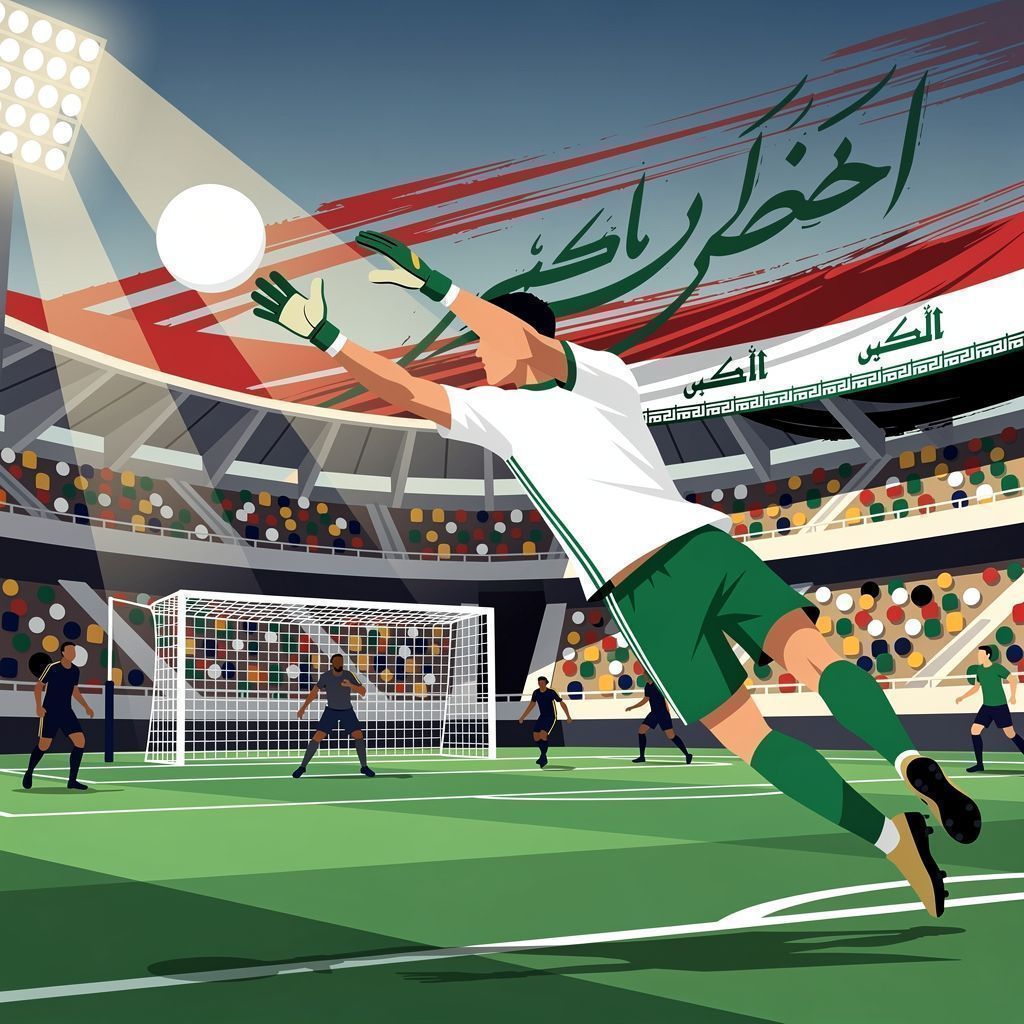
As Iraq intensifies its preparations for the 2026 FIFA World Cup, the spotlight falls heavily on the team’s veteran leader and goalkeeper, Jalal Hassan. His presence on the pitch serves as a foundation for the national squad’s defensive organization during high-stakes continental competitions.
This research provides a comprehensive analysis of Hassan’s career trajectory, spanning from his professional debut in 2010 to his current status as a centurion for the Iraq national team. At 35 years old, Hassan represents a vital bridge between Iraq’s historical successes and their modern sporting aspirations. While recent club performance in the AFC Champions League 2 (ACL2) has shown statistical fluctuations, his domestic dominance with Al Zawra’a SC and his milestone 100th international cap in late 2025 cement his position as the undisputed number one. This synthesis of data regarding his international saves, club honors, and tactical significance provides a holistic view of his readiness for the 2026 World Cup stage.
2. Introduction: The “Majestic” Guardian of Iraq
In the high-stakes arena of international football, a goalkeeper’s role demands more than physical reflexes; it requires a synthesis of psychological resilience, tactical intelligence, and leadership that can stabilize a defense amid chaos. Jalal Hassan Hachem, known mononymously as Jalal Hassan, has crystallized these traits into his identity as Iraq’s most dependable defensive anchor. Standing at 188 cm (6 ft 2 in), his imposing frame commands the penalty area, a critical asset as Iraqi defenses adapt to varied tactical demands in AFC and FIFA tournaments. His journey from modest beginnings in Iraqi club football to captaincy of a nation with storied international credentials illustrates not just skill, but an evolution shaped by relentless dedication. As the 2026 World Cup approaches, Hassan’s influence extends beyond individual performances; he is increasingly viewed as the psychological nucleus of Iraq’s campaign, whose composure under pressure directly impacts team cohesion and morale.
The appellation “Majestic” in Hassan’s name—derived from the Arabic term for “majesty”—aptly encapsulates his commanding on-field demeanor. This symbolic resonance has materialized through his career, transitioning from obscurity in lower-tier leagues to a revered leadership role within Asian football’s most storied national teams. His ability to orchestrate defensive structures, particularly during high-stakes matches, reflects a maturity honed through years of competing at domestic and continental levels. Beyond statistics, Hassan’s presence instills confidence in teammates, a role that has become indispensable as Iraq seeks to compete against rising Asian foes and global contenders. The 2026 World Cup qualification cycle places him at the epicenter of these ambitions, where sustained form and leadership will determine Iraq’s trajectory.
3. Biography and Early Career Foundations
Born on 18 May 1991, in Al Diwaniyah, Iraq, Jalal Hassan’s ascent to the pinnacle of Asian football represents a disciplined progression through the rigorous tiers of the Iraqi league system. Rather than achieving immediate fame, his career is defined by a decade of steady development and consistent performance in high-pressure environments.
3.1. Early Professional Steps
Hassan’s professional journey commenced in earnest in 2010 while playing for Karbala SC. These formative years between 2010 and 2012 served as a critical developmental phase, allowing him to adapt to the intense physicality and mental demands of senior-level football. After establishing himself at Karbala, he transitioned to Erbil SC, a club with a significant historical presence in the top flight. This move provided him with the necessary visibility and competitive exposure required to catch the attention of national team scouts.
3.2. The Path to Domestic Dominance
Following competitive stints at Amanat Baghdad and Al Shorta SC, Hassan found his professional home at Al Zawra’a SC, where his career reached new heights. His tenure at Al Zawra’a remains the defining chapter of his club career, as he has become a central figure in a golden era for the institution. Through tactical discipline and reliable shot-stopping, he helped the club secure three league titles (2017–18, 2020–21, and 2021–22) and two FA Cups (2018, 2022). His ability to maintain elite performance levels over a multi-year period is evidenced by his consecutive “Goalkeeper of the Year” awards in the 2020–21 and 2021–22 seasons.
4. International Career: The Century Milestone
Hassan’s international career is a testament to longevity and consistency, serving as a cornerstone of the Iraqi national team’s defensive structure for over a decade. His journey began when he earned his first cap on 24 March 2010 against Saudi Arabia, marking the start of a sustained period of elite-level competition that has seen him navigate various tactical shifts and generational changes within the squad.
4.1. The 100-Cap Landmark
A defining moment for both Hassan and the Iraqi footballing community occurred on 18 November 2025. During a critical 2–1 victory against the UAE in the 2026 World Cup qualifiers, Hassan reached the historic milestone of 100 international caps. Reaching this century mark is a rare feat in international football and serves as a validation of his reliability amidst a rotating cast of teammates and managers.
This achievement highlights his mental fortitude and physical durability. By maintaining his position as the primary choice for the national team, he has provided a sense of stability that is vital for a team competing in high-stakes continental qualifiers.
4.2. Continental Experience
Hassan’s experience is not limited to the qualifying rounds; he has established himself as a consistent presence in major regional tournaments. He has been a staple in Iraq’s AFC Asian Cup campaigns, appearing in the 2015, 2019, and 2023 editions. This breadth of experience ensures that the squad has a seasoned leader who understands the pressures of high-intensity tournament football.
His ability to perform on the continental stage was highlighted during the 2022 Gulf Cup of Nations, where he was officially recognized as the “premier Goalkeeper”. This international pedigree is essential for a goalkeeper tasked with leading a squad into a World Cup environment, providing the tactical composure necessary to handle the scrutiny of large-scale international stages.
5. Statistical Analysis: Performance and Projections
To gauge Jalal Hassan’s readiness for the 2026 World Cup, it is essential to examine how his career averages compare with his recent performance trends. This analysis looks at his contributions during the latest AFC qualification cycle and his club continental engagements, highlighting both strengths and areas that require attention before the global stage.
5.1. World Cup Qualification Data
During the 2025‑26 AFC qualification campaign, Hassan featured in several pivotal fixtures, most notably against the Central African Republic and Syria.
- Minutes played: 134 minutes
- Saves: 8 saves, including 6 against the Central African Republic and 2 against Senegal
- Efficiency: His save percentage in these specific appearances was recorded at 50 %
Although a 50 % save proportion may seem modest at first glance, the context of qualifying matches often shifts the objective from preserving a clean sheet to limiting damage against stronger opponents. Research shows that Hassan remains positioned within the top thirty save‑makers per ninety minutes in his qualification pool, which implies that the quality of chances he faced was considerably high. This perspective underscores his value as a goalkeeper who can keep his team competitive even when the defensive line is under pressure.
5.2. The Challenge of Recent Form
His involvement in the 2025‑2026 ACL2 season with Al Zawra’a SC provides a different perspective on his current form.
- In 8 appearances for Al Zawra’a SC, Hassan recorded 1 clean sheet but conceded 2.13 goals per game
The elevated goals‑against average points to either a back‑line that is frequently under siege or the heightened tempo of continental competition testing Hassan’s reflexes more than domestic fixtures. While a single clean sheet indicates he can still produce shutouts, the overall trend suggests that improving defensive coordination will be vital if he is to replicate his qualification performances on the World Cup stage.
Looking ahead to the 2026 World Cup, several researchers have put forward a cautious outlook, estimating that Hassan might achieve a save rate of roughly thirty‑three percent, which would translate to about two saves while conceding four goals and failing to keep a clean sheet in the most demanding encounters. This forecast, however, should be balanced against his track record of elevating his performance in prestigious tournaments, particularly his showings in the Gulf Cup, where he has repeatedly demonstrated the capacity to surpass expected numbers.
…
6. FIFA World Cup Outlook
The approaching tournament draws attention to how the Iraqi coaching team can harness Jalal Hassan’s seasoned expertise while carefully addressing the vulnerabilities linked to his current age and recent club performances. Balancing the value of a goalkeeper who has amassed a hundred‑one caps and thrice represented his nation in the Asian Cup against the physical demands of a crowded World Cup slate is a nuanced challenge. The decision hinges on whether Hassan’s historical resilience can translate into the high stakes of 2026, and whether the squad can provide the defensive framework needed to support a veteran presence.
6.1. The Argument for Inclusion
Jalal Hassan remains the most logical candidate for the starting XI, largely because his 101 international appearances and participation in three Asian Cup campaigns afford him a depth of experience that younger keepers typically lack. His proven consistency during qualification, highlighted by a 71% save rate across 16 matches, demonstrates the mental strength required for world‑stage competition. Moreover, his familiarity with the pressure of continental tournament play offers stability to a squad that may otherwise be in transition.
6.2. Risks and Variables
The primary concerns can be grouped into three categories:
- Recent Form: A noticeable decline in club performance, reflected by a 2.13 goals conceded per game average in the second tier of the Asian Champions League, warrants close monitoring.
- Aging Curve: At 35, Hassan’s recovery speed and ability to sustain peak physical output are reduced, which could impact his effectiveness during the intensive World Cup schedule.
- Defensive Support: His success is closely linked to the solidity dürfen of the Iraqi backline; any defensive breakdown could expose gaps that diminish his individual statistical contributions regardless of his skill set.
7. Conclusion: The Indispensable Veteran
Jalal Hassan stands as more than just a goalkeeper for Iraq; he embodies the nation’s footballing resilience and determination. Over a career that has seen him earn 101 international caps, claim several league championships, and receive notable individual accolades, he has repeatedly proven his ability to perform when the pressure mounts. Recent analysis of his performances in the ACL2 and World Cup qualifiers shows a temporary dip in save efficiency and an increase in goals conceded, yet these figures do not overshadow the long‑term consistency he has demonstrated.
Looking ahead to the 2026 World Cup, Hassan is expected to serve as a cornerstone of Iraq’s defensive unit. Whether he manages to sustain his historically high save percentages or confronts a statistically demanding tournament, his veteran leadership and commanding presence within the squad remain indispensable for the team’s competitive aspirations. His experience offers a stabilizing influence that can elevate the performance of younger teammates and help Iraq navigate the challenges of the global stage.