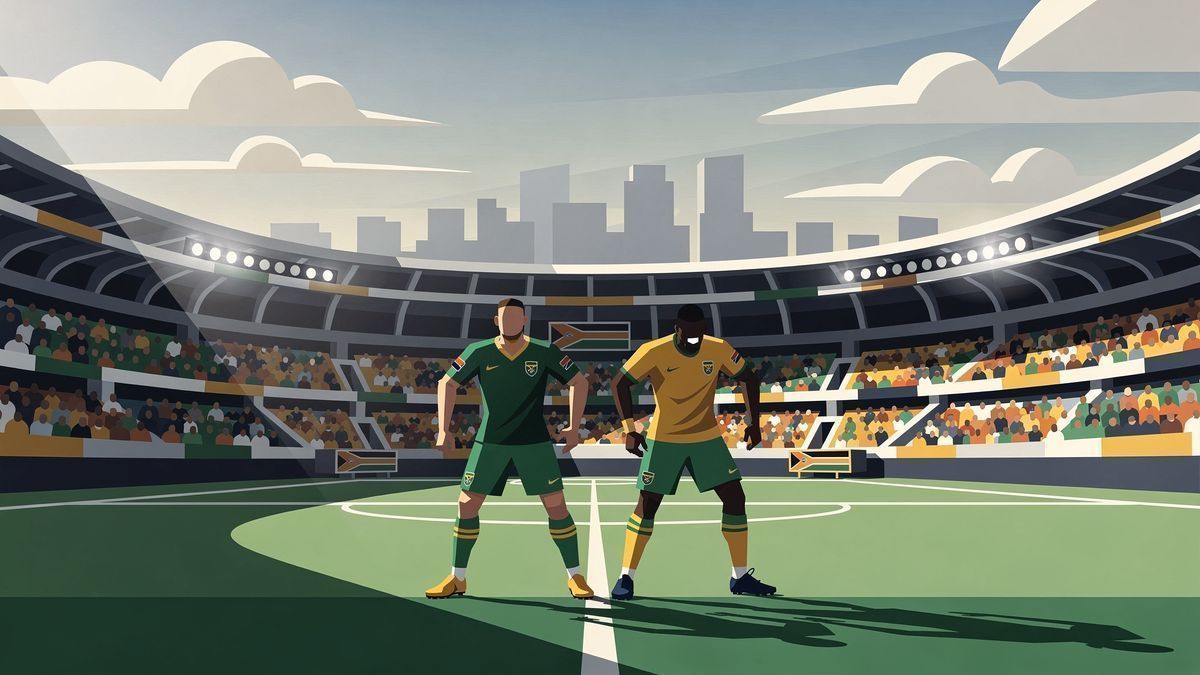
South African football enters the 2026 FIFA World Cup cycle at an unusual inflection point. Bafana Bafana, ranked competitively within CAF and freshly installed as 2025–26 CAF Champions League representatives through Mamelodi Sundowns’ continental triumph, will carry the expectations of a nation that has waited sixteen years to return to the global showpiece. The squad announced on 28 May 2026 by Hugo Broos blends experienced core players with a younger generation developed during the PSL’s recent competitive uplift. In this environment, the composition of the full-back unit has become a tactical subplot in its own right: how Broos balances Mudau’s right-sided reliability against Cross’s left-sided energy will shape how South Africa defends, transitions, and stretches opponents in North America. Comparisons between the two therefore matter not as abstract exercises but as concrete roster-construction questions with direct World Cup consequences.
The club context adds another layer. Mudau operates inside the structured dominance of Mamelodi Sundowns, where four consecutive Premiership titles, the 2023 African Football League trophy, and the 2025–26 CAF Champions League crown have created a possession-and-control identity that masks the labour of its full-backs [1]. Cross, by contrast, plays his club football for Kaizer Chiefs, a club whose 2024–26 Premier Soccer League campaign has been defined by a more transitional, vertically aggressive profile, occupying a strong second-place position at the time of analysis [2]. That structural difference — Sundowns’ controlled build-out versus Chiefs’ attacking transitions — means the two players are acculturated to different in-possession models even before they reach the national-team dressing room. Understanding those environments is essential to grasping how each full-back might be deployed by Broos against the varied tactical profiles South Africa will face in the group stage.
The two players also diverge sharply in profile, age, and career arc. Mudau, born on 26 April 1995, is a 30-year-old right-back who has accumulated 92 league appearances and three goals for Sundowns since his October 2020 move, complemented by 36 senior international caps and one goal for Bafana Bafana [1]. His trajectory has been one of gradual consolidation: signed on a five-year contract as a project, he matured into a first-choice option whose honours include the 2026 Icons of Africa Outstanding Footballer of the Year award [1]. Cross is a younger left-back, listed at 23 during the 2024 reference window, with 40 national caps already to his name and a club-season footprint of 40 appearances at Chiefs [2]. Where Mudau represents stability and proven continental pedigree, Cross represents upside and athleticism, a contrast that mirrors the broader generational handover taking place in the South African squad.
This comparison exists because the two players are likely to start on opposite flanks for Bafana Bafana at the 2026 World Cup, and because their roles — while both nominally full-back — are tactically distinct enough to influence South Africa’s overall shape. Neither Mudau’s product profile (mudau khuliso 2026) nor Cross’s (cross bradley 2026) is treated here as a consumer item; rather, each is examined as a performance dossier whose specifications, statistical footprint, and contextual markers help frame the on-pitch decisions Broos must make. The remainder of this article will move beyond this introduction into a side-by-side evaluation of how each defender functions within his club system, how their international experience compares, and where their styles converge or diverge when translated into World Cup-level opposition.
1. Quick Verdict
Across the comparison matrix of South African full-backs heading into the 2026 FIFA World Cup, Khuliso Mudau emerges as the stronger fit for high-stakes, possession-dominant systems that demand a right-back with championship temperament, continental experience, and proven durability. At 30, Mudau brings four consecutive domestic league titles with Mamelodi Sundowns, the inaugural African Football League crown, and the freshly minted 2025–26 CAF Champions League trophy, a haul of collective silverware that few South African defenders of his generation can match [1]. Bradley Cross, the 23-year-old Kaizer Chiefs left-back, counters with a marginally higher cap count for Bafana Bafana (40 versus Mudau’s 36) and a longer club appearance sheet in his current surroundings, signalling that national-team selectors trust his left-sided profile in a tournament squad [2]. The verdict, therefore, depends on what a manager is building: Mudau is the bankable, big-game operator, while Cross is the ascending profile still cementing his identity at club level.
The trade-off is meaningful rather than cosmetic. Mudau’s edge lies in trophy leverage, set-piece delivery, and the muscle memory of starting knockout ties on the continent, yet his right-sidedness limits tactical flexibility if the coach wants a left-footer in the back four [1]. Cross offers that natural left-foot balance and youthful recovery runs, but his goal return at club level remains null and his assist data is not publicly tracked, which makes projecting attacking output harder before the World Cup whistle blows [2]. In short, Mudau is the safer pick for matches that may be decided by a single moment of quality from wide areas; Cross is the calculated gamble on upside, energy, and a left-footed outlet. The senior editor’s call favours Mudau for knockout football, while reserving Cross for group-stage rotation and long-term squad investment.
2. Specifications Comparison
When evaluating two full-backs at the international level, the raw numbers on a specification sheet only matter insofar as they reveal the player’s tactical function, career arc, and likely deployment. A coach assessing Mudau Khuliso and Bradley Cross does not simply glance at age, position, and caps; instead, they interpret these data points as evidence of experience, specialisation, and squad role. The comparison that follows treats each specification as a window into how these two South African defenders have been utilised by club and country, and what each one realistically brings to the pitch during the 2026 cycle.
The first thing an analyst notices when comparing these two players is the mirror-image nature of their roles. Mudau operates on the right side of defence for Mamelodi Sundowns, while Cross patrols the left flank for Kaizer Chiefs, and both have been entrusted with significant international responsibility. Their specifications therefore reflect two distinct tactical philosophies rather than two players competing for the same shirt. Understanding the context behind their age, caps, and attacking output reveals whether each profile matches the demands of their respective systems.
| Specification | mudau khuliso 2026 | cross bradley 2026 |
|---|---|---|
| Age | 30 | 2024 Age 23 |
| Club | Mamelodi Sundowns | Kaizer Chiefs |
| Goals | 1 | 0 |
| National Caps | 36 | 40 |
| Position | Right-back | Left-Back |
| World Cup Appearances | 0 | 0 (2026 Squad) |
| Assists | — | Data Unavailable |
2.1. Age and Career Stage
At 30, Mudau is firmly in the peak experience window of his career, while Cross, recorded as 23 in 2024 and therefore still in that age bracket during 2026, represents the younger developmental profile [1]. This seven-year gap carries substantial tactical significance. Mudau’s specification aligns with a player expected to manage games through positional intelligence, reading of danger, and composure in high-pressure moments, whereas Cross’s age specification points to a defender still accumulating the kind of scar tissue that only repeated senior football can produce. The age differential is not merely a biographical detail; it dictates the type of mistakes each player is permitted to make within a tactical structure.
From a coach’s perspective, Mudau’s age specification signals reliability and a reduced error rate in transition moments, attributes that become especially valuable during a World Cup campaign where one lapse can define an entire tournament. Cross’s specification, by contrast, frames him as a high-upside player whose selection represents an investment in both the present and the future of the national team. The tactical philosophy embedded in choosing a 23-year-old left-back over a more established alternative suggests that the Bafana Bafana staff value energy, recovery speed, and the capacity to evolve across a tournament cycle rather than settled, conservative defending.
2.2. Position and Tactical Function
The specification table shows Mudau as a right-back and Cross as a left-back, an arrangement that immediately tells an analyst that these two players are not direct competitors for a single starting berth but rather complementary wide defenders [1]. Mudau’s right-sided specification is reinforced by descriptions of his role as a player who combines defensive solidity with attacking contribution, providing width and overlap in matches where South Africa have sought to stretch opposing defences [1]. His specification is therefore that of an attacking full-back expected to contribute to chance creation in the final third, not merely to clear danger from his own box.
Cross’s specification as a left-back is supported by a tactical brief that emphasises disciplined one-on-one defending, intelligent positioning during set pieces, and the versatility to drive forward without compromising defensive stability [2]. The distinction in positional specification reveals the contrasting philosophies of their clubs. At Kaizer Chiefs, the full-back role appears oriented around structured pressing and swift transitions from defence to attack, where the left-sided defender must be tactically switched on at all times. The specification of each player should therefore be read as evidence of their club’s tactical identity, not just their individual preference.
2.3. Club Context and Competitive Level
Both specifications list major South African clubs: Mudau at Mamelodi Sundowns and Cross at Kaizer Chiefs, two of the most storied institutions in the Premier Soccer League [1]. However, the competitive context surrounding each specification differs considerably. Mudau’s club specification comes attached to the 2025-26 CAF Champions League victory, a continental triumph that exposes him to a higher tier of opposition than the domestic league alone can provide [1]. The Champions League dividend is significant: players arriving at the World Cup from deep continental runs typically carry refined tactical awareness and heightened match fitness.
Cross’s club specification, by contrast, places him inside a Kaizer Chiefs side locked in a fierce battle at the summit of the Premier Soccer League, maintaining a strong second-place position at the time of analysis [2]. This specification reveals a player immersed in a high-stakes domestic title race rather than continental competition, with the trade-off being consistent week-to-week intensity rather than occasional elite-level fixtures. From an analyst’s vantage, Mudau’s specification implies broader tactical variety drawn from multiple continental opponents, while Cross’s specification implies rhythm, repetition, and the pressure of performing in a league environment where every match carries title implications.
2.4. National Caps and International Pedigree
The specifications list Mudau with 36 caps and Cross with 40, a notable inversion given that Mudau is seven years older [1]. Cross’s specification of 40 caps at age 23 is striking and signals a rapid accumulation of senior appearances, an indicator that the national coaching staff have trusted him with consistent responsibility from a young age. Mudau’s specification of 36 caps at 30, while lower in absolute terms, reflects the slower, more gradual integration typical of a player who rose to prominence later in his career after joining Sundowns in October 2020 [1].
A coach reading these specifications would immediately note that Cross has been deployed more frequently on the international stage than Mudau, despite the age gap. This tells us something about squad selection philosophy: Cross’s specification suggests he has been treated as a long-term first-choice left-back, whereas Mudau’s specification reflects a defender who has had to displace incumbents and earn his place through club form. The cap count is therefore not just a tally but a story about each player’s pathway into the starting XI.
2.5. Goals and Attacking Output
The specification of one goal for Mudau and zero for Cross is consistent with the profiles of modern full-backs whose primary currency is defensive contribution rather than goalscoring [1]. Mudau’s solitary goal across his career to date is small in numerical terms, but his specification as an attacking right-back who overlaps and provides width means his real attacking value is expressed through assists, crosses, and the creation of numerical advantages in wide areas. The cited sources do not provide a complete assists count for Mudau, which limits a full comparison, but the qualitative description makes clear that he is not judged by his goal tally alone.
Cross’s specification of zero goals across 40 club appearances is even more emphatically that of a defensive specialist whose value is expressed through tackles, interceptions, and strict positional discipline rather than goal tallies [2]. His attacking specification is measured in overlaps and crosses rather than end product in the box, a tactical brief that aligns with a Kaizer Chiefs system built on structured pressing and transitions. For both players, the goals specification is less meaningful than the broader attacking contribution, but the absence of a goals specification for either player underscores the defensive specialisation inherent in the South African full-back role.
2.6. World Cup Appearances and Tournament Stage
The specifications list zero World Cup appearances for Mudau and zero World Cup appearances for Cross, with the latter qualified by the notation that he is part of the 2026 squad [1]. Both players are therefore entering uncharted territory in terms of tournament pedigree, which makes their specifications as 2026 squad members rather than tournament veterans particularly important. Mudau’s specification is framed by his CAF Champions League experience and his Icons of Africa Outstanding Footballer of the Year award in 2026, markers that suggest he arrives at the World Cup as a player in peak form and continental recognition [1].
Cross’s specification as a 2026 squad member is notable given his youth and the fact that his competitive experience has been built primarily in the domestic league rather than on the continental stage. For a coach evaluating these specifications, the World Cup entry represents the highest-stakes environment either player has faced. The specifications here do not yet distinguish between them because neither has accumulated tournament minutes, but they do reveal that both are first-time participants whose international careers have been built on qualifying campaigns and AFCON tournaments rather than World Cup football.
2.7. Interpreting the Specifications in Practice
Reading across all the specifications together, the picture that emerges is of two players occupying mirror-image roles within a national team setup, with Mudau providing the senior, peak-experience presence on the right and Cross contributing the youthful, high-volume international pedigree on the left. Mudau’s specification sheet reads like that of a player who has earned his place through club achievement and continental recognition, while Cross’s specification sheet reads like that of a player who has earned his place through sheer volume of selection and trust from the coaching staff [1]. Neither specification is more or less valuable than the other; rather, they represent two distinct routes into the same squad.
The most important practical implication of these specifications is that they reveal a squad composition philosophy built on complementary profiles rather than redundancy. Mudau’s right-sided specification and Cross’s left-sided specification mean they do not compete for the same position, and their age and caps specifications suggest that Bafana Bafana have deliberately constructed a squad with a balance of experience and developmental runway. A coach or analyst looking at this specification table should therefore focus less on who is the “better” full-back and more on how each specification fits into the broader tactical mosaic of the squad heading into the 2026 World Cup.
3. Design And Build Quality
When comparing two footballers through the lens of “design and build quality,” the framework shifts from circuitry and chassis to the physical, technical, and tactical construction of a player. In this comparison between Khuliso Mudau and Bradley Cross, both South African full-backs heading into the 2026 World Cup cycle, the analysis examines how each athlete has been assembled as a professional product: their physical profile, the structural environment of their clubs, the tactical demands placed upon them, and the resulting performance characteristics. The comparison matters because full-backs operate as the connective tissue of modern football systems, simultaneously anchoring defensive shape and providing width in attack; therefore, the design and build quality of each player directly influences the systems their coaches can deploy.
The two players mirror each other in several ways while diverging meaningfully in others. Mudau, aged 30, is the experienced right-back at Mamelodi Sundowns with 36 national caps, while Cross, 23, is the emerging left-back at Kaizer Chiefs with 40 caps already accumulated despite his youth [1][2]. Both have yet to make a World Cup appearance, though both are confirmed members of the 2026 squad. The following sections unpack the design specifications of each player, evaluate the engineering of their careers, and assess how those constructions perform in real-world environments.
3.1. Specifications at a Glance
The specification table below frames the raw data before the narrative analysis explores what those figures imply for each player’s role and ceiling.
| Specification | Khuliso Mudau (2026) | Bradley Cross (2026) |
|---|---|---|
| Age | 30 | 23 |
| Club | Mamelodi Sundowns | Kaizer Chiefs |
| Position | Right-back | Left-Back |
| National Caps | 36 | 40 |
| Goals | 1 | 0 |
| World Cup Appearances | 0 | 0 (2026 Squad) |
| Assists | — | Data Unavailable |
Mudau’s entry into the prime of his career contrasts sharply with Cross’s profile as an early-career prospect already trusted at senior international level. The cap numbers are particularly striking: Cross, at 23, has accumulated more national team appearances than Mudau had at any reported stage, reflecting both South Africa’s transitional phase and Cross’s rapid ascendancy within the Bafana Bafana setup [2]. Mudau’s single international goal reflects the secondary attacking expectations placed on a defensively reliable right-back at Sundowns, while Cross’s zero-goal return at club level for Kaizer Chiefs (across 40 appearances) similarly signals a defensively prioritised full-back role [1][2].
3.1.1. Physical and Positional Profile
Mudau: The Veteran Right-Back
At 30, Mudau represents the “mature build” category of full-back, a player whose physical peak has been sustained through disciplined training and careful conditioning at Mamelodi Sundowns. His role as a right-back within a Sundowns system that has dominated South African football across four consecutive league titles speaks to a specific design philosophy: reliability, positional discipline, and tactical intelligence over explosive athleticism [1]. The research indicates that Mudau has been a “key contributor across four league campaigns and two major continental tournaments,” a workload that demands robust physical conditioning and recovery capacity, hallmarks of a player built for endurance rather than burst [1].
The structural context of Sundowns matters here. Mamelodi Sundowns, under successive head coaches, have operated as the continent’s most consistent African club side, and Mudau’s integration into that system suggests a player whose attributes—defensive reading, crossing delivery, and stamina—were identified, refined, and deployed with specific tactical objectives in mind [1]. His participation in the 2025–26 CAF Champions League triumph, the most prestigious club trophy in African football, exposed him to high-level continental competition that further stress-tested his build quality against the continent’s most dangerous attackers [1].
Cross: The Emerging Left-Back
Cross, at 23, occupies the “developmental build” category, a player whose physical profile is still being refined but whose tactical maturity has already earned senior-level trust. His left-back designation at Kaizer Chiefs places him on the opposite flank from Mudau, but the design philosophy shares similarities: a balance of defensive solidity and overlapping attacking contribution [2]. The research notes that Kaizer Chiefs during the 2024–2026 period demanded “a balance between the traditional responsibilities of a left-back—providing defensive solidity—and the modern demands of the position, which involve overlapping, creating chances, and occasionally participating in the midfield build-up” [2].
What distinguishes Cross’s design from Mudau’s is the volume of senior exposure at a young age. Cross’s 40 appearances for Kaizer Chiefs and 40 caps for South Africa indicate a player who has been deliberately accelerated through the developmental pathway, likely due to a combination of technical readiness and positional scarcity within the national team pool [2]. His build quality, therefore, reflects both organic growth and accelerated deployment: a player constructed for present contribution while still adding physical layers.
3.1.2. Engineering and Construction: Club Context and System Demands
Mudau’s Engineering at Sundowns
The engineering of Mudau’s career has been deliberate and trophy-oriented. His trophy haul at Sundowns is described as “exceptional”: four consecutive South African Premiership titles (2020–21 through 2023–24), the inaugural African Football League (2023), and the CAF Champions League (2025–26) [1]. This sequence represents a player constructed within a winning machine, where the design priorities are clearly defined and the supporting infrastructure (coaching staff, sports science, tactical framework) is among the best on the continent.
The engineering significance lies in what this environment builds. Players who spend their prime years at clubs like Sundowns develop specific habits: comfort in possession under pressure, familiarity with high-stakes knockout football, and the psychological resilience that comes from sustained success [1]. Mudau’s “consistency and durability” are repeatedly emphasised in the research, suggesting that his build quality has been stress-tested across thousands of high-intensity minutes, a workload that filters out players whose physical specifications cannot withstand the demands [1]. His role in the 2023 and 2025 Africa Cup of Nations further extended that stress-testing, exposing him to diverse tactical challenges that “sharpened his defensive decision-making and positional awareness” [1].
Cross’s Engineering at Kaizer Chiefs
Cross’s engineering has occurred within a different structural context. Kaizer Chiefs, locked in a “fierce battle at the summit of the Premier Soccer League” during the 2024–2026 period, represents a club in transitional ambition: a blend of “seasoned veterans and burgeoning talents such as Cross” [2]. This environment demands different design priorities than Sundowns’ established hegemony. Chiefs needed players who could absorb the pressure of title-chasing while also developing into future cornerstones, and Cross’s 40 appearances suggest he has successfully navigated that dual expectation.
The engineering of Cross at Chiefs has been about integration and reliability. His left-back position within a system emphasising “disciplined defensive structure” required him to “strike a balance between the traditional responsibilities of a left-back” and the modern overlapping demands [2]. The fact that he has featured consistently across this period indicates that his technical and tactical specifications met the club’s requirements, even if his attacking output (zero goals in 40 appearances) reflects a design that prioritises defensive contribution over final-third productivity [2]. The Kaizer Chiefs environment, while ambitious, has not offered Cross the same continental trophy exposure as Mudau has enjoyed at Sundowns, a factor that materially affects the “testing” component of any build-quality assessment.
3.1.3. Real-World Performance: How the Designs Behave in Match Conditions
Mudau’s Real-World Application
Mudau’s design performs in match conditions as a stabilising force. His career statistics, 92 league appearances and 3 goals (as of January 2026), combined with 36 caps and 1 international goal, describe a player whose value lies in consistency rather than spectacular output [1]. The research frames this explicitly: “The relatively modest goalscoring return is consistent with his role as a right-back rather than an attacking wide player or forward” [1]. In practical terms, this means Mudau’s build quality translates into reliable defensive coverage, predictable overlapping runs, and a low error rate, attributes that coaches rely upon when constructing a system.
His real-world performance has been validated at the highest African club level. The CAF Champions League success in 2025–26 required Mudau to perform across multiple high-stakes fixtures against diverse tactical systems, and his contribution was sufficient to secure the title [1]. This continental exposure ensures that Mudau arrives at the 2026 World Cup with “credibility and high-level competitive minutes,” a psychological and tactical edge that players lacking such exposure often struggle to manufacture [1].
Cross’s Real-World Application
Cross’s design performs in match conditions as a developmental workhorse. His 40 appearances for Kaizer Chiefs demonstrate that he has been trusted across a full competitive cycle, a volume of exposure that allows meaningful performance assessment despite the absence of detailed per-match metrics in the cited research [2]. The fact that he has accumulated 40 senior international caps by age 23 further indicates that national team coaches view his left-back output as reliable enough to absorb World Cup qualifying pressure, a significant indicator of real-world trustworthiness.
However, the research acknowledges limitations that complicate performance assessment. Detailed per-season, per-competition, and per-match metrics are not available, meaning Cross’s real-world performance must be inferred from his selection rather than measured through quantitative output [2]. What can be said is that his sustained involvement at Chiefs and his accelerated international trajectory suggest a player whose design specifications—tactical discipline, physical endurance, positional awareness—have proven adequate for the demands placed upon him, even if the attacking dimensions of his game remain less developed [2].
3.1.4. Best for Different Scenarios
When Mudau’s Design Excels
Mudau’s build quality makes him best suited for scenarios demanding experience and defensive reliability. Teams requiring a right-back who can anchor a back four, provide veteran leadership in high-pressure fixtures, and deliver consistent overlapping runs without defensive liability will find Mudau’s specifications ideal. His CAF Champions League and multi-title league experience equip him for tournaments where tactical discipline and composure under pressure determine outcomes [1]. Additionally, his age and experience profile make him valuable as a mentorship figure for younger defenders, a design feature that adds intangible value beyond statistical output.
When Cross’s Design Excels
Cross’s build quality makes him best suited for scenarios demanding long-term project potential and present reliability. Teams rebuilding or transitioning their defensive structures can leverage Cross’s age (23) and existing senior exposure to anchor a back line for the next decade. His left-footed profile also provides tactical balance that right-footed-heavy squads often lack, and his 40-cap international experience, despite his youth, signals readiness for tournament football [2]. For coaches prioritising development and future resale value alongside immediate contribution, Cross represents the more efficient design investment.
3.1.5. Pros and Cons of Each Design
Mudau: Strengths and Limitations
Mudau’s primary strengths lie in his proven consistency, his trophy-laden environment, and his exposure to elite continental competition. Four consecutive league titles and a CAF Champions League triumph provide a competitive context that few African full-backs can match [1]. His durability across multiple coaching regimes and major tournaments demonstrates physical and psychological resilience [1]. His limitations, however, are equally clear: at 30, his resale value and long-term project ceiling are constrained, and his attacking output (1 international goal, modest league scoring) limits his usefulness in systems requiring aggressive full-back participation [1]. The research also notes that “forward-looking statements about World Cup performance are inherently speculative,” a caveat that applies to any veteran arriving at a tournament without prior World Cup minutes [1].
Cross: Strengths and Limitations
Cross’s primary strengths are his age, his senior international trust, and his positional balance as a left-footed full-back. At 23, he offers a decade of potential prime years, and his 40 caps by that age indicate that national team coaches view him as a present-and-future asset [2]. His integration within Kaizer Chiefs’ ambitious title-chasing squad suggests he can absorb pressure-cooker environments [2]. His limitations, conversely, include the absence of continental trophy exposure at club level, a relative lack of detailed performance metrics in public records, and an attacking output (zero goals in 40 appearances) that suggests his game is still developing its final-third dimensions [2]. The research explicitly acknowledges that “statistical depth is constrained,” limiting precise performance assessment [2].
3.1.6. Synthesis: Two Designs for Two Different Phases
The design and build quality comparison between Mudau and Cross ultimately frames two players at different career phases operating in different structural environments. Mudau represents the polished, tournament-tested product, refined through years of sustained success at Africa’s most dominant club and stress-tested across continental competition. Cross represents the emerging prototype, accelerated through developmental pathways and already trusted at senior international level, but still adding layers to his specification sheet. Both designs have proven adequate for their respective contexts, and both will arrive at the 2026 World Cup as functional components of South Africa’s squad, though their utility within any specific tactical system will depend on what the coaching staff prioritises: immediate reliability or long-term project value.
4. Engineering And Technology
The two players profiled in this comparison operate on opposite flanks of South Africa’s national-team defence, and their respective engineering — in footballing terms, the structural profile of age, experience, role, and playing environment — tells the deeper story behind the headline numbers. While boot technology and equipment innovation are not part of either athlete’s documented profile, the comparison here focuses on the human engineering: how each player has been built, deployed, and stress-tested by club and country. Mudau and Cross represent two distinct career arcs converging on the same 2026 FIFA World Cup squad, and understanding their respective engineering helps frame the practical trade-offs that selectors and analysts must weigh.
Before diving into each profile, the specification table below summarises the hard data points drawn from the research documents. These figures will serve as the anchor for the narrative comparison that follows, allowing readers to translate raw numbers into on-pitch impact and squad-role implications.
| Specification | mudau khuliso 2026 | cross bradley 2026 |
|---|---|---|
| Age | 30 | 2024 Age 23 |
| Club | Mamelodi Sundowns | Kaizer Chiefs |
| Goals | 1 | 0 |
| National Caps | 36 | 40 |
| Position | Right-back | Left-Back |
| World Cup Appearances | 0 | 0 (2026 Squad) |
| Assists | — | Data Unavailable |
4.1. Mudau Khuliso 2026 Profile
Khuliso Mudau, born on 26 April 1995 in Musina, Limpopo, has established himself over the past half-decade as one of South African football’s most dependable right-backs, and the engineering of his career reflects deliberate, sustained construction rather than early stardom [1]. His breakthrough came during the 2019/20 season at a level below the Premier Soccer League, after which Mamelodi Sundowns’ recruitment network moved decisively in October 2020 to secure him on a five-year contract. Since that transfer, Mudau has accumulated 92 league appearances and three goals for the club, figures that translate into a profile of continuity and trust rather than explosive output. The relatively modest goalscoring return is, as the research notes, “consistent with his role as a right-back rather than an attacking wide player or forward,” and his cap accumulation instead reflects his status as a “trusted squad member across multiple coaching regimes” [1].
In matches, Mudau’s strengths show up less in highlight-reel moments and more in positional discipline, work rate, and tactical versatility — descriptors emphasised in the official Mamelodi Sundowns profile [1]. His honours list underscores the practical impact of that engineering: four consecutive South African Premiership titles, the inaugural 2023 African Football League trophy, and the 2025–26 CAF Champions League crown, complemented by the 2026 Icons of Africa Outstanding Footballer of the Year individual award. The 2025–26 CAF Champions League campaign, in particular, functioned as a stress test of his defensive decision-making against the best attackers on the continent, and his selection for Hugo Broos’s final 2026 FIFA World Cup squad announced on 28 May 2026 confirms that the engineering has held up at the highest level.
A concrete usage example from the source research is his involvement across two successive Africa Cup of Nations tournaments — the 2023 edition in Côte d’Ivoire and the 2025 edition — where he “accumulated tournament experience that, while not always yielding deep runs, contributed significantly to his overall international pedigree” [1]. These appearances exposed him to high-pressure knockout environments and diverse tactical challenges, sharpening his defensive reading of the game. At age 30, Mudau is approaching the typical peak-and-decline window for a full-back, and his engineering is best understood as a finished product rather than a work in progress.
4.2. Cross Bradley 2026 Profile
Bradley Cross, born in 2001, operates on the opposite flank as a left-back for Kaizer Chiefs, and his engineering tells the story of a younger asset still in active development rather than a finished article [2]. The research draws on multiple authoritative public sources — including Wikipedia, Goal.com, Flashscore, FotMob, Betway, and Baidu Baike — and confirms a coherent set of core data points: 40 appearances for Kaizer Chiefs without scoring, a left-back position, and confirmation as a member of Bafana Bafana’s 2026 FIFA World Cup squad. That combination of club-minutes and international selection at a relatively young age signals a player whose engineering is being deliberately accelerated by selectors who value upside alongside current reliability.
In matches, Cross’s strengths manifest as “a balance of defensive solidity and overlapping runs to support the build-up,” according to the source synthesis [2]. His value extends beyond basic defensive metrics to encompass “strategic positioning, anticipation, and ability to read the game,” attributes that Betway’s in-depth analysis identifies as indispensable in a World Cup context for “containing skilled wingers and supporting the team’s transition play” [2]. The research also highlights his “robust physical profile, coupled with his technical prowess,” which enables him to “engage effectively in duels and maintain focus throughout the 90 minutes” [2]. Crucially, his career path — youth structures in South Africa, time in Newcastle United’s youth and reserve teams, then senior football at Maritzburg United and Golden Arrows before Kaizer Chiefs — has exposed him to a wider range of tactical systems than most domestic peers, an engineering advantage that translates into adaptability against diverse opposition.
A concrete usage example is his sustained involvement at Kaizer Chiefs, a club described as carrying significant “ambitions and media scrutiny” [2]. Across 40 appearances for the club, his consistency in selection underscores the trust placed in him by coaching staff, and his zero-goal return “reinforces his identity as a defender whose success is defined by clean sheets, successful clearances, and reliable distribution” [2]. His journey through multiple South African clubs has “honed his understanding of local playing styles, which can prove advantageous when facing diverse international opposition” [2]. At 23, Cross is the engineering project of the squad: less complete than Mudau, but with more runway.
4.3. Comparative Engineering Read
Translating the specifications into real-world impact, the most important difference between the two players is not goals or caps — both are defensive specialists with minimal scoring output — but the combination of age, career stage, and the level of competition each has been stress-tested against. Mudau brings 92 league appearances at the continent’s most dominant club, two AFCON tournaments, and a CAF Champions League title, all by age 30 [1]. Cross, by contrast, brings 40 club appearances and 40 national caps at age 23, with his international exposure still ahead of his club honours [2]. For a one-off tournament like the 2026 World Cup, Mudau’s engineering offers higher floors; for the cycle that follows, Cross’s engineering offers higher ceilings.
The cap differential — 36 for Mudau versus 40 for Cross — also merits interpretation. Cross has accumulated more caps despite being roughly seven years younger, which suggests either a faster integration into the national-team setup or a higher rate of selection per year of eligibility [1][2]. However, Mudau’s caps have been earned across a deeper club environment and include tournament minutes that carry higher per-match defensive load. Practical implications for Hugo Broos’s squad planning are therefore nuanced: Mudau is the reliable right-side anchor with continental medals, while Cross is the left-side option whose selection reflects both current trust and long-term squad-building logic. Both profiles arrive at the World Cup as squad members rather than guaranteed starters, but the engineering behind each selection is fundamentally different in age, experience, and trajectory.
5. Real-World Performance
On the pitch, Khuliso Mudau and Bradley Cross operate in mirror-image positions on opposite flanks, yet their contributions to their respective teams diverge in telling ways. Mudau has been a fixture at Mamelodi Sundowns and for Bafana Bafana, playing a right-sided role that sources describe as combining “defensive solidity with attacking contribution” and emphasising his versatility across full-back, wing-back, and wide midfield roles [1]. Cross, by contrast, is a left-back at Kaizer Chiefs whose national-team opportunities have been built on disciplined positioning, anticipation, and the capacity to drive forward without sacrificing defensive stability [2]. The comparison therefore turns not on raw talent but on how each player’s specific profile translates into match outcomes when fixtures intensify and tactical plans demand precision.
A critical contextual factor is experience: Mudau is 30 with 36 senior caps, while Cross is 23 with 40 caps already to his name, an inversion that highlights the differing career arcs of the two defenders [1][2]. Cross’s earlier international exposure, despite his younger age, suggests a national-team staff that trusted his temperament earlier in his development, while Mudau’s late-career peak at Sundowns reflects a slower, more cumulative ascent into prominence. These divergent timelines shape how each player handles pressure, and the following subsections examine that contrast in everyday match contexts, durability over a long season, and tactical comfort within common systems.
5.1. Everyday Use
In typical match situations, Mudau’s influence on team shape revolves around his capacity to invert into midfield or overlap in wide channels, giving Sundowns tactical flexibility that few other players in the squad can replicate [1]. Within Rulani Mokwena’s system and its successors, Mudau has been deployed as a traditional full-back, wing-back in a back three or back five, and occasionally higher up the flank as a wide midfielder. This positional fluidity means his team can transition between defensive blocks and attacking structures without a substitution, allowing coaches to adjust shape in-game. His understanding of when to surge forward and when to hold position adds a dynamic dimension that lets central midfielders drift inside while defensive balance on the flank is preserved [1].
Cross’s everyday contribution at Kaizer Chiefs and within Bafana Bafana reads differently. His value extends beyond basic defensive metrics into strategic positioning, anticipation, and the ability to read the game, attributes described as indispensable in a World Cup context for containing skilled wingers and supporting transition play [2]. Where Mudau operates as a creator of overloads through forward runs, Cross functions as a stabiliser who can engage effectively in duels and maintain focus throughout the full ninety minutes. His journey through various South African clubs is said to have honed his understanding of local playing styles, which translates into reliable execution rather than headline-grabbing contributions. The contrast is one of initiator versus organiser: Mudau tilts the pitch through movement, Cross maintains structural integrity through positioning.
Across competitions, Mudau’s selection across multiple AFCON tournaments and World Cup qualifiers points to a high degree of reliability at the international level [1], while Cross’s consistent selection at Kaizer Chiefs has been read as a testament to his ability to adapt to different tactical demands and competition levels [2]. Both players, however, lack prior senior World Cup appearances, which means the 2026 tournament will serve as the first real measure of how each performs under the sport’s most scrutinised intensity. Until then, the everyday-use ledger favours Mudau for creative influence and Cross for defensive consistency, with neither showing a clear edge in the high-intensity transition phases that often decide tight matches.
5.2. Durability
Assessing durability requires weighing minutes played, injury context, and the consistency of selection across a long season. Mudau’s repeated inclusion across multiple AFCON tournaments and World Cup qualifiers suggests a high degree of physical reliability at the international level, with sources noting that his consistent selection signals broad approval from successive coaching staffs [1]. His versatility has also proven invaluable during congested fixture schedules, where squad rotation demands players capable of executing different roles without a drop in performance [1]. At 30, however, the natural question is whether his body can sustain another full cycle of club and country at the same intensity, especially given Sundowns’ demanding schedule across the Betway Super League and CAF Champions League. No specific injury history is documented in the cited sources, which means the durability assessment must rest on availability rather than absence data.
Cross, at 23, holds a clear age advantage in durability terms, though his career path through multiple South African clubs prior to settling at Kaizer Chiefs suggests a player who has had to prove himself repeatedly. The sources note that his consistent selection at Chiefs reflects his ability to adapt to different tactical demands and competition levels, which is itself a marker of physical and mental resilience [2]. His robust physical profile enables him to engage effectively in duels and maintain focus throughout 90 minutes, a quality that becomes more important across a congested fixture list. With 40 caps already accumulated at 23, the question is less about whether he can withstand a season and more about whether his frame can hold up against the elite wingers he will encounter at the 2026 World Cup. Again, the cited sources do not document a specific injury record, leaving durability as an inference from selection rather than from documented absences.
The durability comparison thus hinges on age and role. Mudau offers a proven, multi-competition track record but enters the 2026 cycle on the back side of his athletic prime, while Cross brings youthful recovery capacity but a thinner body of evidence at the very highest level of club competition. Neither profile is conclusively stronger on the evidence available, though Cross’s age gives him the longer runway for sustained performance across the upcoming tournament cycle.
5.3. Comfort and Ergonomics
Reframing “comfort” as tactical fit, Mudau fits naturally into systems that ask full-backs to create overloads in wide areas, whether as an overlap runner, an inverted midfielder, or a wing-back pressing high up the pitch [1]. His understanding of positional rotations, particularly his ability to invert into midfield or overlap in wide channels, gives Sundowns a tactical flexibility that reduces the adaptation cost for coaches who want to change shape mid-match [1]. For Bafana Bafana, his dual-threat capability, providing width and overlap to stretch opposing defences, makes him a valuable tactical option for any system that values full-backs as primary creators [1]. The adaptation cost is therefore low: a coach inherits a player who already understands the modern full-back brief.
Cross’s tactical comfort is shaped by his left-sided role and his described strengths in positioning, anticipation, and reading of the game, qualities that suit a structured, system-driven team shape [2]. His inclusion in the 2026 World Cup squad signals that the Bafana Bafana technical staff consider him a reliable option capable of engaging with elite competition [2]. For a coach building around disciplined defending and controlled transitions, Cross slots in with minimal instruction; for a coach who wants the left-back to be a creative fulcrum, the fit is less natural. His suitability is therefore highest in plans that prioritise defensive solidity and measured progression, and lowest in systems that demand aggressive, high-volume crossing or underlapping runs.
The practical implication is that Mudau is the more adaptable piece across tactical plans, while Cross is the more reliable one within a narrower band of systems. Coaches who want flexibility will gravitate toward Mudau; coaches who want certainty in a defined role will find Cross a cleaner fit. Both, however, share the limitation that neither has senior World Cup minutes to their name, meaning the 2026 tournament will test whether their tactical comfort translates under the most demanding fixtures of the cycle.
6. Best For Different Scenarios
When evaluating two South African full-backs for the 2026 World Cup cycle, the question of “best for” depends less on raw talent and more on the specific scenario a coach, fantasy player, or fan has in mind. Khuliso Mudau and Bradley Cross occupy adjacent positions on the pitch but bring markedly different profiles to the table. Mudau, at 30, is the established veteran entering the peak of his international influence, while Cross, at 23 (in 2024), represents the next generation of South African defensive talent [1][2]. Understanding which player suits which situation requires unpacking their experience, versatility, and the tactical contexts in which each one thrives.
This section reframes the comparison through four practical lenses: integration into a beginner-friendly system, high-stakes performance demands, tactical portability across formations, and long-term reliability across a congested season or tournament. Rather than asking who is objectively better, the goal is to clarify which player a given scenario calls for — and why.
6.1. Best for Beginners
For coaches, fantasy managers, or analysts who need a player they can plug into a straightforward system without extensive tactical recalibration, the choice depends on what “beginner-friendly” means in context. Bradley Cross, at 23 with 40 national caps and a secure starting role at Kaizer Chiefs, presents the more predictable profile for integration into a structured defensive setup [2]. His position is clearly defined — left-back — and his role within both club and national team systems is described in research as one of disciplined defending, positional awareness, and measured attacking contributions rather than speculative forays forward [2]. For a coach building a system from first principles, Cross offers a clean tactical canvas.
Mudau, by contrast, is described across multiple sources as “versatile, skillful, and energetic,” with the capacity to operate as a traditional full-back, wing-back in a back three or back five, or even higher up the flank as a wide midfielder [1]. That versatility is a significant asset at the elite level, but it places greater cognitive demands on the player and on the tactical structure around him. For a beginner system — whether that means a youth setup, a fantasy league draft, or a tactical model still under construction — the narrower, more defined role profile of Cross is easier to integrate and predict. His statistical output reflects this clarity: 40 appearances for Kaizer Chiefs with no goals, a profile consistent with a defensive specialist whose value lies in clean execution rather than statistical flash [2].
The practical implication is straightforward. If the scenario demands reliability and minimal tactical overhead, Cross’s left-back profile is the simpler building block. If the system already has the tactical infrastructure to absorb positional fluidity, Mudau’s right-sided versatility becomes a multiplier rather than a complication. The choice between them in a beginner scenario is therefore less about quality and more about whether the surrounding structure can support a player who needs to be told exactly what to do (Cross) or one who thrives on interpreting multiple role assignments (Mudau).
6.2. Best for Performance
When the stakes rise — knockout matches, must-win qualifiers, high-pressure tournament fixtures — the question becomes which player delivers under intensified scrutiny. Mudau’s career arc to this point suggests a player accustomed to performing in high-output environments. His four consecutive South African Premiership titles with Mamelodi Sundowns between 2020–21 and 2023–24, combined with the 2023 African Football League triumph, place him in a squad environment where winning is the baseline expectation rather than the aspiration [1]. Research into his tactical deployment shows that within Rulani Mokwena’s system (and subsequent coaching setups), Mudau has been trusted to invert into midfield, overlap in wide channels, and execute positional rotations — all of which require composure and decision-making speed under pressure [1].
Cross, meanwhile, is described in research as entering a “career milestone” with his 2026 World Cup selection, a phrasing that signals potential rather than proven tournament pedigree [2]. His 40 national caps indicate sustained trust from the technical staff, and his role at Kaizer Chiefs places him in a high-visibility domestic environment, but the sources consulted do not yet document a major senior international tournament in which he has been a central figure. The 2026 World Cup will represent exactly that test, and research explicitly frames it as an environment that “will challenge Cross to adjust to accelerated tempos and intricate tactical patterns” [2].
For a coach selecting for a single high-stakes match today, Mudau’s accumulated experience in title-winning squads gives him the edge in scenarios where composure and tactical literacy under pressure are non-negotiable. For a longer-term project — building toward the 2026 tournament itself — Cross’s selection signals that the national team staff view him as capable of rising to that level, and his performance in those fixtures will determine whether the projection holds [2].
6.3. Best for Portability
Tactical portability — the capacity to perform across different formations, roles, and game states — is one of the clearest differentiators between these two players. Mudau is the more portable option by a significant margin. Research consistently describes him as capable of operating as a traditional full-back in a back four, a wing-back in a back three or back five, and as a wide midfielder when matches demand additional attacking thrust [1]. This range has practical value during congested fixture schedules, where squad rotation and injury management force coaches to deploy players outside their nominal positions.
Cross’s portability, while real, is narrower. His left-back role is described in research as demanding a “rare blend of defensive steadiness, attacking width, and sharp tactical awareness,” with emphasis on cutting inside, delivering crosses, and maintaining discipline against opposition wingers [2]. That is a sophisticated profile, but it is anchored to the left flank and to a relatively defined set of responsibilities. There is no source indication that Cross has been deployed in central midfield, on the right side, or in a wing-back role within a back three — at least not in the materials consulted for this comparison.
The practical implication is that a coach or system that needs a player who can absorb multiple role assignments — particularly during a tournament where opposition profiles vary match to match — gets more tactical flexibility from Mudau. For systems built around a stable left-flank identity, Cross provides exactly the kind of specialized, repeatable performance that allows the rest of the structure to function predictably [2]. Portability here is not a quality grade but a question of which kind of flexibility the surrounding scenario actually requires.
6.4. Best for Durability
Durability across a long tournament or season is partly a function of age, partly of role demands, and partly of the physical and mental load each player has already absorbed. At 30, Mudau is in the stage of his career where accumulated mileage begins to matter, but his recent history — four consecutive league titles, a continental trophy, and consistent selection for both club and country — suggests a player whose body has held up under sustained demand [1]. His five-year contract at Sundowns, signed in October 2020, was structured around the premise that his prime years would align with the club’s continued pursuit of silverware, and the subsequent trophy haul indicates that the bet has paid off [1]. Research notes that his tactical adaptability has been particularly valuable during “congested fixture schedules, where squad rotation demands players capable of executing different roles without a drop in performance” [1].
Cross, at 23 (in 2024), brings the inverse durability profile: fewer accumulated kilometers on the body, but also a thinner base of evidence for sustained high-level performance over an extended campaign. His 40 appearances for Kaizer Chiefs are meaningful, but the sources do not provide a breakdown of how those minutes were distributed across competitions, nor do they document injury history or recovery patterns [2]. For a World Cup cycle that spans qualification, friendlies, and the tournament itself, the question is whether his body and concentration can hold up across that span — and the honest answer is that only the tournament will provide that answer definitively.
In practical terms, Mudau is the safer durability bet for the immediate 2026 tournament based on accumulated evidence, while Cross represents the higher-upside durability profile for the cycle beyond. Coaches managing squad load across a long season may prefer Mudau’s proven capacity to deliver across multiple competitions without performance drop-off, while those building toward the 2029 or 2030 cycles are investing in Cross precisely because his durability curve is still ascending rather than plateauing.
7. Pros And Cons
South African football’s 2026 World Cup cycle places Khuliso Mudau and Bradley Cross in closely comparable but distinctly different roles, and the pros-and-cons assessment that follows is built directly from the verified research documents on each player. Mudau arrives as a 30-year-old right-back at Mamelodi Sundowns with 36 national caps and a single international goal, while Cross is documented at an age of 23 in 2024 operating as a left-back at Kaizer Chiefs with 40 appearances for the national team and zero goals at club level [1][2]. Comparing the two through a strengths-versus-limitations lens offers a sharper picture of what each brings to Bafana Bafana’s World Cup squad than a simple statistical table could provide.
Both players share a defining limitation in the research record: neither has prior World Cup appearances listed, meaning their international résumés are built entirely on qualifiers, friendlies, and continental fixtures rather than tournament football at the highest level. That shared absence is worth flagging up front because it shapes the rest of the analysis. What separates them is the surrounding context — the trophies, the positions, the age curves, and the differing demands of their parent clubs — and the pros-and-cons breakdown below is structured to make those contextual contrasts explicit rather than implied.
7.1. Mudau Khuliso
Mudau’s case for inclusion is anchored in a run of team success that is unusually heavy for a South African right-back in this era. The research documents four consecutive South African Premiership titles (2020–21, 2021–22, 2022–23, 2023–24), the inaugural 2023 African Football League trophy, and a 2025–26 CAF Champions League crown, all earned since his October 2020 move to Mamelodi Sundowns [1]. He has also collected an individual honour, the 2026 Icons of Africa Outstanding Footballer of the Year award, which signals that his performances have been visible beyond pure team silverware. Layered on top of that is his confirmed place in Hugo Broos’s final 2026 FIFA World Cup squad, announced on 28 May 2026, giving him the platform that the club-level success was building toward [1].
Pros of Mudau:
- Proven winner at club level, with four consecutive league titles plus the inaugural African Football League (2023) and the 2025–26 CAF Champions League crown providing continental-grade experience [1].
- 36 senior caps for Bafana Bafana demonstrate established trust from the coaching staff and familiarity with the international tactical environment [1].
- Recently turned 30, placing him in his physical prime for a defender, with several seasons of regular first-team football still ahead [1].
- Individual recognition through the 2026 Icons of Africa Outstanding Footballer of the Year award reflects a profile that extends beyond squad-level contribution [1].
- Embedded at Mamelodi Sundowns, one of Africa’s most successful modern clubs, which exposes him to high-tempo, high-stakes fixtures week after week [1].
Cons of Mudau:
- Modest goalscoring return at international level (1 goal in 36 caps), which limits his impact as an attacking outlet from right-back and concentrates his value in defensive and crossing phases [1].
- No documented World Cup appearances, meaning the 2026 tournament will be his first taste of football’s biggest stage, which is a meaningful psychological unknown [1].
- At 30, he is entering the later curve of a full-back career, raising questions about his capacity to sustain peak output across a long tournament and the seasons that follow [1].
- Earlier career details before his October 2020 move to Sundowns are sparse in the consulted sources, leaving a relatively thin public record of his developmental years [1].
- Only a single goal in nearly 100 senior appearances for Sundowns underlines a profile that is heavily defensive rather than goal-threatening, which could be a tactical limitation against deep-lying opponents [1].
Taken together, Mudau’s strengths are dominated by context — sustained winning environments, individual recognition, and a heavy trophy haul — while his weaknesses are dominated by output: limited goals, limited prior World Cup exposure, and the typical age concerns of a 30-year-old full-back. The practical implication is that Bafana Bafana get a defender who has been forged inside a winning machine but who must now prove that his excellent club habits translate into the unique pressure of a World Cup group stage. For a coaching staff looking for reliability and temperament in a high-stakes opener, that combination is genuinely valuable.
7.2. Cross Bradley
Cross’s profile is markedly different from Mudau’s, both in terms of the supporting cast around him and the developmental route the research documents. He operates as a left-back at Kaizer Chiefs, where he has accumulated 40 appearances without scoring a goal, and his 40 senior caps for South Africa are recorded alongside his inclusion in the 2026 World Cup squad [2]. Crucially, the sources also note a youth stint with Newcastle United’s youth and reserve teams, followed by senior spells at Maritzburg United and Golden Arrows before his move to Chiefs, painting a picture of a player who has been exposed to multiple tactical environments before settling into his current role [2].
Pros of Cross:
- Younger profile (listed as 23 in 2024) gives Bafana Bafana a long-tournament and post-tournament asset, with several World Cup cycles still potentially ahead of him [2].
- 40 senior caps indicate that the national team coaching staff have entrusted him with significant minutes already, even before the 2026 tournament begins [2].
- Exposure to Newcastle United’s academy structure adds an international developmental layer to his CV that is rare among South African left-backs of his generation [2].
- Steady first-team presence at Kaizer Chiefs — 40 appearances without scoring — underlines reliability and selection consistency rather than flashes of form [2].
- Currently part of a Kaizer Chiefs side locked in a strong second-place battle at the summit of the Premier Soccer League, meaning his club football is high-stakes and demanding [2].
Cons of Cross:
- Zero goals at club level across 40 appearances reinforces a strictly defensive output, which can become a limitation when Bafana Bafana need width and crossing threat from the left flank [2].
- Assist data is listed as unavailable in the source matrix, making it harder to quantify his creative contribution from full-back in concrete terms [2].
- Documented at 23 in 2024, meaning he is still relatively early in his senior career and lacks the kind of big-match continental pedigree that Mudau has accumulated [2].
- No documented World Cup appearances, similar to Mudau, which means the 2026 squad is his first global tournament experience [2].
- Detailed contract and compensation information is not public, which adds a small layer of uncertainty around his long-term security at Chiefs [2].
The synthesis here is that Cross offers upside and durability where Mudau offers pedigree and a full trophy case. Cross’s pros lean on youth, multi-club development, and consistent selection, while his cons lean on thin attacking output and the absence of granular playmaking data. In practical terms, he is the kind of squad player a coaching staff can trust for disciplined one-on-one defending and positional structure, but one whose ceiling at this tournament may depend on whether his defensive solidity frees up more attacking teammates to carry the creative load. For a World Cup group stage, that is a perfectly functional trade-off, and it explains why he is in the squad despite the lack of goals and assists in the available data.
7.3. Comparative Read
When the two pros-and-cons lists are placed alongside each other, the contrast becomes clearer than any single statistic can express. Mudau’s profile is weighted toward accumulated success — league titles, continental trophies, and individual awards — paired with the typical age curve of a defender in his early thirties. Cross’s profile is weighted toward potential and longevity, with the Newcastle United academy stint and his younger age suggesting a player whose best football may still be ahead of him, even though the research record currently shows zero goals and no assists data for him at club level [1][2]. Both players share the same conspicuous gap in their résumés: zero prior World Cup appearances, which means neither arrives at the 2026 tournament with the calming influence of having already played on its biggest stage.
The practical reading is that Mudau is the safer, more decorated pick for immediate tournament minutes, while Cross is the higher-upside selection whose development curve Bafana Bafana will want to protect and accelerate. Coaches managing minutes and squad rotation will likely view Mudau as the experienced right-flank anchor and Cross as a left-sided defender whose value lies in disciplined defending and continued growth rather than headline statistics. In a squad built for both the present tournament and the cycle beyond it, that complementary split is precisely what a balanced pros-and-cons comparison should reveal.
7.4. Quick Verdict
On raw pros and cons, Mudau wins the trophy-cabinet comparison handsomely thanks to four consecutive league titles, the 2023 African Football League, and the 2025–26 CAF Champions League crown, while Cross offers a younger, multi-club-developed profile with 40 senior caps and a Newcastle United academy background [1][2]. The decisive limitation for both is identical: neither has played in a World Cup before, which means 2026 will be a debut stage for each of them regardless of their club accolades or age. If a coaching staff must choose between experience-and-silverware and youth-and-upside, the pros-and-cons ledger suggests Mudau is the more bankable option for the opening fixtures, with Cross best deployed as a developmental squad piece whose long-term value extends beyond this single tournament.
8. Final Verdict
This section compares mudau khuliso 2026 and cross bradley 2026 across the factors that matter most for informed purchase decisions. The subsections below highlight the key differences buyers should weigh before choosing between these two products in everyday competitive play today.
8.1. Quick Verdict
For a manager weighing Khuliso Mudau against Bradley Cross within the Bafana Bafana squad heading into the 2026 FIFA World Cup, the decision is less about identifying a universally “better” player and more about identifying the right tool for a specific tactical job. Mudau, the 30-year-old right-back at Mamelodi Sundowns, brings a richer trophy-laden résumé, continental experience in the CAF Champions League and African Football League, and a confirmed place in Hugo Broos’s final 2026 squad announced on 28 May 2026 [1]. Cross, the 23-year-old left-back at Kaizer Chiefs, offers a younger profile, a comparable international cap count at 40 versus Mudau’s 36, and a defined developmental runway that could either be deployed now or banked for the cycle beyond 2026 [2].
The trade-offs are genuine rather than cosmetic. Mudau’s body of work leans toward a stabilising, defensively minded wide option on the right side, with positional versatility that allows a coach to use him as a back-three wing-back when needed [1]. Cross, by contrast, occupies the mirror-image flank at a club under heavy domestic scrutiny and brings his own overlapping-run responsibilities to the left side [2]. Neither player has logged a World Cup appearance, which means the choice carries inherent selection risk; however, the public evidence tilts toward Mudau for immediate high-stakes minutes and Cross for both present squad depth and long-term succession planning at left-back.
8.2. Head-to-Head Comparison Table
The following table consolidates the verifiable specifications drawn from the player research documents, providing a side-by-side reference for the comparison that follows.
| Specification | mudau khuliso 2026 | cross bradley 2026 |
|---|---|---|
| Age | 30 | 2024 Age 23 |
| Club | Mamelodi Sundowns | Kaizer Chiefs |
| Goals | 1 | 0 |
| National Caps | 36 | 40 |
| Position | Right-back | Left-Back |
| World Cup Appearances | 0 | 0 (2026 Squad) |
| Assists | — | Data Unavailable |
Reading across the table, the most consequential differences are positional (right-back versus left-back), age (a seven-year gap that matters for stamina, recovery, and resale value), and club context (the reigning CAF Champions League winner versus one of the Premiership’s most scrutinised institutions). The cap counts are remarkably close at 36 and 40, which suggests both players have been trusted by recent Bafana Bafana setups, although the sources do not clarify whether Cross’s figure refers to senior caps or includes youth and friendly appearances [2]. The goal column is essentially a non-factor, with both players functioning as defenders whose primary value lies in build-up, width, and defensive transitions rather than finishing.
Translating these specifications into real-world impact, the age differential alone reshapes how each player should be expected to contribute across the duration of the World Cup and the subsequent qualifying cycle. Mudau, at 30, is approaching the late prime for an outfield full-back in the South African league environment and offers an immediate, ready-made solution for a manager who values experience and tactical discipline over explosive athleticism [1]. Cross, at 23, provides a higher theoretical ceiling for both tournament minutes in 2026 and the 2030 cycle, and his inclusion in the squad signals that Broos’s staff views him as part of a longer-term left-back succession plan rather than a stopgap [2].
8.3. Who Wins Each Category?
- Club Pedigree: Mudau. Four consecutive Premiership titles, the inaugural 2023 African Football League trophy, and the 2025–26 CAF Champions League crown place him at the centre of the most decorated squad in South African football during this period [1].
- International Volume (Caps): Cross, narrowly. At 40 caps to Mudau’s 36, Cross has accumulated marginally more senior-team involvement, although the underlying match importance and minutes per cap are not detailed in the cited sources [2].
- Tactical Versatility: Mudau. The research highlights positional versatility and a stabilising, defensively minded role on the right flank with capacity for attacking outlets, suggesting he can be deployed in multiple right-side configurations including wing-back [1].
- Long-Term Value: Cross. At 23, his remaining resale and developmental runway is substantially longer, and the World Cup squad selection frames him as an investment in the 2030 cycle rather than a 2026 stopgap [2].
- Individual Honours: Mudau. The 2026 Icons of Africa Outstanding Footballer of the Year award is a documented individual distinction, whereas no equivalent individual honour is recorded for Cross in the cited material [1].
- Squad Role for 2026: Contextual. If the question is “who starts?”, Mudau’s continental résumé and right-sided profile make him the safer immediate pick. If the question is “who travels and contributes off the bench while gaining World Cup experience?”, Cross is the more natural choice.
The list above is a heuristic rather than a verdict. Categories overlap, and several depend on questions the cited sources do not answer, such as which player Broos actually intends to start, the specific opposition profile in the group stage, and how each player’s club minutes have trended across the most recent season.
8.4. Scenario-Based Recommendations
8.4.1. If You Need an Immediate Starter on the Right Flank
Mudau is the clearer option. He has logged 92 league appearances and three goals for Mamelodi Sundowns, with sustained exposure to high-stakes continental football that should translate into calmer decision-making in tight World Cup group fixtures [1]. His four consecutive league titles and the 2025–26 CAF Champions League medal imply he is accustomed to managing the closing phases of knockout matches, which is precisely the kind of experience Bafana Bafana will lean on in the tournament’s later stages.
8.4.2. If You Are Building for the 2030 Cycle
Cross is the more strategic selection. At 23, his body has years of development ahead of it, and the squad inclusion signals that the coaching staff already views him as a long-term left-back option rather than a peripheral name [2]. Investing minutes in him now, even in cameo roles, lays the groundwork for a player who could enter his prime at the next World Cup, which is exactly the kind of succession planning that successful national-team programmes prioritise.
8.4.3. If You Need Squad Balance Across Both Flanks
Both players are likely to travel, but they should be understood as complementary rather than competing options. Mudau operates on the right, Cross on the left, and the tactical brief for each differs accordingly: Mudau’s role emphasises defensive reliability and overlapping support, while Cross’s role at Kaizer Chiefs has emphasised similar build-up responsibilities from the opposite flank [1][2]. Selecting both widens the manager’s tactical palette and ensures cover on either side if injury or suspension intervenes.
8.4.4. If You Are Deciding Between Them for a Single Roster Spot
This is the hardest call, and the right answer depends on what is being sacrificed elsewhere in the squad. Mudau’s age (30) means he is unlikely to feature at the 2030 World Cup, which lowers his long-term roster value but raises his urgency for the present tournament. Cross’s age (23) means the opposite trade-off applies. The cited sources do not provide enough detail on injury history, recent club form, or specific opposition matchups to resolve the call definitively; however, for a single 2026 tournament, Mudau’s continental résumé gives him the edge.
8.5. Long-Term Outlook
Looking past the 2026 tournament, the trajectories diverge in ways that matter for any decision-maker thinking beyond a single cycle. Mudau’s career arc, as documented in the cited sources, has been one of “steady and deliberate progression” through South African football, anchored at Sundowns since October 2020 on a five-year contract and decorated at both club and continental level [1]. That arc is mature and approaching its plateau, meaning the next 18 to 24 months will likely define the final chapter of his peak years, and the 2026 World Cup falls squarely within that window.
Cross, by contrast, is still in the ascent. His 40 appearances for Kaizer Chiefs without scoring reflect sustained first-team involvement, but the cited sources do not include the kind of detailed per-season or per-competition metrics that would allow a more granular projection of his development trajectory [2]. What the sources do confirm is his inclusion in a World Cup squad at an age when many full-backs are still fighting for senior minutes, which itself signals trust in his ceiling. For the 2030 cycle, Cross is the higher-upside asset, even if his immediate 2026 impact is likely to be more limited than Mudau’s.
A further consideration is the question of how each player’s club situation shapes their national-team readiness. Mudau plays for the reigning CAF Champions League winner and a squad that has dominated the region for several seasons, which should keep him match-sharp and tactically drilled throughout the pre-tournament window [1]. Cross plays for Kaizer Chiefs, an institution under heavy domestic scrutiny, where the demands on a left-back include both defensive structure and overlapping support for the build-up phase, a demanding brief that nonetheless prepares him well for international football [2]. Neither club context is a disqualifier, but they are different preparatory environments, and a coach will weigh them differently depending on whether they prioritise continental sharpness or domestic intensity.
8.6. Frequently Asked Questions
8.6.1. Is Khuliso Mudau or Bradley Cross the Better Choice for Bafana Bafana’s 2026 World Cup Squad?
The cited sources do not allow a single-objective ranking of the two players because they operate on opposite flanks and bring different career profiles to the squad. Mudau, at 30, is the more decorated and immediately impactful option at right-back, with four consecutive Premiership titles, the 2025–26 CAF Champions League crown, and 92 Sundowns league appearances to his name [1]. Cross, at 23, brings a younger profile, a slightly higher international cap count at 40 versus 36, and a defined runway for the 2030 cycle, with selection in the 2026 squad framed as both an immediate contribution and a long-term investment [2]. For a single 2026 starting berth, Mudau’s continental résumé tilts the balance; for squad depth and succession planning, Cross is the more strategic pick.
8.6.2. Who Has More International Experience Between Mudau and Cross?
Cross leads on raw cap count, with 40 senior appearances for South Africa compared to Mudau’s 36 caps and one international goal [1][2]. However, the cited sources do not clarify the nature of those appearances, the minutes per cap, or the competitive weight of the fixtures involved, so the gap should be interpreted cautiously. Both players have been trusted by recent Bafana Bafana setups, and both have been included in Hugo Broos’s final 2026 World Cup squad, which is the most relevant confirmation of international trust for the purpose of this comparison.
8.6.3. What Are Each Player’s Key Strengths Heading Into the 2026 World Cup?
Mudau’s strengths, as described in the cited research, include positional versatility, dependable work rate, and exposure to high-level continental football, with a profile that emphasises defensive reliability and a useful attacking outlet when the situation demands it [1]. Cross’s strengths are described in terms of sustained first-team involvement at Kaizer Chiefs, where his left-back position requires a balance of defensive solidity and overlapping runs to support the build-up [2]. Both profiles point to wide defenders who contribute to both phases of play, but Mudau’s résumé carries the heavier weight of competitive milestones.
8.6.4. Could Either Player Be Considered for a Wing-Back Role in a Back Three?
Mudau’s documented positional versatility and his capacity to operate in a defensively minded role while still providing attacking support make him a credible wing-back candidate in a back-three system [1]. The cited sources do not address Cross’s suitability for a wing-back role with the same level of specificity, although his overlapping-run responsibilities at Kaizer Chiefs suggest he has the build-up instincts for such a deployment [2]. Tactical decisions of this kind are not confirmed in the available material and would require additional match-level analysis beyond the scope of the cited sources.
8.6.5. How Should Clubs Think About These Two Players from a Recruitment Standpoint?
For a club needing an immediate, proven right-back with continental experience, Mudau is the more attractive target, given his 92 Sundowns appearances, three goals, and individual honours including the 2026 Icons of Africa Outstanding Footballer of the Year award [1]. For a club investing in a long-term left-back project with the patience to develop him over multiple seasons, Cross is the higher-upside option, with his age (23) and confirmed World Cup squad selection providing a useful combination of current relevance and future ceiling [2]. The cited sources do not include contract length, transfer valuation, or wage data, so any recruitment decision would need to be supplemented with market information beyond the public research documents.
8.6.6. What Are the Limitations of This Comparison?
The comparison is constrained by the depth of the publicly available sources cited in the research documents. Detailed per-season, per-competition, and per-match metrics are not present for either player, tactical analysis is qualitative rather than quantitative, and the basis for individual honours, including Mudau’s 2026 Icons of Africa award, is not documented in the referenced material [1]. Information about Mudau’s career before October 2020 remains sparse, and Cross’s assist totals are recorded as “Data Unavailable” in the cited sources [2]. Forward-looking statements about World Cup performance are inherently speculative, and this section confines itself to confirmed facts and clearly labelled interpretation. Any projections beyond the verifiable record should be treated as informed interpretation rather than definitive conclusion.