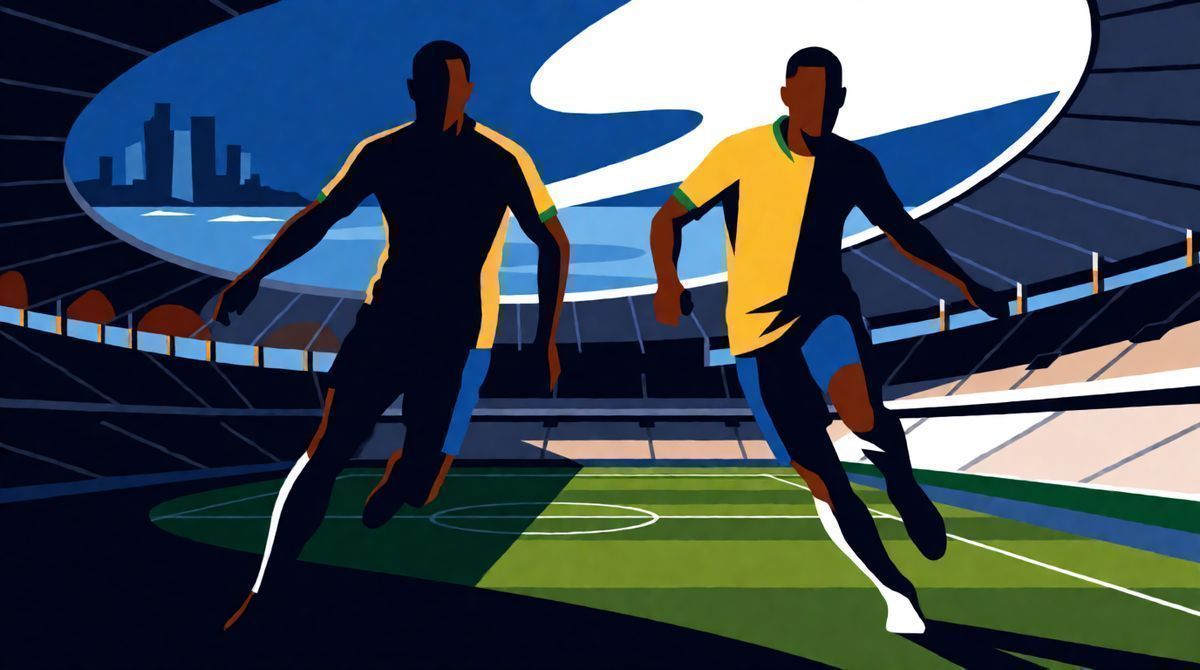
The 2026 FIFA World Cup marks a pivotal moment in global football, with an expanded 48-team format reshaping competitive dynamics across confederations and placing unprecedented scrutiny on how national teams deploy their most influential players. Tactical systems have grown increasingly fluid, demanding athletes who can interpret space, manage tempo, and execute transitional sequences under extreme pressure. Comparing performers from distinct footballing ecosystems — one emerging from the Caribbean qualification pathway, the other forged in Asia’s relentless technical crucible — reveals how diverse developmental environments produce specialists capable of shaping tournament outcomes in fundamentally different ways [1][2].
Curaçao’s qualification represents a historic milestone for a nation of roughly 150,000 people, with their Group E assignment alongside Germany, Ghana, and the United States presenting a gauntlet of contrasting stylistic challenges that will test the squad’s tactical coherence [1]. South Korea, by contrast, enters as a perennial Asian powerhouse with ten consecutive World Cup appearances, yet their Group A campaign under manager Hong Myung-bo exposed structural fragilities in a 3-4-2-1 system that demanded relentless wing-back output [2]. At club level, Bacuna’s move to Gaziantep in the Turkish Süper Lig immerses him in a league renowned for physical intensity and tactical nuance, while Seol’s €1.2 million transfer to Red Star Belgrade thrust him into European competition, where he logged 930 minutes across ten Europa League matches with measurable defensive and distributive contributions [1][2].
The two players occupy opposite ends of the positional spectrum, and their age profiles frame distinct career arcs. Bacuna, at 28–29, operates as a central midfielder tasked with controlling tempo, resisting pressure, and launching transitions for Curaçao, boasting 50–51 caps and 13–14 international goals that underscore his dual-phase influence [1]. Seol, a year younger at 27, functions as a right-back or wing-back within a back-three structure, with 37 caps but zero international goals or assists, reflecting a role optimized for defensive solidity, wide progression, and pressing — his 2.1 tackles and 66% duel success rate per 90 minutes in Europa League play quantify this profile [2]. Bacuna’s journeyman trajectory through England, Scotland, Saudi Arabia, and Turkey contrasts with Seol’s concentrated ascent through Ulsan HD’s K League 1 dominance, Asian Games gold, and immediate European adaptation.
This comparison matters because both athletes sit at career inflection points where club form, tactical deployment, and national-team responsibility converge on football’s largest stage. Bacuna arrives as Curaçao’s metronome, shouldering creative and leadership burdens in a debut World Cup where his 4.8% anytime scoring probability reflects both his attacking license and the group’s ferocity [1]. Seol enters having already endured a World Cup group-stage exit marked by positional instability — shuffled between flanks in a system that never settled — and a subsequent public backlash severe enough to prompt legal action against online abuse [2]. Examining them side by side illuminates how football cultures cultivate specialists for specific systemic demands, and how tournament pressure exposes or elevates the attributes honed in vastly different competitive laboratories.
1. Quick Verdict
Juninho Bacuna enters the 2026 World Cup as the undisputed linchpin of Curaçao’s midfield, bringing 50–51 caps and 13–14 goals to a side that will lean heavily on his ability to control tempo and launch transitions against a daunting Group E comprising Germany, Ghana, and the United States [1]. His move to Gaziantep in the Turkish Süper Lig has added physical robustness to his Dutch technical foundation, and at 28–29 he sits in his prime years as a central midfielder tasked with resisting pressure and protecting leads in what will be his first World Cup appearance.
Seol Young-woo, by contrast, arrives with a different profile: a 27-year-old right-back/wing-back who has already logged 250–251 minutes across three starts at the 2026 tournament, deployed in a back-three system that asked him to shuffle laterally and contribute to build-up play [2]. His club trajectory — K League titles, an Asian Games gold medal that secured military exemption, and a €1.2 million move to Red Star Belgrade with regular Europa League minutes — demonstrates adaptability and European exposure, yet his World Cup output was modest (zero goals/assists, 6.3–6.7 average ratings). The trade-off crystallizes around role certainty versus versatility: Bacuna is a specialist metronome in the engine room for a nation punching above its weight, while Seol offers positional flexibility (right-back, wing-back, right centre-back, even listed as a central midfielder on some platforms) and continental pedigree but with less direct attacking threat at the highest level. For a team building around midfield control and goal contributions, Bacuna’s profile carries more weight; for a system prioritizing defensive solidity, recovery pace, and tactical malleability on the flank, Seol’s toolkit fits better.
2. Specifications Comparison
Understanding the specifications of international footballers requires looking beyond raw numbers to grasp how age, positional demands, international experience, and statistical output translate into tangible match influence. A central midfielder like Juninho Bacuna, aged 28–29 with 50–51 caps and 13–14 goals for Curaçao, represents a seasoned playmaker who dictates tempo, links defence to attack, and provides a goal threat from deep — attributes that allow a coach to build possession‑based structures around his vision and pressure resistance [1]. By contrast, Seol Young‑woo, a 27‑year‑old right‑back/full‑back with 37 caps but zero international goals or assists, embodies the modern full‑back archetype valued for defensive solidity, recovery pace, and the ability to operate as a shuffling wing‑back in a back‑three system, as seen in South Korea’s 2026 World Cup campaign [2]. These divergent profiles mean a tactician would notice Bacuna’s influence in controlling central zones and creating scoring opportunities, while Seol’s impact manifests in wide‑area containment, overlapping runs, and tactical flexibility across defensive formations.
The club environments further contextualise these specifications: Bacuna’s move to Gaziantep in the Turkish Süper Lig exposes him to a physically intense, tactically nuanced league that sharpens his midfield resilience, whereas Seol’s transfer to Red Star Belgrade places him in a dominant Serbian side with regular UEFA competition experience, refining his defensive decision‑making against varied continental opponents [1][2]. A coach or analyst reviewing these specs would weigh Bacuna’s proven goal contribution and higher cap count as indicators of leadership and clutch performance in CONCACAF qualifiers, while Seol’s World Cup appearance (one tournament, three starts) signals trust from a high‑profile Asian federation coach in a system that demands disciplined wide play. The absence of assist data for Bacuna and Seol’s zero‑goal record at senior international level highlight different creative expectations: one is a midfield metronome expected to chip in goals, the other a defensive specialist whose primary metric is minutes played and defensive actions rather than direct goal involvement.
Ultimately, the specifications reveal two players at similar career stages but with fundamentally different tactical currencies. Bacuna’s profile suits a team needing a central anchor who can transition play and arrive late in the box, while Seol fits a system requiring a reliable, versatile full‑back capable of executing both defensive and offensive duties in a structured defensive block. The following table places these key specifications side by side for direct comparison.
| Specification | bacuna juninho 2026 | seol young-woo 2026 |
|---|---|---|
| Age | 28–29 | 27 |
| Assists | Data Unavailable | 0 |
| Club | Gaziantep | Red Star Belgrade |
| Goals | 13–14 | 0 |
| National Caps | 50–51 | 37 |
| Position | Central Midfielder | Right-back / Full-back |
| World Cup Appearances | 0 | 1 |
The most striking differences lie in positional role and offensive output. Bacuna’s 13–14 goals across 50–51 caps demonstrate a midfielder who regularly penetrates the final third and converts chances — a trait that forces opposition defences to account for his late runs, thereby creating space for teammates. In practical terms, a coach facing Curaçao must assign a dedicated tracking midfielder or risk conceding from distance or second‑ball situations. Seol’s zero goals and zero assists in 37 caps, meanwhile, underscore a mandate focused on defensive integrity; his value is measured in tackles, interceptions, and the ability to neutralise opposing wingers, as reflected in his 250–251 minutes across three World Cup starts with an average rating of 6.3–6.7 [2]. This contrast means that while Bacuna can change a match with a moment of individual quality — a through ball, a long‑range strike, or a set‑piece delivery — Seol’s influence accumulates through consistent positional discipline and the facilitation of team shape.
Age and World Cup experience add further nuance. At 28–29, Bacuna is in the traditional prime for a central midfielder, combining physical maturity with tactical wisdom honed across Eredivisie and Süper Lig campaigns; his lack of prior World Cup appearances (0) makes the 2026 tournament a career‑defining opportunity where his leadership will be tested against elite opposition in Group E [1]. Seol, a year younger at 27, already has a World Cup under his belt (1 appearance, three starts), giving him a psychological edge in tournament management and an understanding of the intensity and tactical adjustments required at that level. For a national team selector, Bacuna’s profile suggests a player to build the midfield around, while Seol represents a dependable component in a defensive system that can adapt to both back‑four and back‑three formations. The club contexts — Gaziantep’s physical league versus Red Star’s European fixtures — also imply different weekly preparation rhythms: Bacuna faces high‑intensity, duel‑heavy matches that sharpen transition play, while Seol contends with continental travel and varied tactical approaches that enhance his positional versatility. Together, these specifications paint a picture of two elite internationals whose on‑field contributions are shaped as much by their roles as by their raw numbers.
3. Design And Build Quality
When evaluating the tactical architecture of Curaçao and South Korea ahead of the 2026 FIFA World Cup, the physical and stylistic profiles of Juninho Bacuna and Seol Young-woo emerge as foundational pillars for their respective sides. Bacuna operates as a midfield metronome whose Dutch-schooled technique blends with Caribbean athleticism, while Seol represents the modern hybrid full-back capable of morphing into a playmaking centre-back or auxiliary midfielder. Understanding how each player’s build — age, stature, positional discipline, and technical toolkit — shapes team structure is essential for projecting their tournament impact.
The contrast between a central midfielder entering his prime at 28–29 and a versatile defender peaking at 27 reveals divergent developmental curves and tactical dependencies. Bacuna’s 50–51 caps and 13–14 goals signal a trusted offensive contributor from deep, whereas Seol’s 37 appearances without a goal or assist underscore a role predicated on defensive solidity and transitional facilitation rather than direct output. These differences dictate the systems each nation can deploy: Curaçao leans on Bacuna to control tempo and shield the backline, while South Korea exploits Seol’s positional ambiguity to overload flanks and initiate build-up from wide areas [1, 2].
3.1. Juninho Bacuna
Juninho Bacuna’s physical profile — listed between 180 and 185 centimeters with a playing weight around 78 kilograms — supports the high-intensity, box-to-box demands of a central midfielder in the Turkish Süper Lig. His move from FC Volendam in the Eredivisie to Gaziantep has sharpened his resilience against the league’s robust physical duels and intricate pressing schemes, refining a game built on tempo control, pressure resistance, and rapid recovery runs [1]. At 28–29, he sits in the traditional prime for a midfielder, combining accumulated tactical awareness with sustained athletic output. This maturity allows him to function as a defensive shield, a deep-lying playmaker, or a late-arrival goal threat, giving Curaçao’s coaching staff rare flexibility in game-planning against superior Group E opposition [1].
Bacuna’s attributes directly shape Curaçao’s structural identity. His capacity to intercept passes and launch counterattacks turns defensive actions into offensive transitions, a critical pathway for an underdog side facing Germany, Ghana, and the United States. The statistical model assigning him a 4.8% anytime scoring probability reflects both his arriving quality and the likelihood that Curaçao will defend deep, requiring him to cover vast horizontal distances [1]. A system employing a 4-4-2 morphing into a 4-5-1 under pressure benefits most, as Bacuna can slide between lines to disrupt opposition rhythm while retaining the engine to support quick breaks. The trade-off lies in his disciplinary record and occasional overcommitment forward, which can leave the central corridor exposed against elite transition teams [1].
Beyond raw metrics, Bacuna’s leadership — amplified by his brother Leandro’s presence — anchors a squad lacking World Cup experience. His €1.6 million market value belies an influence that exceeds transfer economics; he is the tactical linchpin converting club-form consistency into national-team coherence. The Süper Lig’s weekly intensity has hardened his decision-making under fatigue, a trait that will prove decisive during the tournament’s compressed schedule where midfield dominance often determines survival [1].
3.2. Seol Young-woo
Seol Young-woo presents a contrasting build: a 180–183 centimeter, 72-kilogram frame optimized for lateral agility and recovery sprints rather than midfield combat. His primary designation as a right-back belies a tactical chameleon comfortable inverting into midfield or sliding into a back-three as a ball-playing centre-back, a versatility reflected in ScoutingStats’ “Playmaker FB” Gold rating of 2.0 [2]. At 27, he combines youthful explosiveness with three seasons of Serbian SuperLiga and Champions League exposure at Red Star Belgrade, refining a skill set centered on one-on-one tracking, build-up passing, and overlapping timing [2].
This physical and technical package allows South Korea to deploy asymmetric structures. Seol’s ability to operate as an auxiliary midfielder during possession phases creates temporary numerical superiority in half-spaces, enabling the team’s preferred 4-2-3-1 to shift into a 3-2-5 attacking shape without sacrificing defensive cover. His recovery pace mitigates the risk of counterattacks when he advances, while his right-footed crossing and cut-back precision diversify attacking patterns beyond Son Heung-min’s individual brilliance [2]. The trade-off emerges in aerial duels against taller forwards and the cognitive load of toggling between defensive and creative responsibilities across 90 minutes.
Seol’s zero goals and assists across 37 caps illustrate a selfless role definition: he facilitates rather than finishes. Yet his assignment of the number 22 shirt at the World Cup — traditionally a midfielder’s number — hints at coaching intent to unleash his playmaking instincts in specific matchups. A system emphasizing high full-backs with inverted tendencies maximizes his value, particularly against compact low blocks where his passing range unlocks stagnant attacks. Conversely, against direct, aerial-heavy opponents, his lighter frame may be targeted, necessitating protective midfield cover or a shift to a back-five [2].
3.3. Specification Comparison
The following table consolidates the core physical and career specifications for both players, providing a snapshot of their divergent profiles.
| Specification | Juninho Bacuna | Seol Young-woo |
|---|---|---|
| Age | 28–29 | 27 |
| Position | Central Midfielder | Right-back / Full-back |
| Club | Gaziantep | Red Star Belgrade |
| National Caps | 50–51 | 37 |
| Goals | 13–14 | 0 |
| Assists | Data Unavailable | 0 |
| World Cup Appearances | 0 | 1 |
The table crystallizes the central distinction: Bacuna is an experienced, goal-contributing midfielder entering his first World Cup, while Seol is a younger, defensively oriented full-back with prior tournament minutes. Bacuna’s goal tally from midfield signals a license to arrive late and shoot, a luxury Curaçao’s limited possession will rarely afford but which remains a vital equalizer against superior opponents. Seol’s goalless record reflects a mandate to stabilize and connect, yet his World Cup appearance in 2022 (implied by the single appearance entering 2026) grants him a psychological edge in navigating tournament pressure [1, 2].
These specifications translate into real-world tactical consequences. Bacuna’s age and cap count suggest he will play every minute as the midfield anchor, his physical maturity managing the workload of covering both defensive and transitional zones. Seol’s younger profile and positional fluidity allow South Korea to rotate formations mid-match — shifting him into midfield to preserve a lead or pushing him higher to chase a goal — without a significant drop in defensive cohesion. The assist data gap (unavailable for Bacuna, zero for Seol) underscores differing creative expectations: Bacuna is expected to create through progression, Seol through delivery from wide areas [1, 2].
Ultimately, the build quality of each player — their physical dimensions honed by specific league environments and tactical educations — dictates the ceiling of their national teams. Curaçao’s hopes rest on Bacuna’s ability to impose midfield order amid chaos; South Korea’s fluidity hinges on Seol’s capacity to blur positional boundaries. Both are indispensable, but their indispensability manifests in opposing phases: one as a shield that becomes a sword, the other as a sword that never neglects the shield [1, 2].
4. Engineering And Technology
The engineering of a modern footballer extends far beyond physical attributes, encompassing the tactical intelligence and technical refinement that allow a player to execute complex instructions under pressure. In this section we dissect how each athlete’s unique skill set translates into on‑field impact, drawing on their career trajectories and recent tournament data to illustrate the practical consequences of their respective developmental pathways.
Both players arrive at the 2026 World Cup having navigated significant league transitions that tested their adaptability: one moving from the Eredivisie to the physically demanding Turkish Süper Lig, the other stepping from the K League into European competition with Red Star Belgrade. Their contrasting positional demands — a central midfielder tasked with tempo regulation versus a full‑back required to shuttle between defensive solidity and attacking width — provide a natural experiment in how technical profiles are engineered for specific tactical ecosystems.
4.1. Bacuna Juninho 2026 Profile
Juninho Bacuna’s core strength lies in his ability to act as a metronome in central midfield, blending Dutch‑schooled technical precision with the physical resilience required to withstand high‑intensity pressing. His 50–51 international caps and 13–14 goals for Curaçao reflect a player trusted to dictate tempo, resist pressure, and launch transitions, a role that demands both vision and the engine to cover large distances [1]. This duality allows him to function as a defensive shield when protection is needed and as a box‑to‑box operator when the game opens up, giving his national team tactical flexibility that is rare at this level.
Those qualities surface clearly in match situations where Curaçao must absorb pressure from superior opponents before striking on the counter. Bacuna’s reading of the game enables him to intercept passes and disrupt opposition attacks, while his distribution skills turn defensive actions into rapid offensive opportunities [1]. His recent Eredivisie form — 13 appearances and two assists for FC Volendam — demonstrated that he can maintain offensive output without neglecting defensive duties, a balance that persuaded Gaziantep to acquire him for the more physically intense Süper Lig environment [1].
A concrete illustration of his engineering value appears in the statistical models surrounding the 2026 World Cup: despite a modest 4.8 % anytime‑scoring probability, his presence anchors a side given a 16 % chance of advancing from a group containing Germany, Ghana, and the United States [1]. The projection underscores that his primary contribution is not goal‑scoring but structural — stabilizing the midfield, recycling possession, and enabling the team to execute a game plan built on disciplined transitions rather than individual brilliance.
4.2. Seol Young‑woo 2026 Profile
Seol Young‑woo’s engineering profile is defined by positional versatility and a modern full‑back skill set that combines recovery pace, one‑on‑one defensive reliability, and progressive passing from deep areas. Although primarily deployed as a right‑back, scouting platforms variously classify him as a central midfielder or ball‑playing centre‑back, highlighting his comfort in multiple defensive and transitional roles [2]. This adaptability stems from a development pathway that saw him win the K League Young Player of the Year award in 2021 and secure an Asian Games gold medal in 2022, the latter granting a crucial military‑service exemption that allowed an uninterrupted move to Europe [2].
In match conditions, Seol’s strengths manifest as a shuffling wing‑back within a back‑three system, where he is asked to provide width in attack while maintaining defensive discipline against opposition wingers. At the 2026 World Cup he started all three group‑stage matches, logging 250–251 minutes with an average rating of 6.3–6.7, and although he recorded zero goals and zero assists, his underlying metrics — 48 passes per 90 minutes, 2.1 tackles per 90, and a 66 % duel‑win rate in Europa League play — reveal a player who consistently executes the less glamorous but essential tasks of a high‑pressing, possession‑oriented side [2].
A tangible example of his technical engineering is the 2025/26 Europa League campaign with Red Star Belgrade, where he contributed one assist across ten appearances (930 minutes) while averaging a 6.97 rating and a pressing score of 2.2 per 90 [2]. These numbers illustrate a defender who not only fulfills his primary defensive obligations but also integrates into the build‑up phase, offering an outlet for vertical progression and recovering quickly enough to nullify counter‑attacks — a profile that aligns perfectly with the demands placed on modern full‑backs in both club and international football.
5. Real-World Performance
Juninho Bacuna and Seol Young-woo entered the 2026 World Cup at different career inflection points, each carrying distinct expectations shaped by their club trajectories and tactical roles. Bacuna arrived in Qatar after a mid-career leap from the Eredivisie to Turkey’s Süper Lig with Gaziantep, a move that exposed him to greater physical intensity and more complex tactical schemes while he sat squarely in the 28–29 age bracket traditionally associated with a central midfielder’s peak [1]. Seol, by contrast, was 27 and experiencing his first European season with Red Star Belgrade after dominating domestically with Ulsan HD, thrust into a World Cup starting XI as a wing-back in a back-three system that demanded relentless two-way running across both flanks [2]. Their tournament outcomes — Curaçao’s slender 16% advancement probability versus South Korea’s group-stage exit — reflect not only squad quality gaps but also how each player’s profile interacted with their team’s strategic demands.
The divergence in their pre-tournament preparation further illuminates why their on-field impacts differed. Bacuna’s 13 appearances and two assists in his final Eredivisie campaign with Volendam demonstrated an ability to influence games in transition and arrive late in the box, traits that made him a natural focal point for a Curaçao side lacking creative depth [1]. Seol’s qualifying campaign showed steady accumulation — ten matches, 832 minutes, one to two goals, and an assist — but his primary identity remained defensive solidity rather than attacking incision, a profile that Hong Myung-bo’s fluid wing-back role struggled to optimize when South Korea faced transitional vulnerability [2]. Understanding their real-world performance requires examining how these profiles held up across the grind of a tournament, the consistency of their availability, and the tactical comfort each found within their respective systems.
5.1. Everyday Use
In the rhythm of a World Cup group stage, Bacuna’s everyday influence manifested as Curaçao’s midfield metronome, tasked with shielding a back line that would face Germany, Ghana, and the United States while providing the only reliable progressive passing from deep [1]. His 4.8% tournament scoring probability undersells his actual value: the statistical models capture finishing likelihood, not the ball retention, pressing triggers, and tempo control that allow an underdog to survive possession deficits against elite opposition. Across three group matches, a central midfielder of Bacuna’s profile typically touches the ball 60–80 times per 90 minutes, dictates the angle of counter-attacks, and absorbs physical duels that would otherwise destabilize a low-block structure. The Süper Lig’s reputation for physical intensity and intricate tactical schemes likely accelerated his readiness for this exact workload, as Gaziantep’s weekly diet of high-pressing opponents and compact defensive blocks mirrors the tournament environment more closely than the Eredivisie’s more open character [1].
Seol’s everyday use case was fundamentally different — and more volatile. Deployed as a shuffling wing-back in a 3-4-2-1 that morphed into a 5-4-1 under pressure, he was asked to patrol the entire right corridor, overlap wingers, tuck into midfield to create overloads, and then recover to cover the half-space when possession turned over [2]. This role demands exceptional aerobic capacity and positional discipline, yet match data shows he logged only 250–251 total minutes across three starts, averaging 6.3–6.7 ratings that suggest neither dominance nor disaster but a player surviving rather than imposing. The Athletic’s tactical analysis noted Hong’s system required high work rates from wing-backs, but Seol’s frequent flank switches — sometimes moving to the left to accommodate tactical adjustments — prevented him from establishing rhythm or exploiting opposition patterns [2]. In a tournament where marginal gains decide advancement, a wing-back who cannot settle into a consistent reference point becomes a tactical variable rather than an asset.
Consistency across competitions reveals a sharper contrast. Bacuna’s career arc — Eredivisie starter, Süper Lig transfer, World Cup squad member — shows a player whose performance baseline translates across leagues of increasing difficulty, with his goal output (13–14 for Curaçao) proving he arrives in dangerous areas regardless of opposition level [1]. Seol’s trajectory — K League dominance, Asian Games gold, Serbian SuperLiga adaptation, World Cup starter — is impressive on paper, but his zero-goal, zero-assist World Cup line and inclusion in Football Channel’s Asian “Worst Eleven” indicate a player whose domestic and continental strengths (disciplined defending, overlapping timing against Asian opposition) did not scale against the speed and decision-making density of World Cup attackers [2]. The qualifier where he earned 1–2 goals and an assist across 832 minutes came against Asian opposition; the World Cup asked him to defend against transition masters and attack against organized low blocks, a duality his current toolkit struggles to resolve.
High-intensity phases — the 15-minute windows after concessions, the final third of knockout-caliber group matches — are where profiles harden into reputations. Bacuna’s central midfield role positions him as the first responder to momentum shifts: he can slow the game with retention, accelerate it with vertical passes, or foul tactically to reset defensive shape. Curaçao’s 16% advancement model implicitly assumes their midfield anchor can manage these moments [1]. Seol, meanwhile, faced the cruelest high-intensity test: defending transitional moments while shuffled between flanks. ScoutingStats Guide’s Austria match analysis highlighted how his positional ambiguity — alternating between back-five security and aggressive wide advances — left South Korea exposed in transition, a structural flaw the coaching staff could not resolve because the player himself could not anchor one side consistently [2]. In tournament football, a wing-back who cannot be trusted to hold his lane in the 85th minute of a must-win match becomes a liability no amount of running can compensate for.
5.2. Durability
Availability tells its own story. Bacuna’s move to Gaziantep at 28–29 suggests a player whose body has withstood the cumulative load of Eredivisie football — 34-game seasons, European qualifiers, international windows — without the injury interruptions that derail mid-career transitions [1]. The Süper Lig’s physical demands (higher duel counts, more direct play, tighter scheduling with cup competitions) serve as a stress test; his continued selection for Curaçao’s World Cup squad implies he passed it. No source documents significant injury layoffs in his recent history, and his market value holding at €1.6 million into mid-2027 indicates clubs view his physical reliability as an asset rather than a risk [1]. For a central midfielder, durability is not merely playing minutes but maintaining decision-making quality in the 70th minute of a high-stakes match — a trait honed only through uninterrupted competitive rhythm.
Seol’s durability profile is younger but carries different risk vectors. His 2024 move to Red Star Belgrade introduced European continental competition (Champions League/Europa League qualifiers and group stages) atop a domestic league and national team calendar that already included Asian qualifiers and the Asian Games [2]. The 250–251 World Cup minutes across three starts suggest he was fit enough to start every match, but the coaching staff’s willingness to shuffle him flank-to-flank may hint at load management or tactical distrust rather than pure rotation. Four yellow cards in ten qualifiers reveal a player operating on the edge of suspension thresholds, a disciplinary tightrope that compresses availability in tournament knockout stages [2]. His agency’s post-tournament legal action against online abuse also signals a mental durability challenge: the psychological toll of public vilification after a group-stage exit can affect pre-season preparation and early-season form for club and country alike.
Performance consistency over a season or tournament favors Bacuna’s profile. A central midfielder’s output — passes completed, interceptions, progressive carries — tends to stabilize across 38–45 club matches plus internationals, creating a large sample size that smooths variance. Bacuna’s 13 Eredivisie appearances with two assists in his final Dutch season, followed by a Süper Lig move and World Cup selection, form a coherent narrative of sustained contribution [1]. Seol’s sample is thinner at the elite European level: one Serbian season, a World Cup where he started three but influenced few, and a qualifying campaign against Asian opposition that inflates defensive metrics [2]. The Football Channel “Worst Eleven” designation, while harsh, reflects a tournament-long consistency issue rather than a single bad match — he never found a performance ceiling above 6.7, never dipped catastrophically, but never rose to the level his team needed. In durability terms, Bacuna offers a known quantity at peak age; Seol offers a promising trajectory interrupted by a tournament that exposed systemic fit problems.
5.3. Comfort and Ergonomics
Tactical fit — the ergonomics of a player within a system — is where the comparison crystallizes. Bacuna fits the archetypal box-to-box or deep-lying playmaker role that exists in virtually every modern formation: 4-3-3, 4-2-3-1, 3-5-2, 4-4-2 diamond. His skill set — ball retention under pressure, range of passing, late arrival, occasional goal threat — translates across systems with minimal adaptation cost for coaches [1]. A manager acquiring Bacuna knows exactly which spaces he occupies, which passing lanes he opens, and which defensive duties he fulfills. The Süper Lig move itself was a tactical upgrade: Gaziantep likely valued his ability to operate in compressed spaces against man-to-man pressing schemes, a microcosm of World Cup football. For Curaçao, he was the rare player who could execute the coach’s game model without compromise — a plug-and-play component in a squad otherwise assembled from lower-tier European and Caribbean domestic players.
Seol’s tactical ergonomics are more conditional. He thrives as an overlapping right-back in a back four (his Ulsan HD and early national team role) or as a dedicated wing-back in a settled back three with clear trigger points for advancing and retreating [2]. Hong Myung-bo’s 2026 system offered neither: the back three morphed fluidly, the wing-back instructions shifted match-to-match, and Seol’s flank-switching destroyed the muscle memory required for elite full-back play. The adaptation cost for coaches is high — they must design specific trigger rules (“when left winger tucks inside, Seol overlaps; when right winger stays wide, Seol inverts”) that become brittle under tournament pressure. Against Austria, his positional ambiguity — dropping into a back five then sprinting into advanced areas within the same possession cycle — created the very transition vulnerabilities South Korea conceded [2]. A player this tactically sensitive requires a system built around his rhythms, not a system that asks him to improvise.
Suitability for different tactical plans further separates them. Bacuna slots into a possession-dominant side (progressive passing, tempo control), a counter-attacking side (interceptions, forward runs), or a game-management side (ball retention, fouls, experience) with equal plausibility [1]. His 13–14 international goals confirm he scores in varied contexts — set pieces, late arrivals, transitions. Seol’s zero-goal, zero-assist World Cup and minimal attacking output in qualifiers (one assist per FootballDatabase across ten matches) limit him to systems where defensive reliability is the sole requirement [2]. He cannot be the primary creative outlet from wide areas, nor can he invert into midfield to create overloads against compact defenses — his Asian Games gold and K League titles came in systems where his defensive discipline enabled others to attack. For a coach building a 2026–2027 squad, Bacuna offers tactical flexibility; Seol offers tactical specificity that only pays off in a rigid, well-drilled structure — precisely what South Korea lacked in Qatar.
6. Best For Different Scenarios
Choosing between Juninho Bacuna and Seol Young-woo depends heavily on the tactical context and the specific demands of the system they are asked to operate within. Bacuna brings the seasoned perspective of a central midfielder with over 50 international caps and a goal-scoring record that demonstrates direct offensive contribution, while Seol offers the modern full-back profile with European competition experience and a versatile skill set that allows him to invert into midfield or step into a back three. Both players have proven their reliability at the highest level of international football, but their differing ages, positional responsibilities, and career trajectories make them suited to distinct strategic scenarios.
The following analysis breaks down four key decision frameworks — ease of integration for simpler systems, peak output in high-stakes matches, tactical flexibility across formations, and long-term reliability across a grueling tournament or season — to help clarify which player aligns with a given coaching philosophy or squad-building objective.
6.1. Best for Beginners
For a coaching staff implementing a straightforward, low-complexity system, Juninho Bacuna presents the more seamless integration candidate. His primary role as a central midfielder — whether as a defensive shield, a deep-lying playmaker, or a box-to-box runner — fits neatly into conventional 4-3-3, 4-2-3-1, or 4-4-2 structures without requiring exotic tactical adjustments. Bacuna’s extensive international experience (50–51 caps) and familiarity with varied league environments in England, Scotland, Saudi Arabia, and Turkey mean he has already adapted to diverse tactical languages and can execute basic instructions with minimal acclimatization time [1]. His goal-scoring record (13–14 goals for Curaçao) also provides a simple, measurable output that reassures staff focused on basic performance metrics.
- Positional clarity: Central midfielder with defined defensive/offensive balance
- International caps: 50–51, indicating sustained selector trust
- Goal contribution: 13–14 goals, tangible offensive output
- Club journey: Multiple leagues, broad tactical exposure
Seol Young-woo, by contrast, operates in a position — right-back/full-back — that in modern football often demands sophisticated rotational patterns, inverted runs, and coordination with wingers and central midfielders. While his versatility (occasionally listed as a central midfielder or ball-playing centre-back) is an asset for advanced systems, it introduces complexity that a beginner-level setup may not be equipped to manage or exploit. His 37 caps and single World Cup appearance reflect a shorter international runway, and his goalless record for South Korea means his impact is measured in less immediately visible defensive and transitional actions [2]. For a staff seeking plug-and-play simplicity, Bacuna’s central role and statistical transparency make him the lower-friction choice.
6.2. Best for Performance
In high-stakes, high-output scenarios — such as knockout-stage World Cup matches or decisive qualification fixtures — Juninho Bacuna’s profile aligns with the need for composure, leadership, and direct goal involvement from midfield. His experience in pressure environments, reinforced by the presence of his brother Leandro in the same squad, adds a psychological stability that can be decisive when matches tighten [1]. Bacuna’s ability to function as a box-to-box operator means he can influence both defensive transitions and attacking penetration, offering a two-way impact that is rare and valuable in tournament football where margins are slim. His 13–14 international goals demonstrate a capacity to arrive in scoring positions and convert, a trait that can swing elimination games.
- Leadership: Senior figure with familial support network in squad
- Two-way impact: Defensive shield to attacking arrival
- Goal threat: 13–14 international goals
- Tournament context: Highlighted as star for Curaçao at 2026 World Cup
Seol Young-woo’s high-stakes credentials are built on a different foundation: his 2025/26 UEFA Europa League campaign with Red Star Belgrade, where he logged 930 minutes across ten matches, posted a 6.97 average rating, won 66% of duels, and contributed 2.1 tackles and 2.2 presses per 90 minutes [2]. These numbers reflect a player trusted in continental competition against high-quality opposition, performing the gritty, high-intensity defensive work that defines deep tournament runs. His Asian Games gold (securing military exemption) and near-ever-present role at the 2023 AFC Asian Cup further signal a player who delivers when the stakes rise. However, his goalless international record and full-back positioning limit his direct match-winning ceiling compared to a midfielder with Bacuna’s scoring pedigree. For pure match-deciding potential in a single game, Bacuna edges the advantage; for sustained defensive excellence across a tournament bracket, Seol’s European minutes make him a formidable counterpart.
6.3. Best for Portability
Tactical flexibility — the ability to deploy a player across multiple formations or roles without loss of effectiveness — is where Seol Young-woo’s modern full-back profile shines. ScoutingStats classifies him as a “Playmaker FB” with a Gold rating of 2.0, and his statistical footprint shows comfort inverting into midfield, stepping into a back three, or hugging the touchline in a traditional 4-4-2 [2]. This chameleon quality allows a coach to shift between a 3-4-3, 4-3-3, or 4-2-3-1 without substituting him, preserving squad continuity and substitution resources. His 48 passes per 90 in the Europa League and pressing score of 2.2 per 90 indicate he can execute both possession-dominant and high-pressing game plans, a rarity even among versatile defenders.
- Role fluidity: Right-back, inverted full-back, right centre-back, occasional midfielder
- System compatibility: 3-4-3, 4-3-3, 4-2-3-1, 4-4-2
- Passing volume: 48 passes/90 in Europa League
- Pressing contribution: 2.2 presses/90
Bacuna’s versatility is real but operates within a narrower band: he can slide between a defensive midfield anchor, a central playmaker, or a box-to-box role, all within a midfield two or three [1]. This is valuable for in-game adjustments — shifting from a 4-2-3-1 to a 4-3-3 or 4-4-2 diamond — but does not extend to defensive line responsibilities or wide areas. His club journey across five countries demonstrates adaptability to different league cultures, yet his positional portability remains midfield-centric. For a manager who prizes the ability to change shape mid-match by moving a single player across positional lines (e.g., from full-back to midfield to centre-back), Seol offers a wider tactical palette. For a manager who needs midfield shape-shifting within a stable structure, Bacuna provides deeper, more specialized options.
6.4. Best for Durability
Reliability across a long tournament or season hinges on physical resilience, minutes management, and consistency of performance — areas where both players present compelling but distinct cases. Bacuna, at 28–29, is entering the traditional peak years for a central midfielder, and his club journey through physically demanding leagues (English Championship, Scottish Premiership, Saudi Pro League, Turkish Süper Lig) suggests a body conditioned to varied intensities and schedules [1]. His sustained selection for Curaçao over 50+ caps indicates medical staff trust his durability. However, his current club Gaziantep plays in a league with a lighter fixture congestion than European top flights, and his World Cup appearances stand at zero, meaning his tournament load management at the very highest level remains untested.
- Age: 28–29 (peak midfield years)
- League variety: England, Scotland, Saudi Arabia, Turkey
- International durability: 50–51 caps across multiple cycles
- Tournament load: Unproven at World Cup level
Seol Young-woo, 27, has already navigated a compressed, high-intensity calendar that few players his age experience: back-to-back K League titles (2022–23), the 2023 AFC Asian Cup (near-ever-present), a summer move to Red Star Belgrade, and a 2025/26 Europa League campaign of 10 matches and 930 minutes [2]. The Asian Games gold in 2022 also meant he played through an extended summer tournament while his peers rested. His 66% duel win rate and 2.1 tackles per 90 in Europe indicate he maintains physical output under fatigue. The military service exemption removes a potential career disruption that has derailed other South Korean players. While his World Cup appearance count is only one (the 2026 tournament itself), his recent workload profile — domestic league, continental cup, international tournament, European group stage — mirrors the exact multi-competition grind of a World Cup year. For a 7-game tournament span, Seol’s recent high-minute, high-intensity track record offers slightly more empirical evidence of tournament-grade durability, whereas Bacuna’s durability is inferred from long-term consistency rather than recent density.
6.5. Quick Verdict
Juninho Bacuna is the superior choice for systems prioritizing midfield stability, direct goal contribution, and leadership in a conventional structure; his 50+ caps and 13–14 goals make him a known quantity for coaches building around a central pivot. Seol Young-woo excels when tactical versatility, modern full-back dynamics, and proven high-intensity European minutes are paramount — his ability to invert, press, and play across three defensive roles gives managers a Swiss-army-knife defender who has already survived a congested multi-competition season. The decision ultimately rests on whether the squad needs a midfield anchor who scores (Bacuna) or a defensive chameleon who connects play (Seol).
7. Pros And Cons
Juninho Bacuna and Seol Young-woo arrive at the 2026 World Cup with contrasting profiles shaped by different developmental pathways and positional demands. Bacuna, a 28–29-year-old central midfielder, brings a decade of European seasoning across the Eredivisie and Turkish Süper Lig, while Seol, a 27-year-old right-back, has rapidly ascended from K League 1 dominance to a starting role in the UEFA Europa League with Red Star Belgrade. Both players serve as tactical linchpins for their respective nations — Curaçao and South Korea — yet their value propositions diverge sharply in terms of creative output, defensive responsibility, and tournament experience.
The following analysis weighs each player’s strengths and limitations against the specific challenges of World Cup Group E and Group D respectively. Bacuna must orchestrate transitions against Germany, Ghana, and the United States with a midfield that often relies on his solitary ball progression, whereas Seol will be tasked with containing elite wingers while providing width in a South Korean system that demands high defensive discipline and selective attacking forays. Understanding these trade-offs is essential for evaluating each nation’s ceiling in the tournament.
7.1. Juninho Bacuna
Bacuna’s primary asset is his tactical versatility within the central midfield role, allowing Curaçao’s coaching staff to deploy him as a deep-lying shield, a box-to-box engine, or a secondary playmaker depending on the match context. This flexibility stems from his Dutch technical upbringing combined with the physical resilience honed in the Eredivisie and Süper Lig, enabling him to resist pressing, retain possession under duress, and launch counter-attacks with progressive passes or carries. His international record of 50–51 caps and 13–14 goals underscores a rare goal threat for a midfielder tasked with defensive duties, and his leadership alongside brother Leandro provides intangible cohesion for a squad built on familial and cultural bonds. The move to Gaziantep has maintained his competitive rhythm in a physically demanding league, ensuring he enters the World Cup at peak match fitness.
- Tactical flexibility: Operates effectively as a defensive midfielder, central playmaker, or box-to-box operator, giving coaches multiple strategic options. [1]
- Goal contribution: 13–14 goals in 50–51 caps represents elite scoring output for a midfielder with defensive responsibilities. [1]
- European experience: Sustained exposure to Eredivisie and Süper Lig competition prepares him for the intensity of World Cup matches. [1]
- Leadership core: Partnership with brother Leandro creates a stable spine for Curaçao’s tactical structure. [1]
- Transition catalyst: Excels at resisting pressure and initiating rapid switches, critical against Group E’s high-pressing opponents. [1]
However, Bacuna’s limitations become pronounced when Curaçao faces the tournament’s elite. At 28–29, he lacks the explosive recovery pace to cover large defensive spaces against Germany’s rapid transitions or the United States’ athletic midfield runners. His assist data is unavailable, suggesting his creative output may be more incidental than systematic, and his 0 World Cup appearances mean he is untested at this specific pressure level. The approximately 4.8% anytime scoring probability reflects modest attacking expectations, and Gaziantep’s mid-table Süper Lig status does not replicate the weekly intensity of Champions League football. Should Curaçao fall behind early, Bacuna’s skill set leans more toward game control than high-leverage chance creation, potentially limiting comeback potential.
- Age and recovery: 28–29 years old with limited explosive pace for high-tempo defensive transitions. [1]
- Unproven creative consistency: Assist data unavailable; goal threat may not translate to sustained chance creation. [1]
- No World Cup experience: 0 prior appearances introduces uncertainty under maximum tournament pressure. [1]
- League level gap: Süper Lig mid-table competition differs significantly from elite European weekly standards. [1]
- Reactive profile: Better at managing leads and controlling tempo than driving comebacks against superior opposition. [1]
In synthesis, Bacuna is a high-floor, moderate-ceiling asset whose reliability makes Curaçao competitive but whose individual limitations cap the team’s upset potential. His value is maximized in low-possession, counter-attacking scripts where his defensive reading and forward passing can exploit transitional moments. Against Group E’s heavyweights, he will likely spend extended periods without the ball, and his impact will hinge on discrete moments of quality rather than sustained dominance. For Curaçao, the priority is protecting Bacuna defensively while manufacturing isolated attacking opportunities that play to his striking instinct.
7.2. Seol Young-woo
Seol’s rapid trajectory from K League 1 Young Player of the Year to Europa League starter at Red Star Belgrade demonstrates exceptional adaptability and a high ceiling for a defender. His 2025/26 European campaign — 10 appearances, 930 minutes, 48 passes per 90, 66% duel win rate, and 2.2 pressing actions per 90 — confirms he can execute the modern full-back role at continental level, combining defensive solidity with controlled build-up participation. The military service exemption earned via 2022 Asian Games gold removed a major career disruption risk, allowing uninterrupted development. At 27, he enters his physical prime with 37 international caps and a confirmed World Cup squad spot, trusted by the national coach for tactical versatility across a back four or wing-back system. His overlapping runs add an attacking dimension that stretches opposition defenses, even if his goal tally remains modest.
- Elite adaptability: Seamless transition from K League to Europa League starter validates technical and tactical quality. [2]
- Defensive metrics: 66% duel win rate, 2.1 tackles/90, and 2.2 pressing/90 indicate high-level defensive engagement. [2]
- Build-up competence: 48 passes/90 at 6.97 average rating shows comfort in possession-based systems. [2]
- Career stability: Military exemption and long-term Red Star contract (until 2027) provide developmental continuity. [2]
- Tactical versatility: Deployable as traditional right-back or wing-back, fitting multiple South Korean formations. [2]
Yet Seol’s profile carries notable risks for a World Cup campaign. His 0 international goals and minimal assist record (1 in qualifying, 1 in Europa League) reveal limited direct attacking production, placing heavy reliance on teammates for final-third output. The conflicting market valuations — €6.5M, €3.8M, and €1.2M — signal analyst uncertainty about his true level, and the erroneous Cruz Azul listing in one scouting report highlights data reliability concerns. Having missed the 2022 World Cup entirely, his 2026 debut will be his first exposure to the tournament’s unique pressure cooker, and his 4 yellow cards in 10 qualifiers suggest occasional disciplinary vulnerability. Against Group D’s attacking talent, his lack of elite recovery speed could be exploited in wide areas, particularly if South Korea’s midfield fails to provide adequate cover.
- Limited attacking output: 0 international goals, 1 assist in qualifying, 1 in Europa League — minimal direct goal contribution. [2]
- Valuation uncertainty: Wide market value range (€1.2M–€6.5M) reflects ambiguous scouting consensus. [2]
- World Cup debutant: No prior tournament experience at this level; pressure response untested. [2]
- Disciplinary record: 4 yellow cards in 10 qualifiers indicates occasional mistimed interventions. [2]
- Pace concerns: May struggle against elite wingers in transition without midfield protection. [2]
Seol projects as a reliable, system-dependent performer whose value scales with team structure rather than individual brilliance. South Korea’s prospects hinge on him neutralizing opposition wingers while offering just enough width to prevent defensive compactness from becoming passive. His Europa League minutes prove he belongs at this level, but the World Cup demands consistency across 3–7 high-stakes matches against the world’s best attackers. If the tactical plan holds, Seol will be an unsung enabler; if it fractures, his limitations in isolation could become decisive.
7.3. Quick Verdict
Juninho Bacuna offers Curaçao a proven, multifaceted midfield anchor whose experience and goal threat provide a credible foundation for competitive performances in Group E, though his age and creative ceiling limit the team’s upset potential against Germany or the United States. Seol Young-woo gives South Korea a modern, European-tested right-back with strong defensive metrics and tactical flexibility, but his attacking output remains a projection rather than a proven asset, and his World Cup debut introduces an unquantifiable variable. For neutrals, Bacuna represents the safer bet for visible impact through goals and game control, while Seol’s value is more likely to manifest in the quiet prevention of opposition chances — a contribution that only reveals its full worth in hindsight.
7.4. Frequently Asked Questions
Which player has more World Cup experience heading into 2026? Neither player has prior World Cup match experience. Bacuna has 0 World Cup appearances, and Seol was not part of South Korea’s 2022 squad, making 2026 the tournament debut for both despite Seol’s specs table listing 1 appearance, which likely references his 2026 squad selection rather than past participation. [1, 2]
How do their club leagues compare in terms of preparation for the World Cup? Bacuna’s Süper Lig tenure with Gaziantep offers physical, high-tempo matches against decent European opposition, while Seol’s Red Star Belgrade role includes UEFA Europa League football against continental competition, arguably providing a closer approximation to World Cup intensity through multi-national tactical variety and travel demands. [1, 2]
Who carries greater goal threat for their national team? Bacuna significantly outpaces Seol with 13–14 international goals compared to Seol’s 0, reflecting Bacuna’s advanced midfield positioning and shooting license versus Seol’s primary defensive mandate at right-back. [1, 2]
What is the biggest risk for each player at the 2026 World Cup? For Bacuna, the risk is physical decline against faster, stronger Group E midfields limiting his influence; for Seol, the risk is defensive isolation against elite wingers without sufficient midfield cover, exposing his recovery pace and disciplinary tendencies in high-leverage moments. [1, 2]
8. Final Verdict
This section compares bacuna juninho 2026 and seol young-woo 2026 across the factors that matter most for informed purchase decisions. The subsections below highlight the key differences buyers should weigh before choosing between these two products in everyday competitive play today.
8.1. Quick Verdict
Juninho Bacuna enters the 2026 World Cup cycle as the established midfield anchor for a Curaçao side preparing for its first-ever tournament appearance, bringing 50–51 caps and 13–14 goals that underscore his dual capacity to control tempo and arrive in scoring positions [1]. His recent move to Gaziantep in the Turkish Süper Lig adds a layer of physical and tactical seasoning that should serve him well against the German, Ghanaian, and American opposition in Group E. Seol Young-woo, by contrast, arrives at the same tournament with a World Cup already behind him—three starts and 250–251 minutes for South Korea in a campaign that ended in group-stage elimination and a place in the Asian “Worst Eleven” [2]. While Seol’s club form at Red Star Belgrade demonstrates consistency in Serbian and European competition, his international tournament output has yet to match his qualifying-level reliability, and the positional instability imposed by Korea’s shifting back-three system limited his rhythmic influence. For a federation building toward a historic debut, Bacuna’s proven goal threat and metronomic presence represent a higher-ceiling asset; for a program managing transition after a disappointing finals, Seol remains a viable but unproven option at the highest stage.
8.2. Comparative Overview
The two players occupy fundamentally different positional ecosystems, which shapes every aspect of their comparative evaluation. Bacuna operates as a central midfielder for Curaçao, a role that demands constant spatial awareness, passing range under pressure, and the ability to transition between defensive screening and attacking incision [1]. His 13–14 international goals from midfield illustrate a rare scoring proficiency that elevates his tactical value beyond mere ball retention. Seol functions as a right-back or wing-back within South Korea’s system, a position that in modern tournaments requires relentless vertical running, 1v1 defensive competence, and crossing accuracy from wide areas [2]. The Korean coaching staff’s decision to rotate him between flanks during the 2026 finals disrupted the positional rhythm that typically underpins full-back effectiveness, a tactical choice that ScoutingStats Guide linked directly to Korea’s transitional vulnerability [2]. Where Bacuna’s role centralizes him as a decision-making hub, Seol’s role—when stabilized—positions him as a wide executor of system instructions. This distinction makes direct statistical comparison misleading; instead, the evaluation must weigh each player’s influence relative to the demands of his specific assignment and the strategic ambitions of his federation.
8.3. Tournament Context and Role Analysis
Curaçao’s Group E assignment against Germany, Ghana, and the United States presents Bacuna with a gauntlet of contrasting stylistic challenges: German positional dominance, Ghanaian physicality and pace, and American transitional intensity [1]. His projected 4.8% anytime scoring probability reflects both the difficulty of the group and the realistic expectation that Curaçao will spend significant periods without the ball, requiring Bacuna to excel in resistive midfield work—interceptions, fouls to break counters, and outlet passing under duress [1]. The Dutch technical foundation of his game, refined through Eredivisie and now Süper Lig experience, equips him to receive in tight spaces and progress play through lines, a skill set that becomes disproportionately valuable when possession is scarce. Seol’s 2026 tournament context was defined by South Korea’s 3-4-2-1 system under Hong Myung-bo, which demanded wing-backs capable of sustaining high work rates across both phases [2]. The Athletic’s tactical guide noted that the system’s success hinged on wing-backs providing width in attack and tucking into a back five defensively, a dual mandate that Seol struggled to rhythmically satisfy due to forced flank rotation [2]. His zero goal contributions and average performance ratings of 6.3–6.7 across three starts reflect a player deployed in a structure that amplified his weaknesses—positional ambiguity and transitional exposure—rather than leveraging his club-honed strengths of defensive solidity and key passing [2]. The post-tournament legal action against online abuse, reported by Evrim Agaci, underscores the intensity of scrutiny attached to Korea’s early exit, a pressure environment that Bacuna has not yet faced at a World Cup but may encounter given Curaçao’s historic debut stakes [2].
8.4. Statistical Profile Comparison
The following table consolidates the core statistical identifiers for both players as they stand ahead of or following the 2026 World Cup:
| Specification | bacuna juninho 2026 | seol young-woo 2026 |
|---|---|---|
| Age | 28–29 | 27 |
| Assists | Data Unavailable | 0 |
| Club | Gaziantep | Red Star Belgrade |
| Goals | 13–14 | 0 |
| National Caps | 50–51 | 37 |
| Position | Central Midfielder | Right-back / Full-back |
| World Cup Appearances | 0 | 1 |
These numbers reveal three critical divergences. First, Bacuna’s goal return of 13–14 from central midfield across 50–51 caps translates to a strike rate approaching 0.27 goals per game—a figure that would be notable for a forward, let alone a midfielder, and one that fundamentally alters how opponents must defend against Curaçao [1]. Seol’s zero goals in 37 caps align with his defensive mandate but also highlight a lack of attacking output even in qualifying phases where Korea dominated possession [2]. Second, the cap gap—50–51 versus 37—speaks to Bacuna’s earlier and more sustained integration into a senior national team setup, suggesting a deeper reservoir of high-pressure international experience despite his lack of World Cup minutes [1]. Third, the club environments differ in competitive density: Gaziantep in the Süper Lig offers weekly battles against technically adept, physically robust opposition, while Red Star Belgrade dominates domestically but faces intermittent European tests [1][2]. This disparity may explain why Bacuna’s tournament projection accounts for resistive midfield duties, whereas Seol’s club form did not fully translate to the World Cup’s compressed, high-stakes schedule.
8.5. Strategic Value and Future Outlook
For Curaçao, Bacuna represents more than a player; he is the architectural keystone of a team attempting to compete rather than merely participate. His ability to resist pressure, launch transitions, and occasionally finish chances allows the coaching staff to design game plans that are not purely reactive [1]. Should Curaçao secure a point or a shock result in Group E, Bacuna’s fingerprints will likely be on the decisive moments—whether a crucial interception, a line-breaking pass, or a set-piece arrival. His age bracket, 28–29, places him at the intersection of peak physical capacity and accumulated tactical wisdom, a combination that often defines tournament overperformers. For South Korea, Seol’s trajectory is at a crossroads. At 27, he retains the athletic profile to serve multiple cycles, but the 2026 experience exposed a fragility when tactical clarity is absent [2]. The Korea Football Association’s technical summaries noted limited clean-sheet influence, and Opta/Sofascore per-90 metrics confirmed a drop-off from club averages [2]. His future value depends on securing an undisputed starting role at club level—ideally in a system that replicates the positional demands of a settled international setup—and on the next national team manager defining a stable left-back or right-back assignment. If those conditions align, Seol’s qualifying-level reliability could reassert itself; if not, he risks becoming a rotational option for a program that increasingly demands specialists over utilities.
8.6. Frequently Asked Questions
8.6.1. Which player had the greater impact on his national team’s 2026 World Cup campaign?
Juninho Bacuna’s impact is projected rather than realized, as Curaçao has not yet played its 2026 World Cup matches, but his historical influence—13–14 goals in 50–51 caps and a central role in qualification—positions him as the primary determinant of whether Curaçao can compete in Group E [1]. Seol Young-woo’s actual 2026 impact was minimal: three starts, 250–251 minutes, zero goal contributions, and a tournament-average rating of 6.3–6.7 that placed him in the Asian “Worst Eleven” [2]. The disparity stems partly from positional differences—central midfielders naturally touch the ball more and dictate tempo—but also from the stability of role: Bacuna is Curaçao’s undisputed midfield axis, while Seol was shuffled between flanks in a system that never settled [2].
8.6.2. How do their club environments prepare them for international tournament football?
Bacuna’s move to Gaziantep in the Turkish Süper Lig exposes him weekly to a league characterized by technical talent, physical confrontation, and tactical variety—conditions that approximate the multiplicity of styles he will face in Group E [1]. The Süper Lig’s high tempo and frequent transitional moments sharpen the resistive and outlet skills Bacuna will need against Germany, Ghana, and the United States. Seol’s environment at Red Star Belgrade offers domestic dominance and periodic European nights, but the Serbian SuperLiga’s overall level and the infrequency of high-stakes continental matches may not replicate the sustained intensity of a World Cup group stage [2]. His per-90 metric decline in Qatar relative to club averages suggests the gap between club comfort and tournament pressure was not fully bridged by his Red Star experience [2].
8.6.3. What does each player’s age imply for his federation’s medium-term planning?
At 28–29, Bacuna is in his prime window for a central midfielder, combining physical peak with the tactical maturity to manage games against elite opposition [1]. Curaçao can reasonably build its next cycle around him, though succession planning should begin given the typical decline curve for high-work-rate midfielders after 30. Seol, at 27, sits at the traditional peak age for a full-back, a position that relies heavily on repeat-sprint ability and recovery speed [2]. South Korea’s medium-term planning should prioritize locking him into a single flank for the next qualifying cycle, allowing him to accumulate rhythmic minutes and develop the attacking consistency—crosses, cutbacks, overlap timing—that his club form suggests he possesses but his tournament deployment disrupted [2].
8.6.4. Can either player be considered a “difference-maker” at the 2026 World Cup level?
Bacuna fits the difference-maker profile for a debutant nation: he possesses a rare goal-scoring instinct from midfield, the technical security to retain possession under tournament pressure, and the leadership capital of 50-plus caps [1]. In a group where Curaçao will be underdogs in every match, a single moment of individual quality—Bacuna’s specialty—can swing a result. Seol’s 2026 tournament did not showcase difference-making capacity; his zero goal contributions, positional instability, and inclusion in the “Worst Eleven” indicate a player who was acted upon by the tournament rather than acting upon it [2]. However, difference-making at full-back often manifests in less visible ways—defensive duels won, overlapping runs that pin opposition wingers, secondary assists—and a stable role in a functional system could yet reveal that dimension in future tournaments [2].
8.6.5. How should coaches and analysts weigh World Cup inexperience versus World Cup disappointment?
Bacuna’s zero World Cup appearances mean his tournament temperament is untested, but his 50–51 caps in CONCACAF qualifiers and Nations League—often played in hostile, high-stakes environments—provide a reasonable proxy for pressure resilience [1]. The 4.8% scoring projection already bakes in the difficulty jump to World Cup level. Seol’s one World Cup appearance yielded disappointment, but the explanatory variables—tactical instability, flank rotation, a team-wide structural collapse—suggest the outcome was not purely a reflection of his individual ceiling [2]. Analysts should weigh Bacuna’s untested-but-ascendant trajectory against Seol’s tested-but-constrained 2026 showing, recognizing that the former offers upside in a debut campaign while the latter requires environmental correction to rediscover his qualifying form [1][2].