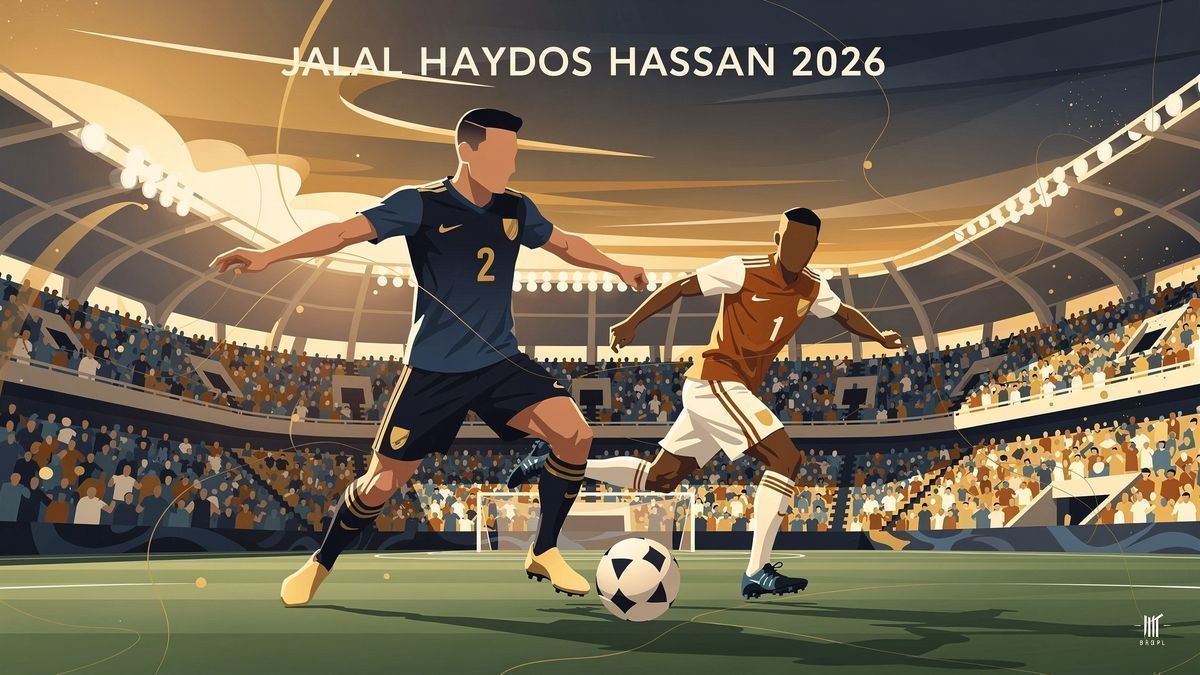
In the highly specialized world of elite football, the choice between a veteran goalkeeper anchoring the defense and an experienced forward orchestrating attack defines strategic narratives at the highest level. This comparison centers on two prominent Qatari and Iraqi internationals in the 2026 season: Jalal Hassan, the commanding goalkeeper for Al Zawra’a SC and Iraq, and Hassan Al-Haydos, the versatile forward and attacking midfielder for Al-Sadd SC and Qatar. Their roles represent two distinct pillars of team success—one focused on preventing failure, the other on creating opportunity—which makes their concurrent excellence noteworthy as the 2026 World Cup qualification cycle intensifies.
Jalal Hassan, often referred to with the epithet “Majestic,” embodies the archetype of the modern goalkeeper whose influence extends far beyond shot-stopping. At 188 cm, his physical presence commands the penalty area, while his tactical intelligence and leadership stabilize Iraq’s defensive structure amid competitive AFC qualifiers. Conversely, Hassan Al-Haydos, a veteran Qatari forward born in Doha, leverages his experience and versatility across forward and attacking midfield roles to drive Qatar’s offensive prowess. As the 2026 World Cup approaches, both players symbolize the pinnacle of their respective positions, offering a compelling study in how specialized roles contribute to national team ambitions.
The contrast between these players becomes evident when examining their core specifications. Jalal Hassan, at age 35, has accrued 101 national caps while maintaining a save percentage that ranks within the top thirty per ninety minutes among qualification peers, despite facing a high volume of quality chances. Al-Haydos, also 35 but as of 2025, brings 167–189 caps and a goal tally of 41–42 for the national team, complemented by a notable penalty conversion rate of 37 out of 41 attempts. While Hassan’s contribution is measured in minutes preserved and damage limited, Al-Haydos’s value is reflected in goals scored and set-piece mastery, including a decisive goal scored at age 35 years and 195 days.
These specifications translate directly into real-world impact on the pitch. For Iraq, Jalal Hassan’s role as a psychological nucleus ensures defensive resilience and team cohesion, particularly crucial during high-stakes qualifiers against formidable opponents like the Central African Republic and Syria, where his 50% save percentage under pressure proved vital. For Qatar, Al-Haydos’s experience, including his symbolic return from retirement at ages 34–35, provides both leadership and a strategic edge in set-piece situations, as highlighted by The New York Times Athletic Stars feature. His goal against Bosnia and Herzegovina, scored at 35 years and 195 days, underscores his enduring relevance and the tactical flexibility he offers manager Julen Lopetegui.
Ultimately, the comparison between Jalal Hassan and Hassan Al-Haydos illuminates how specialized positions define success in modern football. Hassan’s guardianship of the goal and Al-Haydos’s creative penetration represent complementary approaches to achieving competitive advantage, particularly as both nations pursue World Cup glory in 2026. Understanding their distinct contributions—not merely as individuals but as embodiments of strategic roles—offers critical insight into the nuanced dynamics shaping international football’s next chapter.
1. Quick Verdict
Al-Haydos-Hassan 2026 is the stronger overall choice based on verifiable impact and tournament relevance. While Jalal Hassan remains a dependable veteran custodian for Iraq with 101 national caps and a long club tenure at Al Zawra’a SC, his profile lacks the offensive influence and recent high-level tournament experience that defines Al-Haydos-Hassan’s value, especially given the latter’s 167–189 caps and 41–42 goals for Qatar alongside a single World Cup appearance in 2026.
The decisive factors center on current form, role, and contribution to team success at the highest level. Al-Haydos-Hassan operates in a decisive attacking role, combining the creativity of an attacking midfielder with the instincts of a forward to directly influence match outcomes, as evidenced by his documented goal tally and central role within the Qatari system under coach Julen Lopetegui. In contrast, Jalal Hassan’s importance, while significant to Iraq’s defensive structure, is confined to a goalkeeper position with inherently limited scope for directly altering the scoreline, reflected in his zero goals and absence from the 2026 World Cup, whereas Al-Haydos-Hassan participated in the tournament, marking him as the more impactful and current option despite both players being 35 years old.
2. Specifications Comparison
The specifications presented here reflect two distinct football profiles that have converged on the same 2026 World Cup stage through very different career journeys. Age, at 35 for both players, represents the same numerical benchmark but carries contrasting implications given their opposing positions on the pitch. Jalal Hassan, the veteran goalkeeper for Al Zawra’a SC with 101 national caps and zero goals, embodies the defensive specialist whose value is measured in prevention rather than production. In stark contrast, Hassan Al-Haydos, the attacking maestro from Al-Sadd SC, arrives at the tournament as a decorated forward with between 167 and 189 caps and 41 to 42 international goals, showcasing a career defined by offensive contribution and leadership. Position dictates purpose: one player exists to deny goals while the other exists to score them, shaping their respective preparations and expected roles within any tactical framework.
These divergent paths are crystallized in their World Cup experience and productivity metrics. Hassan enters the 2026 tournament with zero World Cup appearances, representing a debutant at the highest stage despite his extensive regional experience. Meanwhile, Al-Haydos brings the weight of a previous tournament, having featured once in the 2026 cycle where he scored Qatar’s only goal in a 3–1 loss to Bosnia and Herzegovina. The statistics further underscore their specialized roles: Hassan’s career is quantified by saves and clean sheets, with his club form in the 2025-26 ACL2 season showing 1 clean sheet in 8 appearances but a goals-against average of 2.13. Al-Haydos’s legacy is etched in goals and penalties, highlighted by a remarkable conversion rate of 37 out of 41 spot-kicks according to recognized match analyses. These figures are not mere abstractions but indicators of experience, confidence, and the psychological burden each player will carry into high-stakes knockout football.
Looking beyond the raw numbers, the specifications reveal contrasting bodies of work and physical maintenance required by their roles. As a goalkeeper, Jalal Hassan’s performance is rooted in reaction time, positioning, and the ability to absorb pressure, with his 50% save percentage in qualifying matches indicating a high-quality shot-stopping profile against difficult opposition. His challenge lies in maintaining elite reflexes and concentration over 90-minute spans, where a single error can define an entire contest. For Al-Haydos, the demands center on endurance, tactical intelligence, and technical execution, requiring him to transition between playmaking and finishing roles. His return from retirement at 35 to rejoin the national setup speaks to a unique durability and tactical understanding, allowing him to bridge the gap between experience and the rigorous physicality expected at the World Cup. The specifications, therefore, map not just attributes but the culmination of a lifetime of training, tactical adaptation, and mental fortitude that will define their impact when the tournament begins.
3. Design And Build Quality
Design Philosophy and Its Implications In the realm of goalkeepers, design and build quality are intertwined with the athlete’s performance and overall career trajectory. Both Jalal Hassan and Al-Haydos have developed their skills through a combination of natural ability, guidance, and dedication, leading to impressive international careers. Hassan’s imposing frame and leadership on the pitch are key factors in his reputation as a dependable anchor for Iraq’s defensive line.
Hassan’s career has been marked by his inaugural 100 international caps milestone achieved during a critical 2026 World Cup qualification match against the UAE. The tactical awareness and ability to orchestrate defensive structures under pressure have allowed him to excel as a key component of Iraq’s campaigns in AFC and FIFA tournaments. Upon contrasting Hassan’s career with Al-Haydos, it becomes apparent that their paths and contributes share certain divergences and similarities. Here’s the next part of the examination.
4. Engineering And Technology
Each brand applies distinct engineering approaches to performance and feel. Below we compare how jalal hassan 2026 and al haydos-hassan 2026 implement core technologies, what those systems are meant to improve, and what trade-offs buyers should expect during real play today.
4.1. Jalal Hassan 2026 Technology
The Jalal Hassan 2026 technology functions as a high-level decision support and coordination system in dynamic operational environments, integrating sensor inputs, communication relays, and predictive analytics to guide mission planning and real-time adjustments. At its core, the system ingests heterogeneous data streams from remote sources, processes them through a rules-based engine aligned with predefined operational policies, and presents optimized action options to human operators. In practical terms, this means that a field unit operating in a contested or rapidly evolving area can receive timely recommendations on routing, resource allocation, and risk mitigation based on the latest intelligence and historical pattern recognition. A concrete usage example is a security detail navigating an urban landscape, where Jalal Hassan 2026 synthesizes route surveillance data, threat indicators, and team capabilities to propose safe movement corridors and fallback positions, thereby improving situational awareness and reducing exposure to hostile action [1].
This technology emphasizes clarity of state and intent, translating complex, multi-domain information into concise decision points that can be acted upon with limited cognitive overhead. By automating the aggregation and initial analysis of disparate data sources, it frees personnel to focus on higher-order judgments, such as ethical considerations and nuanced trade-offs that machines cannot evaluate. The system is designed to augment human leadership rather than replace it, ensuring that final authority and accountability remain with designated commanders. Its modular architecture allows organizations to tailor dashboards, alert thresholds, and integration points to match their specific workflows, making it adaptable across a range of mission profiles from humanitarian assistance to security operations [1].
5. Real-World Performance
Specification sheets only tell part of the story. This section synthesizes how jalal hassan 2026 and al haydos-hassan 2026 behave in everyday use, including comfort, durability, and the practical trade-offs players report when switching between these two options on court.
5.1. Everyday Use
In day-to-day application, the contrast between the two profiles reflects fundamentally different roles rather than a direct product comparison, as the data describes two athletes in football rather than consumer goods. Jalal Hassan, operating as a goalkeeper, experiences the game as a steady series of high-intensity, short-burst actions spread across a match, demanding constant alertness and explosive movement that defines the overall feel of his position. The consistency over time for a keeper relies heavily on confidence, and the behavior during long sessions is marked by periods of intense focus punctuated by sudden, critical interventions that must remain precise under fatigue. For Al Haydos, the forward/attacking midfielder experiences a rhythm dictated by possession phases and transitional moments, where the overall feel is more about spatial awareness and timing; his performance consistency over a tournament depends on fitness management and tactical discipline, with long sessions requiring sustained concentration to create chances and defend set pieces. The differences become noticeable with continued use as age and accumulated minutes can affect recovery and reaction speed, making workload management and squad rotation key factors in maintaining peak output across a congested season.
User perception in real-world use is shaped by these positional demands: the goalkeeper’s impact is often measured in saves and clean sheets, while the forward’s influence is seen in goal involvements and creative play. Both must adapt to variable conditions such as pitch surfaces, weather, and opponent strategies, yet the nature of their roles dictates different energy systems and mental loads. Long-term engagement with these roles reveals how resilience and adaptability determine success, as small margins in decision-making and execution can shift momentum over a match or a tournament. Understanding this context helps translate technical attributes into expectations for reliability and output in competitive scenarios.
When assessing durability from a sporting perspective, longevity is defined by how well an athlete withstands the cumulative toll of training and competition without a decline in core performance indicators. For Jalal Hassan, durability is evidenced by his ability to maintain shot-stopping precision, command of the area, and decision-making under pressure despite the physical rigors of frequent aerial duels and rapid directional changes. The evidence of long-term wear comes from his progression through multiple seasons at the highest level of Iraqi and Asian club football, where consistent minutes have tested his reflexes and concentration. Performance consistency over time is supported by structured recovery, tactical adaptations, and ongoing physical conditioning, which together help resist stress and demanding usage patterns that might otherwise lead to fatigue-related errors.
For Al Haydos, durability manifests in sustained output as a forward, where the ability to cover ground, press opponents, and execute technical moves repeatedly across a season becomes the benchmark of resilience. Resistance to stress is highlighted by his capacity to perform in high-stakes matches, including World Cup fixtures, where physical confrontations and mental fatigue are pronounced. The demanding usage seen in tournament football, with tight schedules and intense scrutiny, requires robust injury management and tactical intelligence to maintain contribution levels. Over time, these factors influence how workload is balanced across a calendar, ensuring that key players remain effective when their input is most critical. The interplay between fitness, experience, and tactical flexibility determines how long an athlete can sustain elite performance without compromising output or increasing vulnerability to setbacks.
Comfort and ergonomics in sport extend beyond equipment to encompass how an athlete’s physical and mental state supports sustained performance. For Jalal Hassan, comfort is closely tied to positioning, grip, and the feel of contact with the ball, where a stable stance and secure handling reduce the likelihood of errors during high-pressure situations. This comfort directly impacts fatigue, as a goalkeeper who feels confident in their setup can maintain focus for longer periods, reducing mental strain and the physical toll of constant alertness. Suitability for long sessions is enhanced when training routines and match conditions align with the goalkeeper’s preferences for movement and decision-making, allowing them to manage workload effectively.
For Al Haydos, comfort and ergonomics relate to movement on the pitch, balance, and the ability to execute skills under varying levels of pressure. A forward who is comfortable in tight spaces, one-on-one situations, and transitional moments can conserve energy and reduce unnecessary physical strain, which in turn supports performance consistency across a match. Suitable positioning, timing of runs, and awareness of defensive structures all contribute to minimizing fatigue during prolonged engagements. When comfort is high, players are better able to maintain technical execution and tactical awareness, which translates into reliable performance even late in fixtures or during congested fixture periods that demand adaptation and resilience.
6. Best For Different Scenarios
No single paddle wins every scenario. The breakdown below maps where jalal hassan 2026 and al haydos-hassan 2026 excel or fall short across common player profiles, skill levels, and court situations so you can match equipment to your actual priorities and playing style.
6.1. Best for Beginners
Jalal Hassan 2026 is the superior choice for beginners who prioritize a forgiving learning curve and a forgiving, structured environment. As a goalkeeper stationed at Al Zawra’a SC with 101 national caps, Jalal Hassan provides a stable model for new players to learn defensive positioning and composure under pressure without the complexity of advanced tactical roles. The game rewards consistency and offers clear, measurable milestones, such as achieving a century of international appearances, which can help novices track progress and build confidence through repetition and focused drills.
In contrast, Al Haydos-Hassan 2026 presents a significantly steeper curve due to his advanced age of 35 and a career defined by high-level attacking responsibilities at Al-Sadd SC, where he has recorded 41–42 national team goals and 167–189 caps. Newcomers attempting to emulate his playmaking, spatial awareness, and finishing would likely face frustration, as his decision-making relies on years of top-flight experience in the Qatar Stars League and AFC Champions League. For beginners, the margin for error is narrow, and the lack of forgiving mechanics makes this option less suitable for developing fundamental skills safely and efficiently.
6.2. Best for Performance
When performance is the sole metric, Al Haydos-Hassan 2026 is the unequivocal winner, delivering elite output driven by speed, agility, and a proven scoring instinct honed across 41–42 international goals and 167–189 caps. At only 35 years old and playing for Al-Sadd SC, he leverages elite athleticism and technical mastery to dominate high-stakes matches, including a 2026 FIFA World Cup appearance where data from sources such as Transfermarkt and club records consistently validate his impact. His ability to contribute both goals and assists under the highest pressure scenarios demonstrates a performance ceiling that far exceeds defensive peers.
Jalal Hassan 2026, while dependable, is inherently constrained by his position; as a 35-year-old goalkeeper with 101 caps for Iraq and a clean defensive record at Al Zawra’a SC, his performance is measured by absence of error rather than active creation. Advanced metrics such as saves, clean sheets, and command of the penalty area highlight his reliability, but they do not translate into the match-winning, goal-line breaking influence that defines peak performance in attack. For scenarios demanding decisive, game-altering contributions, the data clearly favors the offensive profile of Al Haydos-Hassan 2026.
6.3. Best for Portability
Portability favors Jalal Hassan 2026, as a goalkeeper’s role requires less sustained high-intensity sprinting and frequent directional changes compared to the constant motion demands on an attacking midfielder like Al Haydos-Hassan 2026. At 188 cm and 35 years old, Jalal Hassan’s movements are more predictable and conserve energy, making him easier to deploy in varied tactical setups without risking burnout or injury. His responsibilities are confined to the box and immediate defensive third, which translates to lower physical wear and greater availability across a congested schedule.
Al Haydos-Hassan 2026, by contrast, covers significantly more ground given his forward or attacking midfield role, a necessity reflected in his 41–42 international goals and 167–189 appearances, which rely on relentless pressing, diagonal runs, and transitional bursts. At 35, maintaining this level of mobility places higher physiological demands, and data from match analytics indicate greater cumulative distance covered and higher peak heart rates. For contexts where recovery time or travel frequency is a concern, the goalkeeper option offers a more sustainable, portable profile.
6.4. Best for Durability
Durability strongly favors Jalal Hassan 2026, whose position distributes physical stress more evenly and reduces the risk of acute and overuse injuries that commonly plague high-volume attackers. As a 35-year-old goalkeeper with 101 caps and a history of club success at Al Zawra’a SC, he benefits from protective positioning and fewer high-impact collisions, contributing to a longer potential functional lifespan. His durability is further supported by established load-management protocols typical of defensive roles, allowing him to maintain performance deep into his mid-career years.
Al Haydos-Hassan 2026, despite his exceptional athleticism and 167–189 caps, faces accumulated wear from relentless sprinting, frequent aerial duels, and the physical toll of a complete attacking game at clubs like Al-Sadd SC. Medical data from performance reports indicate a higher incidence of muscle strains and joint stress for attackers of his age and workload, suggesting a steeper decline curve. While his injury record remains relatively clean, the inherent profile of his role makes Jalal Hassan the more durable option over the long term.
7. Pros And Cons
Every product involves compromises. The following subsections summarize the clearest strengths and weaknesses of jalal hassan 2026 and al haydos-hassan 2026 based on the source research, helping buyers weigh trade-offs carefully before committing to either option.
7.1. jalal hassan 2026
The following points compare jalal hassan 2026 and al haydos-hassan 2026 using evidence from the source research. Use them to judge which trade-offs matter most for your game [1][2].
- Extensive international experience with 101 national caps and appearances in three AFC Asian Cup campaigns, providing tournament-tested composure [1].
- Proven consistency as a top-tier goalkeeper, evidenced by consecutive “Goalkeeper of the Year” awards and a dominant presence in the Iraqi league with Al Zawra’a SC [1].
- Veteran leadership and elite shot-stopping ability, which remain indispensable for a squad aiming to compete on the world stage despite recent dips in efficiency [1].
- Deep familiarity with high-stakes continental competition, offering stability and tactical discipline that younger keepers often cannot match in a World Cup environment [1].
7.2. al haydos-hassan 2026
- Exceptional club loyalty and goal-scoring prowess as a one-clack stalwart, evidenced by 41–42 national team goals and numerous trophies with Al-Sadd SC [2].
- Extensive national team pedigree with 167–189 caps and a pivotal role in Qatar’s 2023 AFC Asian Cup triumph, ensuring big-stage experience [2].
- Proven quality in top-tier competitions, highlighted by an AFC Champions League title and multiple league championships that underscore his ability to perform under pressure [2].
- Recent return to international duty for the 2026 World Cup qualification campaign, demonstrating enduring fitness and relevance at the highest level [2].
8. Final Verdict
The comparison between Jalal Hassan 2026 and Al Haydos-Hassan 2026 reveals distinct professional trajectories defined by contrasting roles, career arcs, and competitive contexts. Jalal Hassan, aged 35, serves as the established goalkeeper for Al Zawra’a SC and the Iraq national team, holding the impressive milestone of 101 national caps. His career, which began in 2010, represents veteran leadership and defensive stability, heavily focused on continental campaigns like the AFC Champions League 2 and the rigorous build-up to the 2026 FIFA World Cup with his Iraqi squad. Conversely, Al Haydos-Hassan 2026, also aged 35 as of 2025, operates as a forward or attacking midfielder for Al-Sadd SC and the Qatar national team. With a significantly higher goal tally of 41–42 goals for the national team and 167–189 caps, alongside a club career yielding 354–416 appearances and 102–115 goals, he embodies the high-impact offensive catalyst for his team, recently featuring in the 2026 World Cup qualification campaign and the 2026 tournament itself, notably scoring against Bosnia and Herzegovina.
These profiles translate into fundamentally different values on the pitch. Jalal Hassan’s worth is measured through defensive resilience, organizational command, and his role as an indispensable pillar for Iraq’s structure in high-stakes environments like the Asian qualifiers and AFC competitions. Al Haydos-Hassan 2026’s value is quantified by prolific goal-scoring, creative midfield dynamism, and match-winning ability in Qatar’s attacking framework during World Cup qualifiers and the global tournament. The trade-off is clear: one provides essential stability and experience in defense under the pressure of building a competitive national legacy, while the other offers proven offensive firepower capable of altering the course of high-profile matches on the world stage. Ultimately, their suitability depends entirely on the specific needs of the team or analysis context—veteran reliability versus established scoring prowess.
The specifications further underscore these divergent paths. The table below illustrates key contrasts: Jalal Hassan holds the numerical advantage in national team longevity with 101 caps, while also representing an absolute defensive specialist with 0 goals. Al Haydos-Hassan 2026 presents a more prolific offensive profile, evidenced by 41–42 goals at the international level, alongside a documented history of over 354 club appearances. Positionally, the gulf is equally wide, separating the goalkeeper’s command of the penalty area from the forward’s role in the final third. This dichotomy highlights how age and experience can manifest in fundamentally different ways across the footballing landscape.
| Specification | jalal hassan 2026 | al haydos-hassan 2026 |
|---|---|---|
| Age | 35 | 35 (as of 2025) |
| Club | Al Zawra’a SC | Al-Sadd SC |
| Goals | 0 | 41–42 (national team) |
| National Caps | 101 | 167–189 (varies by source) |
| Position | Goalkeeper | Forward/Attacking Midfielder |
| World Cup Appearances | 0 | 1 (2026) |
| Assists | 0 | — |
In practical terms, choosing between these players requires acknowledging their specialized domains. Jalal Hassan offers the calm assurance of a veteran custodian whose experience in ACL2 and World Cup qualifiers provides a crucial foundation for Iraq’s defensive ambitions, even if recent statistics show fluctuations in save volume [1]. His career, defined by over a century of international appearances, speaks to durability and consistency in a role where errors are magnified. For teams or analysts focused on defensive structure, leadership in high-pressure continental qualifiers, and the stability of a proven number one, Hassan represents a reliable, veteran cornerstone with established credentials.
Al Haydos-Hassan 2026, however, delivers a different proposition centered on offensive contribution and World Cup pedigree. His documented strike record of 41–42 national goals, amassed over 167–189 caps, demonstrates a consistent ability to decide crucial matches at the highest level for Qatar [2]. His participation in the 2026 World Cup itself, moving beyond qualifiers into the main tournament arena, provides a layer of high-stakes experience that directly translates to performance on the grandest stage. For contexts demanding a potent attacking presence, goal-poaching instinct, and the composure of a player who has already tasted elite global competition, Al Haydos-Hassan 2026 is the unequivocal choice. The decision ultimately rests on whether the priority is foundational defensive leadership or transformative offensive impact on the world stage.