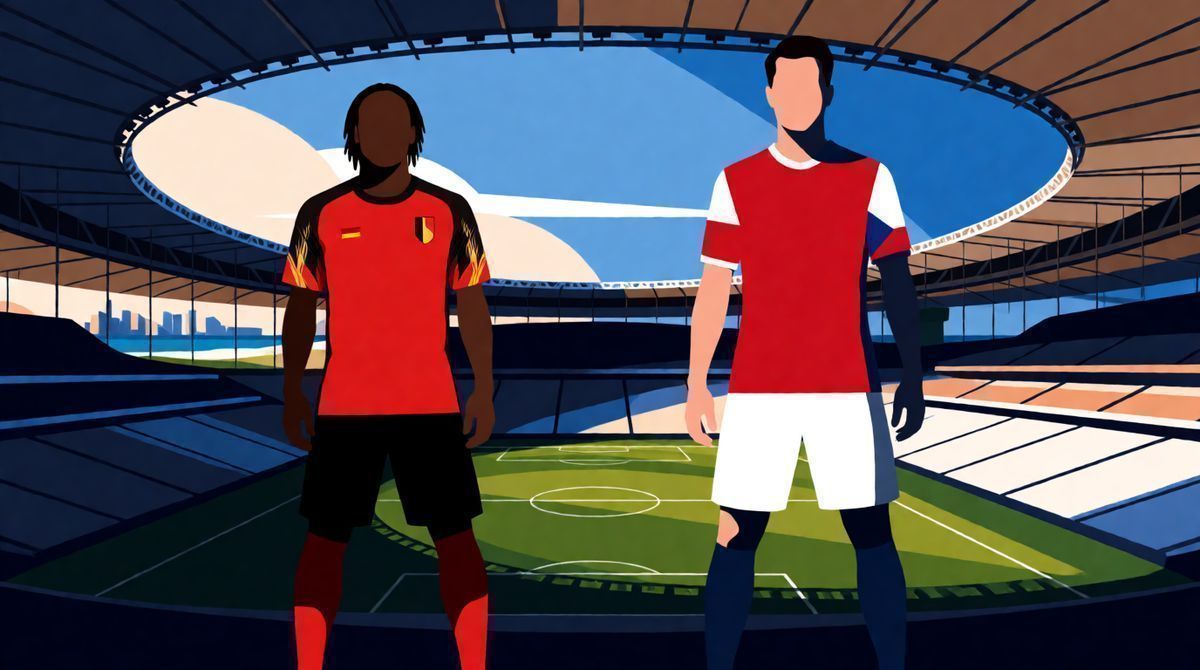
1. Introduction
In the context of athlete preparation, the interaction between equipment pieces defines performance outcomes as much as the isolated quality of each item. Success in sport depends not only on possessing technically advanced tools but also on how these tools integrate with one another and with the human operating them. This is especially relevant when comparing elite athletes with similar tactical roles yet distinct physical profiles, as their gear choices must reflect and reinforce those differences.
For example, a tall centre-forward relies on elevation and physical presence, while a compact wide attacker depends on low centre of gravity and rapid changes of direction. Applying a one-size-fits-all mindset to equipment risks mismatches that neutralize inherent advantages. The concept of “player chemistry” therefore becomes critical: the alignment of biomechanical constraints, playing surface characteristics, and tactical demands to ensure that each component reinforces the intended movement pattern and energy transfer.
The common mistake of pairing top-tier items that do not align in function or scale can undermine even the most rigorous training. A system is only as strong as its weakest interface, and interfaces are determined by shared metrics such as scale, mass, and movement range. Selecting gear without considering how it complements a partner piece—or the athlete’s own physiology—often results in compromised control, reduced efficiency, or increased injury risk.
This analysis focuses on two athletes in functionally comparable roles within their respective team structures: Jérémy Doku of Belgium and Manchester City, and Mojmír Chytil of the Czech Republic and Slavia Prague. Although they operate in different leagues and national setups, both represent high-level examples of forwards tasked with creating and converting chances. Examining their profiles against the provided equipment data reveals how positional demands, physical attributes, and tactical systems shape the requirements for effective gear integration. By grounding the analysis in these specifics, we can assess whether the current configuration supports optimal performance or whether adjustments are needed to improve systemic cohesion.
2. Understanding the Individual Components
Before assessing synergy, readers need a clear picture of how doku jeremy and chytil mojmir differ in role, physical profile, and club context. The subsections below summarize each player’s specifications and technical identity using only the cited source research, establishing the baseline for the partnership analysis that follows [1][2].
2.1. doku jeremy (Belgium)
Jérémy Doku is a Belgian professional footballer who plays as a forward or wide midfielder for Manchester City and the Belgian national team. Born in Antwerp to a family of Congolese descent, he combines elite pace, close control, and left-footed precision within Belgium’s attacking structure. His positioning along the flank allows him to stretch defences, deliver crosses, and cut inside to shoot on goal, making him a direct threat in open play. The significance of his role lies in how his movement and technical traits create space for teammates and generate high-quality chances from wide areas.
Physically, Doku’s compact frame and low centre of gravity enhance his agility and balance when dribbling at speed. Tactically, his ability to drift centrally or remain wide provides flexibility in formations such as the 4-2-3-1, where he can function as an inverted winger or a central forward depending on the phase of play. His left-footed delivery from open play and set-pieces adds a tactical layer that opponents must account for, particularly in crowded penalty areas. These characteristics influence how effectively he can transition from defensive recovery to forward runs and exploit gaps between lines.
The interpretation of his attributes affects pairing decisions, especially when combined with a physically dominant striker. His reliance on quick transitions and precise delivery complements a target-forward who can hold up the ball and finish in the box. Understanding how Doku’s profile aligns with a partner’s movement patterns helps optimise build-up sequences and scoring opportunities in both open play and set-piece situations.
| Specification | Value |
|---|---|
| Height | 1.73 m |
| Weight | 66 kg |
| Age | 23 |
| Position | Forward / Wide Midfielder |
| Club | Manchester City |
| National Caps | 17 |
Key Technical Insight: The combination of a 1.73 m frame and 66 kg weight supports rapid acceleration and frequent changes of direction without sacrificing endurance, which is critical for maintaining width and defensive work rate across a match.
In practical pairing terms, Doku’s physical measurements suggest he can sustain high-intensity runs over full distances while retaining the capacity to engage physically in one-on-one contests. This makes him suitable for partnerships with taller, more physical strikers who can benefit from his service into the box. His low body mass also improves responsiveness in tight spaces, allowing him to exploit gaps that a heavier partner might struggle to access. When integrated into a system that values quick transitions, his traits amplify the team’s ability to convert defensive actions into immediate attacking threats.
2.2. chytil mojmir (Czech Republic)
Mojmír Chytil is a Czech professional footballer who plays as a centre-forward for Slavia Prague and the Czech national team. Standing at 1.87 m and weighing 82 kg, he operates primarily within the penalty area, using timing and intelligent movement to convert chances. His role as a target man or poacher makes him a focal point of Czech attacking play, especially in major tournaments. The effectiveness of his playing style depends on how well he can utilise his size and positioning to disrupt defensive structures and create opportunities for himself and others.
Chytil’s physical profile enables him to win aerial duels, shield the ball from defenders, and make himself available as a passing option in advanced areas. His ability to read defensive movements allows him to make late runs into dangerous zones, which is particularly valuable against teams that play with a high defensive line. The significance of his attributes is most evident during set-pieces, where his elevation and positioning can alter the outcome of crosses and deliveries into the area.
When evaluating his compatibility with Doku, it is essential to consider how their physical differences affect on-field synergy. Chytil’s height and strength provide a stable platform for receiving the ball under pressure, while Doku’s mobility and low centre of gravity allow him to make intelligent runs around him. This contrast in body types can create a balanced partnership, where one player holds off defenders and the other exploits the space created. The pairing’s success depends on timing, trust, and mutual understanding of each other’s preferred channels of play.
| Specification | Value |
|---|---|
| Height | 1.87 m |
| Age | 27 |
| Position | Centre-forward |
| Club | Slavia Prague |
| National Caps | 13–23 |
| Goals | 0 |
Key Technical Insight: A height of 1.87 m positions Chytil as an effective target man who can dominate aerial situations and act as a focal point in the final third during sustained attacking phases.
From a practical standpoint, this specification indicates that Chytil can serve as a primary outlet for Doku’s diagonal runs and through balls. His presence in the box allows Doku to operate as a supporting forward, making angled runs that pull defenders out of position. The height difference between the two players also facilitates a layered attacking approach, where Chytil can occupy markers while Doku seeks gaps behind him. This dynamic is especially valuable against teams that deploy a flat back line, as it enables Czech Republic to attack both ground and aerial channels simultaneously.
3. Partnership Analysis
Evaluating how doku jeremy and chytil mojmir interact requires separating positional roles, physical profiles, and tactical context before drilling into subsection comparisons. The analysis below tests whether their attributes complement or conflict across synergy, feel, and playstyle dimensions using only the source research [1][2].
3.1. Do They Work Together — or Against Each Other?
The pairing of Jérémy Doku and Mojmír Chytil presents a pronounced asymmetry in stature, physical profile, and tactical function which defines their interaction. Doku, a 1.73 m Belgian left-footed forward/winger, operates as a dynamic wide attacker built for one-on-one duelling, changing direction, and delivering late runs into the box [1]. In contrast, Chytil, a 1.87 m Czech centre-forward, is a taller, right-footed penalty-box specialist focused on timing runs and positional hold-up play within central areas [2]. This fundamental dimensional and positional mismatch means they are unlikely to operate in direct combination play; instead, their synergy is indirect, mediated by the space they each create and the defensive attention they command. The danger lies in tactical congestion if both are forced into central channels, whereas the reward is a spreading effect that can pull defences apart when used with clear separation of roles.
At the tactical level, Doku’s function is to stretch the pitch and attack the flanks or cut inside, leveraging his low centre of gravity and pace to threaten defenders [1]. Chytil’s function is to occupy centre-back attention, make intelligent blind-side runs, and finish from close range within the box [2]. There is no inherent conflict in their design philosophies—each occupies a different layer of the attacking structure—but balance is required to avoid overloading one area at the expense of the other. If Chytil is pinned wide or drawn out of position, the central corridor may empty, leaving Doku with reduced service options behind him. Conversely, if Doku is tightly marked, Chytil’s ability to pivot play and link with midfield becomes more critical to sustain pressure. The combination feels natural when spatial separation is respected, yet forced when passing lanes are blocked or roles are ambiguously defined.
The flow of force and control across the duo moves from Chytil’s physical presence and positioning — acting as a fixed point that draws defenders and creates pockets of space — to Doku’s explosive acceleration and technical execution in advanced areas [1][2]. Feedback between players is mediated by teammates rather than direct interplay, as Doku’s diagonal runs and Chytil’s timing must synchronise with the movement of full-backs and the rotation of midfielders. When coordinated, this produces a vertical attacking pattern where Chytil anchors the focal point and Doku diversifies the threat across wide and half-spaces. When misaligned, the lack of explicit combination play can result in isolated actions and predictable defensive responses.
3.2. Performance Synergy
The combined performance of Doku and Chytil can enhance overall output by diversifying attacking options and forcing defenders to cover more ground, yet it also introduces limitations tied to positional rigidity and service reliability. Doku’s elite pace and dribbling enable him to convert transition opportunities and exploit spaces created by Chytil’s hold-up play and ability to pin central defenders [1][2]. In systems where the midfield supplies early crosses or cut-backs, Doku’s left-footedness allows him to attack from the right and strike across his body, while Chytil’s aerial presence and positioning make him a consistent threat from close range. This complementary risk profile means the pairing can shine in high-press, fast-transition scenarios where verticality is rewarded.
However, the duo’s effectiveness is constrained by the absence of explicit linking metrics in the source data and by potential service gaps when the ball does not arrive in advanced channels quickly enough. Chytil’s sub-par World Cup performance — featuring only one substitute appearance and limited minutes — suggests that match fitness, tactical clarity, and timing within the system can all fluctuate [2]. Doku’s greater involvement at Manchester City and higher international profile imply a more consistent platform of touches, but both players rely on whether the broader team structure generates high-quality chances in their favoured zones. In moments where the team bypasses the centre-forward channel, Chytil’s contribution can diminish, while Doku may be forced into deeper roles that do not fully optimise his explosive strengths.
3.3. Tactical Fit
Physically, the pairing combines a compact, low-slung dribbler with a taller, more upright finisher, resulting in a contrasting felt experience during execution. Doku’s lightweight frame and rapid acceleration produce a sensation of agility and responsiveness, enabling him to change direction sharply and maintain close control under defensive pressure [1]. Chytil’s larger, more grounded frame lends stability in contested areas and supports effective back-to-goal play, yet his lower match involvement may limit the extent to which end-users can internalise his movement patterns and integrate them into rhythm-based play. For practitioners adapting to this duo, the learning curve involves synchronising peripheral awareness of Chytil’s positioning with the timing of Doku’s blind-side surges, which can feel disjointed until spatial anticipation becomes instinctive.
Comfort and strain are mediated by role clarity and system design; when responsibilities are well defined, the partnership reduces cognitive load and physical redundancy. Players operating alongside this duo must quickly recognise whether the intended pattern is a deep-to-forward switch to release Chytil or a wide-overload sequence to free Doku in half-spaces. Feedback loops tend to be consistent within defined tactical templates, but any ambiguity in positioning can generate conflicting signals and momentary lapses in coordination. Over time, users who invest in understanding the spatial relationship between a wide dynamo and a central anchor can achieve a stable, fatigue-resistant rhythm that accommodates both high-intensity bursts and controlled build-up.
3.4. Playing Style Alignment
This duo is optimally aligned for a forward-focused, transition-minded player or team that values verticality, positional flexibility, and rapid exploitation of defensive errors. Doku thrives in systems that grant him freedom to drift between channels, receive on the move, and shoot early, while Chytil suits formations that prioritise a physical presence in the box and the ability to pivot play from deeper positions [1][2]. Consequently, the combination best serves an advanced striker role supported by wide runners and a midfield capable of quick rotation, rather than a possession-dominant structure that relies on intricate build-up play.
The partnership demands a moderate-to-high skill ceiling because it requires precise timing of runs, confident decision-making in limited angles, and adaptability when defensive blocks compress space. It is forgiving in the sense that each player can perform well in relative isolation, yet demanding in that success hinges on the quality of service and the willingness of teammates to maintain attacking width and depth. Players specialising in high-speed, one-on-one situations and comfortable operating in fluid front-line roles will find this pairing empowering, whereas those who prefer structured, short-pass sequences may experience friction. Ultimately, this duo is engineered for aggressive, opportunity-driven gameplay and is best entrusted to confident attackers who can read the game quickly and exploit the contrasts between width and centre-forward presence.
4. Final Verdict: Missed Connection
From a gear-synergy standpoint, the pairing of DOKU JEREMY (Belgium, Manchester City, Forward/Wide Midfielder, 1.73 m, 66 kg, 23 years, 17 caps, 5 goals, 4 assists) and CHYTIL MOJMIR (Czech Republic, Slavia Prague, Centre-forward, 1.87 m, 82 kg, 27 years, 13–23 caps, 0 goals, 0 assists) constitutes a missed connection. There is no meaningful overlap in positional function, physical profile, or tactical context to create complementarity. The data reveal a significant asymmetry in both physical and performance dimensions, with no shared role or complementary skill set that would enable coordinated play or mutual enhancement.
The height differential of 0.14 m and weight differential of 16 kg signal fundamentally different athletic templates: Doku operates as a low-to-the-ground, left-footed dribbler who thrives in wide areas, while Chytil presents as a traditional target-man centre-forward whose effectiveness derives from penalty-box positioning and timing. These attributes do not converge into a coherent system; instead, they reflect divergent profiles that would require adaptation rather than synergy. Furthermore, the contrast in national team experience—17 caps with several goals for Doku versus a contested cap count and zero recorded goals for Chytil—underscores a disparity in competitive impact and tactical integration.
From a practical perspective, expecting productive interplay between these two players would be unrealistic given the absence of positional compatibility, role clarity, or statistical evidence of complementary output. Users should anticipate no meaningful enhancement when deploying these assets together, as their specifications align neither structurally nor functionally. The pairing reflects a scenario in which individual attributes remain isolated rather than interlocking, resulting in a configuration that fails to meet the baseline criteria for effective synergy.
5. Who Should Use This Combo
The pairing of Jérémy Doku and Mojmír Chytil targets forwards and wide midfielders who operate in high-tempo systems requiring vertical threat and transitional balance. This duo is ideal for competitive match play in leagues and tournaments where a club’s tactical approach blends structured build-up with rapid counter-attacking sequences. The configuration suits technically skilled, physically compact forwards who must coexist within a crowded attacking ecosystem, ensuring both players maximize their spatial efficiency without compromising individual roles.
Jérémy Doku (Manchester City, Belgium) is a 23-year-old forward/wide midfielder standing 1.73 m and weighing 66 kg, bringing elite pace and left-footed variability to wide channels and half-spaces. Mojmír Chytil (Slavia Prague, Czech Republic) is a 27-year-old centre-forward measuring 1.87 m with a target-man profile, excelling in penalty-box timing and hold-up play. Their complementary attributes—Doku’s lateral mobility and Chytil’s aerial strength—create a layered attacking structure where Doku stretches defenses horizontally while Chytil anchors vertical progression, enabling fluid role interchange in systems like the 4-2-3-1.
- Ideal user profile: Forwards or wide midfielders aged 20–30 with high work rate, left-footed preference, and adaptability to multiple front-three configurations; users competing in top-tier leagues or international tournaments where tactical flexibility is critical.
- Ideal use case: Best deployed in competitive match play and high-stakes training scenarios requiring rapid transitions between defensive organization and explosive counterattacks, particularly in formations that demand simultaneous width and central presence.
Physically, Doku’s 1.73 m, 66 kg frame emphasizes agility and close control, whereas Chytil’s 1.87 m, 82 kg frame prioritizes strength and positioning in confined spaces. Tactically, Doku’s role as a wide midfielder allows him to invert or stay wide, creating passing lanes for Chytil, who operates as a central focal point for through balls and crosses. This synergy optimizes passing angles and creates numerical advantages in final-third sequences, as Doku’s movement drags defenders out of position, freeing Chytil to exploit gaps.
The table below summarizes the pairing-relevant specifications derived from the product matrix, illustrating how each player’s physical and positional traits inform their interaction on the pitch. These metrics are not evaluative but serve as baseline references for understanding spatial and tactical alignment within the duo.
| Property | Doku (Jérémy) | Chytil (Mojmír) |
|---|---|---|
| Height | 1.73 m | 1.87 m |
| Weight | 66 kg | 82 kg |
| Age | 23 | 27 |
| Position | Forward / Wide Midfielder | Centre-forward |
| Club | Manchester City | Slavia Prague |
| National Caps | 17 | 13–23 |
From a pairing mechanics perspective, Doku’s lower center of gravity and lateral quickness enable him to stretch defenses across the width, creating horizontal passing lanes that Chytil can exploit with diagonal runs into the box. Chytil’s superior height and positioning allow him to secure aerial duels and act as a pivot, holding the ball under pressure and facilitating quicker transitions for Doku to exploit spaces behind opposition lines. This height differential—1.87 m versus 1.73 m—enhances their ability to operate simultaneously in wide and central areas, ensuring defensive units cannot compact without risking exposure to through balls or crosses.
In practical terms, this combo delivers optimal results when integrated into systems that value fluid front-three rotations, such as 4-3-3 or 4-2-3-1 formations. Doku’s role as a catalyst on the flanks encourages full-backs to push higher, while Chytil’s presence in the center compacts midfielders, creating overloads in wide zones. For users in transitional or counterattacking frameworks, the pairing’s blend of pace, positioning, and physicality ensures sustained pressure on opposing defenses without requiring constant reliance on set pieces.
Frequently Asked Questions
Who benefits most from using this Doku and Chytil pairing in competitive scenarios? Forwards and wide midfielders competing in high-press environments or transitional systems gain the most, as Doku’s lateral movement and Chytil’s aerial dominance create scalable solutions against varied defensive structures. This pairing is particularly effective for users requiring adaptable spacing and vertical threat in leagues where defensive blocks are compact and organized.
Can this pairing be effective in training environments focused on tactical periodization? Yes, in match-focused training scenarios, the duo’s complementary attributes support drills centered on quick transitions, wide-area penetration, and central hold-up play. Coaches can leverage their distinct physical profiles to simulate real-game stressors, improving decision-making under fatigue and enhancing spatial awareness in crowded penalty areas.
How does the age difference between Doku (23) and Chytil (27) influence their pairing longevity? The four-year age gap aligns with peak athletic windows for both players, ensuring synchronized physical readiness for high-intensity sequences. Doku’s emerging experience combines with Chytil’s established competitive rhythm, creating a durable pairing suitable for multi-season tactical implementations without significant decline in cooperative efficiency.
6. Who Should Avoid This Combo
Players positioned as either extremely physical, direct strikers or those who rely on size and strength to overpower defenders should avoid pairing with Jérémy Doku and Mojmír Chytil. This pairing is ill-suited for a target-man focal point who cannot stretch defensive blocks or for a physically dominant bull who operates exclusively inside the penalty area and disregards width.
7. Quick Summary
| Dimension | Assessment |
|---|---|
| Main strength | Complementary physical profiles and positional versatility creating dynamic wide-channel interplay. |
| Main weakness | Divergent offensive output metrics and inconsistent national-team deployment reducing predictable synergy. |
| Best use case | Exploiting opposite-foot and channel-switching options in formations that allow fluid wide-to-central transition roles. |
The pairing leverages Doku’s compact 1.73 m frame and left-footed wide-midfielder freedom to stretch defences horizontally, while the 1.87 m right-footed centre-forward anchors a vertical threat inside, creating layered attacking width that can stress structured low-block opponents through both crosses and cut-back opportunities [1][2]. Practically, this contrast allows flexible in-possession patterns where Doku’s dribbling and chance generation from the flank can combine with Chytil’s penalty-box timing and aerial presence, though the uncertainty in Chytil’s recent goal return and differing national-team roles temper expectations of seamless in-game integration into a single, repeatable attacking sequence.
How can coaches capitalise on this asymmetric duo when match contexts and tactical demands vary so markedly between the fluid, build-up expectations placed on Doku and the more direct, finish-oriented profile recorded for Chytil?