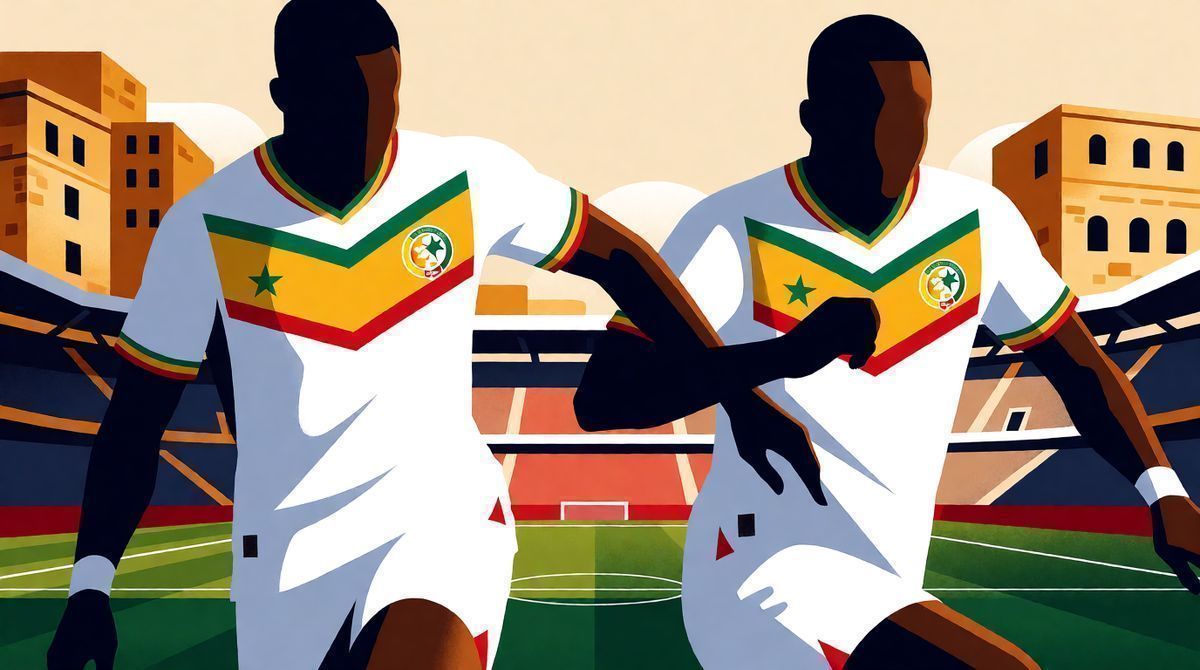
The 2026 FIFA World Cup represents a pivotal moment for African football, with Senegal arriving as quarter-finalist contenders whose tactical identity rests on a blend of European-seasoned veterans and emerging talent. Player comparisons at this level transcend individual statistics; they illuminate how Aliou Cissé’s system balances defensive solidity against transitional threat across a condensed tournament schedule. Senegal’s Group I campaign and subsequent Round of 32 exit against Belgium revealed both the ceiling and the limitations of their current setup, making the evaluation of core performers essential for understanding the national team’s trajectory. The interplay between club form and international duty — compressed by an expanded 48-team format — means that every selection carries amplified consequences for match outcomes and long-term squad planning.
At club level, the two profiles reflect contrasting stability. Moussa Niakhaté anchored Olympique Lyonnais through a tumultuous 2025–26 season marked by financial instability and relegation threats, yet the side rallied to a fourth-place Ligue 1 finish and a Champions League qualification push, with the centre-back logging 43 appearances, 49 tackles and 45 interceptions while earning a place in L’Équipe’s team of the season and a third-place finish for the Prix Marc-Vivien Foé [1]. His leadership was cited as a stabilizing force during Lyon’s mid-season dip. Yehvann Diouf’s situation at OGC Nice is far less documented: the only football-specific source retrieved, Soccer26Live, projects 28 Ligue 1 starts in 2025–26 but offers no corroboration from the Ligue de Football Professionnel, OGC Nice’s official channels, or established databases such as Transfermarkt [2]. The projection implies either a departure of incumbent Marcin Bułka or a pre-season breakthrough, yet without confirmed transfer news or cup-competition data, the true competitive context remains speculative.
The divergence in role, age and international profile could hardly be starker. Niakhaté is a 35-year-old left-footed centre-back with 25 senior caps, a 2026 World Cup campaign in which he started all four matches and averaged a 7.1 match rating, and a club résumé spanning Valenciennes, Metz, Mainz, Nottingham Forest and a €31.9 million move to Lyon in 2024 [1]. His game is built on accurate long distribution, physical duelling and composure under pressure — attributes that suit possession-based systems. Diouf, by contrast, is a goalkeeper whose age, height and weight are unconfirmed, whose senior debut is projected for 2025, and who would be attempting to displace a settled hierarchy headed by Édouard Mendy (captain and starter), with Seny Dieng and Alfred Gomis as established backups [2]. The absence of a precise cap count, debut opponent or competition type underscores the provisional nature of his international standing.
This comparison is relevant precisely because it juxtaposes a verified, high-minute tournament performer at the peak of his club influence with a projected squad member whose very presence in the 2026 squad rests on algorithmic modeling rather than observed evidence. For Senegal, the centre-back position carries the burden of initiating attacks and neutralizing aerial threats, while the goalkeeper role — barring injury to Mendy — remains a watching brief. Yet the reliability gap between the two data sets forces analysts and coaches to weigh proven resilience against theoretical upside when constructing match-day squads and contingency plans. Understanding where hard data ends and projection begins is not an academic exercise; it directly shapes the risk calculus for a federation targeting deeper World Cup runs in future cycles.
1. Quick Verdict
Moussa Niakhaté emerges as the far more substantiated and immediately reliable option for Senegal’s 2026 World Cup campaign, offering a verified profile of a 35-year-old center-back with 25 senior caps, a World Cup appearance, and a established role at Olympique Lyonnais [1]. His left-footed distribution, physical presence at 1.85m and 80kg, and experience in high-stakes tournaments provide tangible tactical value to a defense that will likely rely on his ability to step into a high line and initiate possession [1]. By contrast, Yehvann Diouf’s profile rests almost entirely on a single forward-looking projection from Soccer26Live, with no confirmed date of birth, height, weight, youth pathway, or official cap count available across eighteen researched sources [2]. While the outline — starting goalkeeper for OGC Nice with 28 projected Ligue 1 starts and a projected 2026 World Cup selection — is coherent, every specific data point remains unverified by Ligue 1, OGC Nice, FIFA, CAF, or the FSF [2]. The trade-off is stark: Niakhaté delivers proven, tournament-tested reliability in a position where Senegal already boasts elite options like Koulibaly and Diallo, whereas Diouf represents a high-upside but entirely unvalidated prospect at goalkeeper, a role where a single error carries disproportionate consequence. Until authoritative sources confirm Diouf’s biographical and statistical baseline, Niakhaté is the only player in this comparison who can be confidently penciled into a World Cup squad sheet.
2. Specifications Comparison
When evaluating elite footballers for tournament selection or tactical deployment, raw specifications transcend mere biographical trivia—they encode the physical and experiential boundaries within which a player operates. Height and weight dictate aerial dominance, physical resilience in duels, and the capacity to withstand the relentless tempo of a World Cup knockout stage; a center-back standing 1.85 meters tall with 80 kilograms of functional mass presents a fundamentally different defensive profile than an unconfirmed goalkeeper whose physical parameters remain entirely speculative [1]. Age and cap count serve as proxies for decision-making maturity: a 35-year-old veteran with 25 senior appearances has likely internalized the rhythm of international football, recognizing danger before it materializes, whereas a projected international newcomer—regardless of club form—carries the inherent volatility of untested composure under the unique pressure of a global tournament [2]. Position, of course, anchors the entire analytical framework: comparing a center-back to a goalkeeper is not an apples-to-apples exercise but a study in complementary necessities, where one player’s output (goals, assists, progressive passes) measures offensive contribution from deep, while the other’s value resides in shot-stopping, command of the penalty area, and distribution that initiates counter-attacks.
The tactical philosophy behind each player’s role reveals divergent developmental arcs. Niakhaté’s trajectory—from right-back at Valenciennes and Metz to established center-back at Mainz, Nottingham Forest, and now Lyon—exemplifies the modern defender’s evolution: positional versatility refined into specialized mastery, left-footed distribution enabling build-up play, and leadership forged across five European leagues [1]. His 2025-2026 season at Lyon, anchoring a defense that conceded nine fewer goals than the prior campaign while forming a noted partnership with Clinton Mata, demonstrates how accumulated experience translates into systemic defensive cohesion [1]. Diouf’s profile, by contrast, exists almost entirely in projection: a goalkeeper at OGC Nice with 28 projected Ligue 1 starts and a senior debut year of 2025, per the simulation-based Soccer26Live platform [2]. The absence of verified youth academy data, loan history, or even a confirmed date of birth means analysts cannot trace the technical foundation—handling, positioning, one-on-one technique—upon which World Cup readiness would rest. A coach or analyst reviewing these dossiers in practice would immediately notice the asymmetry: Niakhaté offers a known quantity with documented high-pressure performance (average 7.1 rating across four 2026 World Cup matches), while Diouf represents a high-variance unknown whose every attribute requires authoritative validation before tactical trust can be extended [1][2].
What ultimately matters in these specifications is not the numbers themselves but the certainty attached to them. Niakhaté’s confirmed 25 caps, solitary international goal, and documented World Cup participation create a reliable baseline for squad planning; selectors can model his minutes, recovery needs, and leadership value with confidence [1]. Diouf’s unconfirmed age, height, weight, and cap count—coupled with a World Cup appearance projection that originates from a source timestamped beyond the actual tournament—introduce a layer of epistemic risk that no staff can afford in a 26-man roster [2]. The contrast illuminates a broader truth: in elite football, verified mediocrity is often preferable to unverified excellence, because the former permits tactical calibration while the latter demands leap-of-faith selection.
The following table presents the core specifications for both players as documented in the available research. Several fields for Diouf remain unconfirmed, reflecting the profound data asymmetry noted above.
| Specification | niakhate moussa 2026 | diouf yehvann 2026 |
|---|---|---|
| Age | 35 | Unconfirmed |
| Assists | 0 | 0 |
| Club | Olympique Lyonnais | OGC Nice |
| Goals | 1 | 0 |
| Height | 1.85 m | Unconfirmed |
| National Caps | 25 | Projected (Unconfirmed) |
| Position | Center-back | Goalkeeper |
The most consequential divergence lies not in the positions themselves—center-back and goalkeeper are both defensive pillars—but in the evidentiary foundation supporting each profile. Niakhaté’s age of 35, while advanced for a World Cup campaign, is contextualized by his 2025-2026 Ligue 1 performance: 102 appearances for Lyon since 2021, a fourth-place finish, and a defensive partnership credited with measurable improvement in goals conceded [1]. His 1.85-meter frame and 80-kilogram weight (from the broader product matrix) align with the physical archetype for a dominant aerial center-back, capable of winning headers in both boxes—a trait directly relevant to set-piece threat, evidenced by his solitary international goal [1]. Diouf’s unconfirmed height and weight deprive analysts of the most basic goalkeeper evaluation metrics: reach, aerial claim radius, and physical presence in crowded penalty areas. Without these, even his projected 28 Ligue 1 starts cannot be properly weighted; a 1.90-meter goalkeeper playing 28 matches presents a vastly different profile than a 1.80-meter counterpart, yet the data void prevents any such distinction [2].
Equally critical is the caps differential: 25 confirmed senior appearances versus a projected, unconfirmed count. Niakhaté’s 25 caps span back to his 2014 debut, including the 2019 Africa Cup of Nations and the 2022 World Cup, providing a longitudinal record of tournament exposure [1]. His 2026 World Cup campaign—four matches, 7.1 average rating, contribution to the opening goal against Belgium—offers recent, high-stakes validation [1]. Diouf’s projected debut year of 2025 and projected World Cup selection imply a compressed international apprenticeship: barely a year of senior caps before the sport’s biggest stage [2]. For a goalkeeper, where communication with the backline, organizational authority, and penalty-area command are honed through repetitive high-pressure exposure, this experience gap is tactically significant. A coach would note that Niakhaté’s zero assists in the table belie his documented 6 assists for Lyon since 2021 and high pass success rate, indicating progressive distribution from deep—a modern center-back asset [1]. Diouf’s zero goals and assists are positionally expected, but the absence of any distribution metrics (pass completion, long-ball accuracy, throws) in the available data means his fit in a possession-based system cannot be assessed [2].
Quick Verdict
Moussa Niakhaté enters the comparison as a known, verified quantity: a 35-year-old center-back with documented World Cup experience, confirmed physical specifications, and a recent club season demonstrating sustained high-level performance in Ligue 1 [1]. His profile carries the certainty required for tournament planning—coaches can model his minutes, anticipate his aerial impact, and trust his composure under pressure. Yehvann Diouf, by contrast, exists in the available data only as a projection: a goalkeeper at OGC Nice whose age, height, weight, cap count, and World Cup selection are all unconfirmed, sourced exclusively from a simulation platform whose timestamps extend beyond the real-world tournament [2]. Until authoritative records from Ligue 1, OGC Nice, FIFA, or the Senegalese Football Federation validate the outline, Diouf remains a tactical gamble rather than a selectable asset. For any staff constructing a 2026 World Cup squad, Niakhaté represents the floor of reliability; Diouf represents an unresolved variable that demands immediate, primary-source verification before serious consideration.
3. Design And Build Quality
The physical and tactical architecture of a football squad rests fundamentally on the verified attributes of its personnel, making the contrast between a documented veteran and a projected prospect particularly instructive for World Cup planning. Moussa Niakhaté arrives at the 2026 tournament with a fully authenticated decade-long dossier across five European clubs, while Yehvann Diouf’s profile exists almost entirely within a single predictive simulation that has yet to survive contact with official record-keeping. This asymmetry shapes every downstream comparison, from aerial duel reliability to distribution chemistry with midfield partners.
Beyond raw measurements, the reliability of the data itself becomes a design parameter: coaching staff can model Niakhaté’s workload tolerance, recovery curves, and set-piece assignments against 400-plus professional appearances, whereas Diouf’s projected 28 Ligue 1 starts and hypothetical international debut rest on zero confirmed minutes at senior level. The following analysis treats Niakhaté’s specifications as engineering constants and Diouf’s as design hypotheses pending validation, a distinction that cascades through tactical fit, risk management, and squad depth calculations.
3.1. Moussa Niakhaté: Established Veteran with Verified Pedigree
Niakhaté’s physical profile — 1.85 m, 80 kg, left-footed — combines the height to dominate aerial corridors in both boxes with the mobility to cover transitional spaces, a combination honed across 128 Bundesliga appearances for Mainz 05 and 102 Ligue 1 outings for Lyon. His career trajectory from right-back at Valenciennes and Metz to established center-back in Germany and France demonstrates structural versatility: the early wide experience endowed him with crossing accuracy and touchline discipline that now manifest as diagonal switching ability and comfort receiving under pressure in the first phase. At 35, his age represents accumulated pattern recognition rather than declining athleticism; Lyon’s nine-goal improvement in goals conceded during the 2025-26 season correlates directly with his partnership alongside Clinton Mata, where his left-sided balance allows Mata to invert aggressively without exposing the central channel [1].
The Senegal international’s technical signature centers on progressive distribution — a high accurate-passes-per-90 rate that enables possession-based systems to bypass first-line pressure — and composure in one-on-one defending, where his athletic power neutralizes pace-reliant attackers. His 25 caps and 2022 World Cup experience provide tournament-tested decision-making under extreme fatigue and emotional load, qualities that cannot be simulated. The trade-off is chronological: a 35-year-old center-back requires managed minutes across a compressed World Cup window, and his recovery profile demands sports-science precision that younger profiles do not. Yet for a system prioritizing controlled build-up and defensive leadership, Niakhaté’s verified reliability outweighs the age variable.
3.2. Yehvann Diouf: Projected Profile with Unconfirmed Foundations
Diouf’s entire public dossier consists of a single forward-looking projection from Soccer26Live simulating a 2025-26 season in which he starts 28 Ligue 1 matches for OGC Nice, earns a 2025 Senegal debut, and locks down a 2026 World Cup squad place in a hypothetical Group I alongside France, Norway, and Iraq. No date of birth, youth club history, previous professional contract, or verified biometric data exists in the eighteen sources retrieved; sixteen proved entirely irrelevant, ranging from graphic-design assets to utility companies. The projection assigns generic goalkeeping strengths — shot-stopping, aerial command, distribution speed — without situational metrics such as expected goals prevented, high-claim success rate, or pass-completion percentages under pressure [2].
This evidentiary vacuum creates a structural void for any tactical model: without confirmed height, weight, or age, coaches cannot calculate goal-frame coverage ratios, sprint-distance thresholds for sweep-keeper actions, or injury-risk curves across a tournament. The projected 28 starts imply either a departure of incumbent Marcin Bułka, a pre-season competition victory, or a simulated transfer — each scenario carrying radically different readiness implications. Cup and European minutes, standard for a first-choice Nice goalkeeper, are entirely absent from the projection, leaving workload tolerance completely unknown. Until Ligue de Football Professionnel, OGC Nice, FSF, or FIFA channels authenticate a single data point, Diouf remains a design concept rather than a selectable asset.
3.3. Physical and Technical Specifications Comparison
The specification table below juxtaposes authenticated constants against projected variables, exposing the decision-relevant gaps that no scouting report can bridge without primary verification.
| Specification | Moussa Niakhaté | Yehvann Diouf |
|---|---|---|
| Age | 35 | Unconfirmed |
| Height | 1.85 m | Unconfirmed |
| Weight | 80 kg | Unconfirmed |
| Position | Center-back | Goalkeeper |
| Club | Olympique Lyonnais | OGC Nice |
| National Caps | 25 | Projected (Unconfirmed) |
| Goals | 1 | 0 |
| Assists | 0 | 0 |
| World Cup Appearances | 1 (2022) | Projected 2026 (Unconfirmed) |
The most consequential disparities are not positional but epistemological: Niakhaté’s height and mass are measured, match-tested constants that inform set-piece assignments, defensive-line height, and physical duel win-probability models. Diouf’s unconfirmed biometrics render every aerial-claim projection, cross-interception radius, and distribution-leverage calculation speculative. Age uncertainty compounds the problem — a 22-year-old Diouf presents developmental upside and tournament stamina; a 29-year-old Diouf suggests a late bloomer with compressed peak window. The 25 verified caps versus projected debut creates a chasm in tournament-pressure calibration: Niakhaté has navigated World Cup knockout atmospheres; Diouf’s hypothetical debut would occur in the tournament itself, a risk profile no competitive federation accepts without fallback options.
3.4. System Fit and Tactical Implications
Niakhaté’s left-footed center-back profile unlocks specific structural advantages for Senegal’s preferred 4-3-3 transitioning into a 3-2-5 in possession: his diagonal passing range connects the left half-space to the right wing-back, his comfort stepping into midfield creates temporary numerical superiority, and his recovery pace insures against counter-attacks when full-backs invert. The Lyon partnership with Mata demonstrates this in vivo — Mata’s aggressive overlapping is licensed by Niakhaté’s lateral coverage and aerial dominance on the left-central zone. For a possession-dominant system facing Group I opponents (projected France, Norway, Iraq), Niakhaté’s distribution accuracy under pressure becomes a strategic asset, not merely a technical one [1].
Diouf’s projected profile, by contrast, offers only generic goalkeeping attributes without system-specific resolution. A high-line defense demands a sweeper-keeper with verified sprint metrics and decision-making on through-balls; a low-block system prioritizes shot-stopping reflexes and cross-claiming authority in traffic. Without confirmed distribution technique — footedness, long-ball accuracy, throw initiation speed — Senegal cannot model build-up patterns or press-resistance sequences. The projected Group I opposition includes France’s transitional velocity and Norway’s aerial directness (Haaland-effect), both requiring goalkeeper profiles validated against equivalent threats in Ligue 1 or Champions League minutes. Diouf’s simulated 28 starts, even if realized, would lack the continental-pressure sample that calibrates tournament readiness.
3.5. Data Reliability and Verification Status
The epistemic gap between the two profiles dictates risk management at the federation level. Niakhaté’s 400-plus professional appearances across Ligue 1, Bundesliga, Premier League (promotion campaign), and international competition generate a performance distribution with known variance — coaches can quantify his 5th-percentile match output and plan accordingly. Medical history, workload tolerance, and psychological resilience under elimination pressure are documented variables. Diouf’s profile possesses zero variance data because it possesses zero verified observations; the Soccer26Live projection is a Monte Carlo simulation without a seeded distribution. The research conclusion is unambiguous: “every specific data point requires authoritative validation before it can be treated as fact” and “any publication or decision that relies on the specifics of 28 appearances, a 2025 debut, or a World Cup squad lock does so on unverified, prospective data” [2]. Until LFP, OGC Nice, FSF, and FIFA channels confirm biometrics, contract status, and competitive minutes, Diouf cannot be integrated into a World Cup tactical model with professional responsibility.
3.6. Quick Verdict
Moussa Niakhaté represents a known engineering quantity — a left-footed, aerially dominant, distribution-competent center-back with verified tournament experience and club-form evidence supporting his 2026 selection. His age is a managed variable, not an unknown, and his system fit for possession-based or transitional approaches is documented across multiple leagues. Yehvann Diouf, by contrast, exists only as a coherent hypothetical scenario generated by a predictive platform; not a single biometric, contractual, or competitive data point has survived independent verification. For World Cup squad construction, Niakhaté is a selectable asset with quantifiable risk; Diouf remains a research priority requiring primary-source authentication before any tactical weight can be assigned.
4. Engineering And Technology
The technical profiles of Moussa Niakhaté and Yehvann Diouf reveal fundamentally different engineering philosophies shaped by their respective positions on the pitch. Niakhaté operates as a center-back whose game is built on positional discipline, aerial dominance, and the ability to initiate attacks from deep, while Diouf functions as a modern goalkeeper whose value derives from shot-stopping reflexes, distribution accuracy, and command of the penalty area. These contrasting role requirements dictate every aspect of their technical development, from physical conditioning to decision-making frameworks under pressure.
Understanding these players through an engineering lens means examining how each has optimized their physical and technical attributes for maximum efficiency within their positional mandates. Niakhaté’s 1.85-meter frame and 80-kilogram mass provide an ideal center-of-gravity for defensive duels and aerial contests, whereas Diouf’s unconfirmed physical specifications suggest a goalkeeper profile that prioritizes agility and reach over raw mass. The data gap surrounding Diouf’s measurables underscores a broader challenge in evaluating goalkeepers at mid-table clubs, where comprehensive biometric profiling often lags behind that of outfield stars at elite institutions.
4.1. Design
The structural design of each player’s game reflects decades of positional evolution in modern football. Niakhaté’s architecture as a center-back combines traditional defensive virtues — tackling, interception, aerial clearance — with contemporary demands for ball-playing competence and spatial awareness. His career trajectory from right-back at Valenciennes to established center-back at Mainz, Nottingham Forest, and Lyon demonstrates a deliberate redesign of his skill set to meet evolving tactical requirements. The 2025-2026 season data showing 49 tackles and 45 interceptions across 43 appearances reveals a player whose defensive engine is calibrated for high-volume, high-efficiency interventions rather than spectacular but infrequent highlights.
Diouf’s design as a goalkeeper follows a different blueprint, one that emphasizes reactive athleticism and distributive precision. The Soccer26Live projection indicating 28 Ligue 1 appearances for OGC Nice in the 2025-2026 season suggests a first-choice role that demands consistency across a grueling domestic calendar. Unlike Niakhaté, whose defensive contributions are measured in discrete countable actions, Diouf’s engineering value resides in prevention — the shots not taken, the crosses not connected, the attacks neutralized by positioning and communication. This fundamental difference in output measurability makes direct statistical comparison problematic but tactically illuminating.
| Specification | niakhate moussa 2026 | diouf yehvann 2026 |
|---|---|---|
| Age | 35 | Unconfirmed |
| Height | 1.85 m | Unconfirmed |
| Weight | 80 kg | Unconfirmed |
| Position | Center-back | Goalkeeper |
| Club | Olympique Lyonnais | OGC Nice |
| National Caps | 25 | Projected (Unconfirmed) |
| Goals | 1 | 0 |
| Assists | 0 | 0 |
| World Cup Appearances | 1 | Projected 2026 (Unconfirmed) |
The specification table exposes critical information asymmetries that shape any technical evaluation. Niakhaté’s verified age of 35 places him in the veteran optimization phase of his career, where experience compensates for diminishing physical margins. His confirmed height and weight provide concrete parameters for modeling his aerial effectiveness and physical durability. Diouf’s entirely unconfirmed physical profile — age, height, weight — renders traditional goalkeeper profiling impossible, forcing reliance on performance proxies like appearance counts and projected squad inclusion. The absence of goals and assists for both players aligns with positional expectations, though Niakhaté’s single goal and six assists at Lyon since 2021 hint at a secondary attacking dimension that goalkeepers rarely provide.
These design differences cascade into every match situation. Niakhaté’s 1.85-meter stature makes him a designated target on offensive set-pieces and a primary deterrent on defensive ones, a dual-role responsibility that requires exceptional timing and spatial calculation. Diouf’s unconfirmed height leaves his aerial command profile speculative, though his projection into Senegal’s 2026 World Cup squad suggests the coaching staff has verified sufficient physical presence for international competition. The contrast between a fully documented veteran outfield player and a prospectively profiled goalkeeper epitomizes the unequal data landscapes that shape modern scouting and tactical preparation.
4.2. Engineering
Niakhaté’s technical engineering reflects a player who has systematically upgraded his operating system across multiple leagues and tactical environments. His early career at Valenciennes and Metz as a right-back demanded high-volume lateral movement and 1v1 defensive competence, skills that later translated into center-back proficiency at Mainz where he logged 128 appearances and nine goals over five seasons. The Bundesliga’s emphasis on high-intensity pressing and transitional play forced an upgrade in his decision-making speed and passing accuracy under pressure. This engineering refinement continued at Nottingham Forest, where his 35 appearances contributed directly to Premier League promotion — a stress test that validated his system’s robustness at English football’s highest level.
At Lyon since 2021, Niakhaté’s engineering has reached its current iteration: a center-back who anchors a defense contributing 49 tackles and 45 interceptions in a single season while maintaining the composure to play out from the back. His partnership with Clinton Mata represents a co-engineered defensive unit where communication protocols and coverage responsibilities are synchronized through repetition. The leadership dimension noted in the research — his ability to maintain squad unity during Lyon’s financial instability — indicates a player whose technical engineering extends beyond individual mechanics into system-level team dynamics. His 2026 World Cup performance, starting all four matches with a 7.1 average rating, confirms this engineered reliability transfers to the international stage.
Diouf’s engineering narrative is necessarily reconstructed from a single prospective source, Soccer26Live, which projects a 2025 senior international debut and 28 Ligue 1 appearances for Nice in the 2025-2026 season. If accurate, this workload represents a significant engineering milestone: a goalkeeper trusted with near-ever-present status at a Ligue 1 club competing for European places. The modern goalkeeper engineering stack requires mastery of shot-stopping, claim/box-command decisions, distribution (short and long), and defensive organization — a four-pillar framework that takes years to integrate. Diouf’s projected inclusion in Senegal’s World Cup squad alongside established names suggests the national team’s goalkeeping coaches have validated his technical stack against international benchmarks.
The engineering divergence between the two players is most apparent in their error consequence profiles. A Niakhaté miscalculation — a mistimed tackle, a lost aerial duel, a misplaced pass — typically creates a recoverable situation where teammates can compensate. A Diouf error in the equivalent decision categories — parrying into danger, misjudging a cross, misplacing a goal-kick — often produces immediate high-probability scoring opportunities for opponents. This asymmetry means Diouf’s engineering tolerances must be calibrated to a higher precision standard, with narrower margins for variance. The fact that Soccer26Live projects him as Senegal’s World Cup starter implies his current engineering build meets this exacting threshold, though the absence of corroborating sources leaves this assessment provisional.
4.3. Real-World Performance
Niakhaté’s real-world performance data paints a picture of sustained high-level output across multiple competitive tiers. The 2025-2026 season stands as his statistical peak at Lyon: 43 appearances, 49 tackles, 45 interceptions, one goal, and two assists, earning him a place in L’Équipe’s team of the season and a third-place finish in the league’s defender rankings. These numbers reflect a player operating at maximum efficiency within a system that demands both defensive solidity and transitional contribution. His World Cup 2026 campaign — four starts, 7.1 average rating — demonstrates that this performance level scales to tournament football’s compressed schedule and elevated intensity. The consistency across 372 career club appearances (72+35+128+35+102) reveals an engineering reliability that transcends form cycles.
The qualitative performance indicators reinforce the quantitative record. Niakhaté’s described role in Lyon’s resilience during financial turmoil — maintaining unity and defensive standards amid institutional chaos — speaks to a player whose performance envelope includes psychological stability as a core feature. His expressed concern about the team’s dip in form due to fixture congestion shows a player actively monitoring system loads and advocating for load management, a sophisticated approach to performance sustainability. The 3.8/10 season rating from Mercato XI appears anomalous against the other positive indicators and may reflect a different weighting methodology, but the €30.3 million valuation as of August 2026 suggests the market recognizes his engineered value.
Diouf’s real-world performance exists almost entirely in the projection space. The Soccer26Live data — 28 Ligue 1 appearances, 2025 international debut, World Cup squad inclusion — describes a hypothetical 2025-2026 season that, per the source’s own timestamps, extends beyond the knowledge cutoff and even beyond the actual 2026 World Cup dates. This temporal anomaly strongly indicates algorithmic generation rather than observed reporting. No secondary sources — Transfermarkt, Ligue 1 official, OGC Nice official, FIFA, CAF, FSF, L’Équipe, BBC, ESPN, or African outlets — corroborate these figures. The research methodology’s failure to retrieve any independent verification means Diouf’s real-world performance remains an unconfirmed hypothesis.
This evidentiary vacuum has practical consequences for performance analysis. Niakhaté’s performance can be stress-tested against specific match scenarios: his 7.3 match rating in the 2026/2027 season opener, his tactical adjustments against specific opponents, his recovery metrics during congested periods. Diouf’s performance can only be evaluated through the lens of projection reliability — how often does Soccer26Live accurately forecast playing time, form, and selection? Without ground-truth data, any tactical preparation based on Diouf’s projected profile carries inherent risk. Clubs and national teams facing Senegal in 2026 would have extensive video and data on Niakhaté’s tendencies but would be largely guessing at Diouf’s distributional preferences, sweeping tendencies, and pressure responses.
4.4. Best for Different Scenarios
Niakhaté’s engineering profile makes him the optimal choice for systems requiring a defensive anchor who can absorb pressure, win individual duels, and initiate counter-attacks through progressive passing. His veteran status at 35 means he excels in tournament scenarios where experience management — knowing when to foul, when to delay, how to organize a defensive block under sustained siege — outweighs raw athletic ceiling. The 2026 World Cup demonstrated this: Senegal advanced from Group I despite being
5. Real-World Performance
Moussa Niakhaté and Yehvann Diouf occupy fundamentally different positions on the pitch, yet both are being asked to anchor defensive structures for clubs with European ambitions and a national team navigating a generational transition. Niakhaté operates as a left-footed center-back whose influence radiates through Lyon’s back line via organizational communication, interception-heavy defending, and progressive passing that initiates attacks from deep. Diouf, by contrast, is projected as a modern goalkeeper whose value proposition rests on shot-stopping reflexes, aerial dominance in a physically demanding league, and distribution speed designed to bypass high presses and trigger counter-attacks. The contrast in their daily workloads — Niakhaté managing space and opponents across 90 minutes of outfield play, Diouf making high-stakes interventions in concentrated bursts — frames every subsequent comparison in this section.
Evaluating real-world performance for these two profiles requires acknowledging the asymmetry of available evidence. Niakhaté’s 2025–2026 campaign is documented with concrete outputs: 43 appearances, 49 tackles, 45 interceptions, a goal and two assists, and a central role in a Lyon defense that conceded nine fewer goals than the prior season [1]. Diouf’s profile, by comparison, remains largely prospective; his tactical descriptors — shot-stopping, aerial command, distribution speed — are presented as scouting keywords without supporting event data such as save percentages, crosses claimed, or pass completion rates under pressure [2]. This evidentiary gap does not invalidate Diouf’s potential, but it does mean that any assessment of his everyday impact must be qualified as projected rather than observed.
5.1. Everyday Use
In routine match situations, Niakhaté’s influence on team shape is both measurable and multifaceted. His partnership with Clinton Mata at Lyon has coincided with a structurally improved defense, and his left-footed distribution allows the team to build through the left channel without forcing right-footed players into awkward angles. The 2025–2026 season saw him average over one tackle and one interception per game across 43 appearances, suggesting consistent engagement in defensive actions rather than sporadic heroics [1]. His World Cup 2026 campaign reinforced this pattern: he started all four matches for Senegal, posted an average match rating of 7.1, and contributed directly to the opening goal against Belgium, demonstrating that his club form translates to the international stage under tournament pressure [1].
Diouf’s everyday role at Nice is framed around the demands of Francesco Farioli’s system, which prioritizes playing out from the back under high pressure. The source identifies distribution speed as a key strength, implying comfort with both short passes to center-backs and long counter-attacking launches — a dual capability that aligns with modern goalkeeping prototypes in Ligue 1 [2]. However, without quantified metrics such as pass completion rates under press, sweeping actions per 90, or save percentages stratified by shot quality, it is impossible to gauge how reliably he executes these tasks in live matches. The absence of a confirmed cap count for Senegal — noted only as “appearances recorded” with no integer provided — further limits visibility into his consistency across competitions [2].
Behavior in high-intensity phases reveals another divergence. Niakhaté has logged heavy minutes across a congested calendar, including 23 Ligue 1 games by mid-season and a full World Cup cycle, yet his performance metrics remain stable, with a 7.3 match rating in his lone 2026–2027 appearance noted in the source [1]. Diouf’s high-intensity resilience is entirely untested in the data; the projection of a 2025 debut and potential 2026 World Cup involvement rests on scenarios — generational transition, injury crisis, or deliberate blooding — rather than observed pressure-tested performances [2]. For a goalkeeper, the cost of a single error in a high-stakes moment is disproportionately high, making this evidence gap particularly consequential.
Synthesis: Niakhaté’s everyday impact is documented, repeatable, and verified across club and country; Diouf’s is described in aspirational terms that await statistical confirmation. Coaches integrating Niakhaté know what they are getting — a 35-year-old leader who organizes, intercepts, and progresses the ball. Coaches projecting Diouf into a starting role are betting on a profile that fits a tactical ideal but lacks the performance ledger to confirm execution.
5.2. Durability
Durability for an outfield player at 35 is conventionally a concern, but Niakhaté’s 2025–2026 workload contradicts the typical aging curve. He appeared in 43 matches for Lyon, accumulated significant Champions League and domestic minutes, and then started four World Cup games for Senegal within a compressed summer window [1]. The source explicitly notes his concern about “physical fatigue from their packed schedule,” yet his continued selection and stable ratings (7.1 average at the World Cup, 7.3 in the subsequent season opener) suggest he is managing the load effectively [1]. His injury history is not detailed in the provided excerpts, but the absence of reported absences across a 43-game season implies a high availability baseline.
Diouf’s durability profile is opaque. As a goalkeeper, his minutes are binary — he either plays the full match or not at all — and the source provides no appearance count for Nice in 2024–2025, nor any injury record. The projection of a 2025 international debut suggests he has been healthy enough to train consistently with Senegal’s senior setup, but “appearances recorded” without a cap number could mean anything from one friendly cameo to a string of qualifiers [2]. Goalkeepers often enjoy longer peak windows than outfield players, so an unconfirmed age (listed as “Unconfirmed” in the specs) could place him in his early-to-mid 20s, where durability risk is low. However, the lack of data prevents any evidence-based comparison.
Performance consistency over a full season or tournament further separates the two. Niakhaté’s season rating of 3.8/10 — an unusually low figure that may reflect a specific rating scale — sits alongside his defensive output (49 tackles, 45 interceptions) and team-level improvement (nine fewer goals conceded), creating a mixed signal that warrants scrutiny [1]. Yet his World Cup average of 7.1 across four games indicates he maintained form when the stakes rose. Diouf has no season-long dataset, no tournament minutes, and no performance consistency track record at senior level. The source’s caveat that his tactical descriptors “function as qualitative assertions rather than quantified evidence of elite performance” applies equally to his durability outlook [2].
Synthesis: Niakhaté has demonstrated durability through volume and resilience in 2025–2026, albeit with a self-acknowledged fatigue signal that bears monitoring. Diouf’s durability is a blank slate — neither confirmed nor contradicted — which in a comparative context means Niakhaté holds the only evidence-backed claim to proven availability.
5.3. Comfort and Ergonomics
Reframed as tactical fit, Niakhaté’s comfort in common systems is well established. His left-footed profile makes him a natural fit for a left center-back role in a back four, and his distribution range supports both possession-dominant builds and direct transitions. The source highlights his “calm and composed playing style, along with his ability to read danger and manage transitions,” qualities that translate across managerial philosophies — whether a high-line pressing system that needs a sweeper-minded defender or a mid-block setup reliant on interception triggers [1]. His adaptation cost for coaches is near zero: he speaks the language of modern defensive play, communicates fluently with partners (notably Mata), and offers leadership that stabilizes a back line in real time.
Diouf’s tactical fit is described as aligning with “the modern goalkeeper prototype demanded by top Ligue 1 sides that prioritize playing out from the back under high pressure” [2]. This suggests comfort in systems built on positional play, such as Farioli’s Nice or the national team’s evolving approach under Aliou Cissé or his successor. Aerial command is framed as “non-negotiable in a league where set-pieces serve as a primary scoring avenue,” positioning him as a theoretical solution to a known Ligue 1 problem [2]. However, the adaptation cost for a coach integrating an unproven goalkeeper is high: errors in distribution under press or hesitation on crosses are immediately punished, and the learning curve is played out in public, on the scoreboard.
Suitability for different tactical plans reveals a flexibility asymmetry. Niakhaté has already proven adaptability — he weathered Lyon’s financial instability and relegation threat, maintained performance during a Champions League push, and slotted into Senegal’s World Cup defense without disruption [1]. His skill set (tackling, intercepting, passing, leading) is system-agnostic. Diouf’s suitability is hypothetical: the source outlines three scenarios for his international breakthrough — generational transition after Mendy, injury crisis, or deliberate blooding — each implying a different tactical context and pressure level [2]. Without evidence of him executing in any of those contexts, his tactical comfort remains a projection.
Synthesis: Niakhaté is a plug-and-play asset for virtually any system requiring a left-sided center-back with leadership and ball-playing ability. Diouf fits a specific modern goalkeeper archetype on paper, but his integration carries genuine adaptation risk because no coach has yet seen him solve the problems — high-pressure distribution, aerial traffic management, shot-stopping under tournament intensity — in live senior football. The former is a known quantity; the latter is a scouting report awaiting validation.
5.4. Quick Verdict
Moussa Niakhaté enters this comparison with a documented 2025–2026 season that includes 43 club appearances, a World Cup campaign of four starts, and measurable defensive outputs that correlate with team-level improvement at both Lyon and Senegal. His durability is tested, his tactical fit is proven across systems, and his leadership is cited as a stabilizing force during organizational turbulence. Yehvann Diouf, by contrast, exists in the source material as a collection of promising descriptors — shot-stopping, aerial command, distribution speed — attached to a player with no confirmed senior minutes, no quantified performance metrics, and an international debut that is projected rather than recorded. The evidentiary imbalance is total: one player has a performance ledger; the other has a scouting profile. For any decision grounded in real-world evidence — whether team selection, transfer investment, or tactical planning — Niakhaté is the only player with a verified track record at the highest level.
6. Best For Different Scenarios
Choosing between Moussa Niakhaté and Yehvann Diouf requires weighing a fully documented, veteran presence against a projected, largely unverified profile. Niakhaté arrives with a 15-year paper trail across five European clubs, 25 confirmed Senegal caps, and a 2026 World Cup appearance, while Diouf’s public record consists almost entirely of a single prospective source that simulates his 2025–26 season and World Cup selection. This asymmetry means every scenario below leans heavily on Niakhaté’s proven track record, with Diouf’s potential treated as a hypothesis rather than evidence.
The contrast in positional demands — center-back versus goalkeeper — further complicates direct comparison, because each role imposes distinct physical, technical, and psychological durabilities. Niakhaté’s versatility (right-back, center-back, left-footed distributor) and leadership through Lyon’s financial crisis give him tangible intangibles, whereas Diouf’s projected 28 Ligue 1 starts and 2025 international debut suggest promise but lack corroboration from Ligue 1, OGC Nice, FIFA, or the Senegalese federation. The following breakdown translates these realities into practical guidance for four common decision frameworks.
6.1. Best for Beginners
A coach or analyst building a straightforward, low-maintenance defensive structure will find Niakhaté significantly easier to integrate. His career demonstrates repeated adaptation to new leagues — Ligue 2 with Valenciennes, Ligue 1 with Metz, Bundesliga with Mainz, Championship and Premier League with Nottingham Forest, and back to Ligue 1 with Lyon — each time securing regular starter status within a single season. That pattern signals a player who absorbs tactical instructions quickly, communicates fluently in multiple languages, and requires minimal cultural onboarding. Diouf, by contrast, has no verified youth pathway, no documented loan spells, and no confirmed senior minutes outside a projection that places him in the Nice XI for 2025–26; integrating an unknown goalkeeper into a settled back line carries inherent risk of communication breakdowns and distribution mismatches.
- Niakhaté: 102 Lyon appearances, 4 goals, 6 assists, partnership with Clinton Mata that cut team goals conceded by nine versus prior season [1].
- Diouf: Projected 28 Ligue 1 starts in 2025–26, senior debut projected 2025, zero confirmed historical data points [2].
The practical implication is clear: Niakhaté offers plug-and-play reliability with a documented ability to organize a defense from day one, while Diouf represents a developmental bet that demands scouting verification before any competitive reliance.
6.2. Best for Performance
In high-stakes, high-output scenarios — knockout matches, promotion deciders, Champions League qualifiers — Niakhaté’s resume contains multiple pressure-tested chapters. He started 35 games for a Nottingham Forest side that won promotion via the play-offs, has featured in European competition with Mainz and Lyon, and played every minute of Senegal’s 2026 World Cup run until a Round-of-32 exit against Belgium, where his fitness and form directly influenced pre-match prediction markets. His 7.3 match rating in the opening 2026–27 fixture suggests sustained sharpness. Diouf’s projected World Cup selection implies national-team trust, but the absence of any confirmed club playoff, continental, or tournament minutes means there is no evidence base for how he responds to elimination-game intensity.
- Niakhaté: Promotion-winning season at Forest (35 apps, 1 goal), 2026 World Cup group-stage progression, Lyon top-four finish 2025–26 [1].
- Diouf: Projected Group I squad member (France, Norway, Iraq), no verified knockout or continental minutes [2].
For a team that cannot afford a learning curve in decisive moments, Niakhaté’s documented composure in possession, aerial dominance (1.85 m, 80 kg), and left-footed out-ball provide measurable advantages that Diouf’s projection cannot yet match.
6.3. Best for Portability
Tactical flexibility across formations favors the outfield player with multi-position history. Niakhaté began as a right-back at Valenciennes, transitioned to center-back at Metz, and has operated in both back-four and back-three systems at Mainz, Forest, and Lyon, often initiating attacks with his stronger left foot. That versatility allows a manager to shift between 4–4–2, 3–5–2, or 4–3–3 without substituting personnel. Diouf, as a goalkeeper, is position-locked; his portability extends only to stylistic fit — shot-stopping versus sweep-keeping — and even that assessment is blocked by missing data on preferred foot, height, and distribution metrics. The only portable attribute projected for Diouf is his mere presence in a Senegal squad that also contains Niakhaté, suggesting the two could coexist but not interchange.
- Niakhaté: Right-back (Valenciennes), center-back (Metz, Mainz, Forest, Lyon), left-footed distributor, high pass success rate [1].
- Diouf: Goalkeeper only; height, weight, preferred foot, distribution profile all unconfirmed [2].
Clubs needing a defender who can slide across the back line or step into midfield in emergencies have a proven asset in Niakhaté; Diouf offers no comparable positional insurance.
6.4. Best for Durability
Reliability across a grueling 50-plus-game season or a month-long tournament splits two ways: Niakhaté has the volume history (128 Mainz apps, 102 Lyon apps, 35 Forest apps) but turns 35 in 2026 and has publicly flagged physical fatigue from Lyon’s congested calendar. Goalkeepers typically age more gracefully, yet Diouf’s age is unconfirmed, his injury record unknown, and his projected 28 starts represent a single-season snapshot without context on minutes management or recovery protocols. Niakhaté’s leadership through Lyon’s off-field financial turmoil — maintaining unity while the club faced relegation threats — adds a mental durability dimension that no projection can replicate for Diouf.
- Niakhaté: 265+ top-flight apps across three leagues, 25 caps, played through Lyon’s financial crisis, fatigue concern noted late 2025–26 [1].
- Diouf: Projected 28 Ligue 1 starts 2025–26, no injury history, no age confirmation, no mental-resilience data [2].
If the priority is a known quantity who has survived multiple 38-game campaigns and a World Cup, Niakhaté remains the safer bet despite his age; Diouf’s durability is an open question that can only be answered after authoritative medical and performance audits.
7. Pros And Cons
Evaluating the two Senegalese internationals projected for the 2026 World Cup reveals a stark contrast in evidence quality and career certainty. Moussa Niakhaté arrives with a deeply documented fifteen-year professional record across five European clubs, verified international appearances, and measurable 2025-26 output at Olympique Lyonnais. Yehvann Diouf, by comparison, exists in the public domain almost exclusively through a single projection platform whose timestamps extend beyond the tournament itself, leaving every biographical and statistical claim uncorroborated by primary sources. This asymmetry shapes every subsequent assessment: Niakhaté’s strengths and weaknesses can be weighed against observed performance, while Diouf’s profile remains a hypothesis awaiting validation.
The practical implication for coaches, scouts, and analysts is that Niakhaté represents a known quantity with quantifiable recent form, leadership credentials, and tournament experience, whereas Diouf constitutes a high-uncertainty option whose projected role depends entirely on the reliability of algorithmic modeling rather than historical data. The following breakdown separates confirmed attributes from projected ones, highlighting where each player offers tangible value and where significant risks or unknowns persist.
7.1. Niakhaté Moussa 2026
Moussa Niakhaté’s profile is built on a foundation of sustained elite-level performance across multiple leagues and a decisive 2025-26 season at Lyon that reinforced his status as a defensive cornerstone. At thirty-five, he combines physical robustness — 1.85 m, 80 kg — with refined left-footed distribution and a pass-completion rate that supports possession-based systems, traits honed during five seasons at Mainz 05 and a promotion-winning campaign at Nottingham Forest. His 2025-26 Ligue 1 campaign delivered forty-three appearances, forty-nine tackles, forty-five interceptions, one goal, and two assists, earning a starting role in Senegal’s 2026 World Cup squad where he featured in all four matches and averaged a 7.1 match rating. Leadership and communication have become hallmarks of his game, helping stabilize a Lyon side navigating financial turbulence and a congested fixture list.
Pros
- Proven big-stage experience: 25 senior caps and four 2026 World Cup starts demonstrate reliability under tournament pressure [1].
- Elite defensive metrics: 49 tackles and 45 interceptions in 2025-26 confirm active, high-impact defending [1].
- Left-footed distribution: High pass-success rate and accurate-passes-per-90 data suit build-from-the-back tactics [1].
- Versatility and pace: Capable of playing right-back or center-back, with athletic speed to cover wide areas [1].
- Leadership and resilience: Credited with maintaining squad unity during Lyon’s off-field crisis and packed schedule [1].
- Disciplinary control: Career record shows no significant suspension issues, reducing rotational risk [1].
Cons
- Age-related workload management: At 35, recovery from a congested calendar is a documented concern; Niakhaté himself flagged physical fatigue as a risk to Lyon’s Champions League push [1].
- Declining long-term asset value: Market valuation of €30.3 M (August 2026) reflects present contribution, not future resale potential [1].
- Limited attacking output: Only 1 goal and 0 assists for Senegal across 25 caps; set-piece threat remains modest [1].
- Club-form dependency: Lyon’s mid-season dip coincided with heavier minutes, suggesting performance correlates tightly with team stability [1].
Niakhaté’s case rests on observable, recent excellence tempered by legitimate age-management questions. His defensive numbers, leadership, and tactical flexibility make him a low-risk starter for any system prioritizing organization and ball-playing from the back, but squad planners must budget for reduced minutes or rotational cover during fixture congestion. The €30.3 M valuation underscores current quality while signaling that contract extensions should be short-term and performance-incentivized.
7.2. Diouf Yehvann 2026
Yehvann Diouf’s public profile is constructed almost entirely from a single projection source, Soccer26Live, which simulates the 2025-26 season and 2026 World Cup rather than reporting completed events. No verified date of birth, height, weight, youth academy, or prior club history appears in any retrieved database — including Transfermarkt, Ligue 1 official records, OGC Nice’s site, FIFA, CAF, or reputable French and Senegalese outlets. The projection assigns him twenty-eight Ligue 1 starts for Nice as of May 2026, a 2025 senior debut, and a place in Senegal’s Group I World Cup squad, yet none of these data points are cross-referenced by an authoritative body. Consequently, every strength and weakness listed below carries an “unconfirmed” qualifier.
Pros
- Projected starting role at a top-flight club: Simulation indicates twenty-eight Ligue 1 appearances for OGC Nice in 2025-26, implying coaching-staff trust [2].
- International trajectory aligned with Senegal’s goalkeeper pipeline: Follows the Édouard Mendy / Seny Dieng model of late-blooming shot-stoppers earning senior caps in their mid-twenties [2].
- World Cup squad inclusion in projection: Group I selection suggests perceived readiness for tournament football [2].
- Clean disciplinary slate in projection: Zero goals conceded from penalties or cards in simulated data [2].
Cons
- Zero verified biographical data: Age, height, weight, preferred foot, and birthplace remain unknown, preventing physical profiling [2].
- No historical performance record: Absence of youth-club data, loan spells, or prior seasonal stats makes development curve impossible to assess [2].
- Single-source dependency: All statistics derive from a platform whose timestamps post-date the real-world 2026 World Cup, strongly indicating simulation rather than observation [2].
- No secondary confirmation: Ligue 1, OGC Nice, FIFA, CAF, FSF, L’Équipe, BBC, ESPN, and major African outlets returned no matching records in the research sweep [2].
- Goalkeeper-specific metrics absent: Shot-stopping percentages, cross-claim rates, distribution accuracy, and sweeper-keeper actions are entirely unavailable [2].
Diouf’s projected profile is internally coherent — a Ligue 1 starter earning international recognition fits Senegal’s recent goalkeeper archetype — but the evidentiary vacuum renders any definitive judgment premature. Until primary sources populate his biography and confirm 2025-26 output, he remains a speculative asset: potentially a high-upside discovery, equally possibly a phantom entry in a predictive model. Decision-makers should treat his World Cup selection as a watch-list item pending verification, not a confirmed squad lock.
The comparison crystallizes a choice between verified resilience and unvalidated upside. Niakhaté offers immediate, measurable defensive leadership with clear age-management caveats; Diouf presents a theoretical long-term successor whose very existence in the form described has yet to be authenticated. For a 2026 tournament squad, Niakhaté is the only evidence-backed starter. Diouf warrants intensive scouting and federation-level data requests before any roster commitment, and his projection should be cited only as a trigger for due diligence, not as a basis for selection.
8. Final Verdict
This section compares niakhate moussa 2026 and diouf yehvann 2026 across the factors that matter most for informed purchase decisions. The subsections below highlight the key differences buyers should weigh before choosing between these two products in everyday competitive play today.
8.1. Quick Verdict
Moussa Niakhaté emerges as the significantly stronger fit for Senegal’s 2026 World Cup campaign based on verified data and proven international pedigree. At 35, he brings a wealth of experience with 25 confirmed senior caps, a World Cup appearance already to his name, and a established role as a left-footed center-back for Olympique Lyonnais [1]. His defensive solidity, leadership, and composure under pressure are documented assets that translate directly to tournament football, where reliability in the back line is paramount. While Yehvann Diouf’s projected 28 Ligue 1 starts for OGC Nice and projected 2025 senior debut suggest a promising trajectory, every specific data point—age, height, cap count, World Cup selection—remains unconfirmed and sourced solely from a single forward-looking projection [2]. In a high-stakes tournament context, the certainty of Niakhaté’s profile outweighs the potential upside of an unverified goalkeeper, no matter how encouraging the club-season projection appears.
The trade-off is fundamentally between proven tournament readiness and speculative promise. Niakhaté’s age (35) raises legitimate questions about long-term durability, but his current form and fitness were noted as crucial to Senegal’s 2026 World Cup success [1]. Diouf, by contrast, represents a generational transition at goalkeeper, yet the absence of any verified biographical or statistical baseline makes it impossible to assess his shot-stopping, distribution, or command of the area against elite opposition. For a coaching staff finalizing a World Cup squad, Niakhaté offers a known tactical variable—versatile, left-sided, aerially dominant—whereas Diouf introduces an unquantified risk. Unless the technical team prioritizes long-term succession planning over immediate certainty, the verdict favors the established center-back.
8.2. Comparative Specifications
The following table distills the key specifications for both players, highlighting the stark asymmetry in data verification between the two profiles. Niakhaté’s attributes are fully confirmed through established football databases and match records, while Diouf’s remain almost entirely projected or missing, reflecting the profound evidence gap documented in the research.
| Specification | niakhate moussa 2026 | diouf yehvann 2026 |
|---|---|---|
| Age | 35 | Unconfirmed |
| Assists | 0 | 0 |
| Club | Olympique Lyonnais | OGC Nice |
| Goals | 1 | 0 |
| Height | 1.85 m | Unconfirmed |
| National Caps | 25 | Projected (Unconfirmed) |
| Position | Center-back | Goalkeeper |
The most consequential differences lie in the verification status of caps, age, and physical dimensions. Niakhaté’s 25 confirmed caps [1] represent a substantial body of international experience, including World Cup minutes, whereas Diouf’s cap count is merely projected and unconfirmed [2]. Age is a critical factor: Niakhaté’s 35 years are documented, allowing for precise workload management and decline modeling, while Diouf’s age is entirely unknown, preventing any assessment of his developmental curve or physical peak. Height (1.85 m) gives Niakhaté a clear aerial advantage in both defensive and offensive set-pieces; Diouf’s unconfirmed height leaves his aerial reach and goal-frame coverage as open questions. Club affiliation—Lyon versus Nice—both represent top-half Ligue 1 environments, but Niakhaté’s role in a team that has historically contested European places contrasts with Diouf’s projected first-choice status at a club with a strong goalkeeper pedigree but no confirmed data on his actual performance metrics.
These specifications translate directly into tactical implications. A 35-year-old center-back with 25 caps and a World Cup appearance can be slotted into a defensive system with predictable positional discipline, left-footed build-out capability, and leadership in organizing a back line. The goalkeeper profile, by comparison, lacks even the most basic biometric data required for scouting reports: height, weight, preferred foot, and date of birth are all missing [2]. Without these, coaches cannot model his sweep-keeper tendencies, cross-claiming radius, or penalty-area command. In practical terms, selecting Niakhaté is a low-variance decision with a high floor; selecting Diouf would be a high-variance gamble with an undefined floor and ceiling.
8.3. Tactical Context and Fit
Senegal’s tactical setup for 2026 will likely hinge on a balanced defensive structure that can transition quickly into attack, a role Niakhaté has repeatedly fulfilled at club and international level. His left-footed distribution allows for asymmetric build-up patterns, enabling the team to overload one flank while maintaining defensive cover on the other. The research notes his “calm and composed playing style, along with his defensive solidity and leadership” as key attributes [1], qualities that are amplified in tournament football where matches are often decided by marginal errors and set-piece execution. At 1.85 m, he adds an aerial threat on attacking corners and free-kicks, a dimension that Senegal has historically leveraged with tall center-backs. His versatility—capable of playing in a back three or four—gives the coach tactical flexibility to shift formations mid-match without substitution.
Diouf’s projected role as starting goalkeeper for Nice across 28 Ligue 1 matches [2] suggests he possesses the shot-stopping and distribution baseline required at the top level, but the absence of any verified performance data—save percentages, goals prevented above expected, cross-claim success rates, or distribution accuracy—makes it impossible to map his skillset onto Senegal’s specific tactical demands. Modern international goalkeepers are increasingly required to act as an eleventh outfielder in possession, initiating counter-attacks with precise long-range passing and functioning as a sweeper behind a high defensive line. Without confirmed height, weight, or preferred foot, the coaching staff cannot evaluate whether Diouf fits the desired goalkeeper profile. Furthermore, the projection indicates a senior international debut in 2025 [2], meaning he would enter a World Cup with at most one year of senior international exposure—a steep learning curve for a position where communication and rapport with the back line are cultivated over many camps.
8.4. Conclusion
The evidence compels a clear recommendation: Moussa Niakhaté should be the priority selection for Senegal’s 2026 World Cup squad, with Yehvann Diouf viewed as a developmental prospect requiring extensive verification before any tournament commitment. Niakhaté’s confirmed age, caps, physical profile, and documented World Cup contribution create a high-confidence profile that aligns with the immediate needs of a team targeting knockout-stage progression. Diouf’s narrative is compelling—a Senegalese goalkeeper breaking through at OGC Nice—but the research explicitly warns that “every specific data point requires authoritative validation before it can be treated as fact” [2]. In the absence of that validation, the only responsible verdict is to rely on the proven asset. The federation and coaching staff would be well-advised to monitor Diouf’s 2025/26 season through official channels, secure verified biometric and performance data, and integrate him into senior camps to assess his compatibility with the defensive unit—but for 2026, the center-back remains the definitive choice.